

Science fiction at its best isn't always just about spaceships and aliens. While blockbusters give us explosions and invasions, the truly great ones use their futuristic settings to dig into questions that have haunted humans forever. What makes us human? Is reality even real? Do our choices actually matter or is everything predetermined?
Today we've put together 15 sci-fi films that genuinely wrestle with really big ideas. From Kubrick's cosmic odyssey to indie time-travel mind benders made for pocket change, these movies prove that science fiction's real power isn't necessarily just predicting technology.
Some of these will frustrate you with their ambiguity. Others will gut-punch you with their emotional honesty. A few might genuinely change how you see the world.
1. 2001: A Space Odyssey (1968)
Stanley Kubrick's 1968 masterpiece follows humanity's evolution from prehistoric times to space exploration.
The film starts with prehistoric apes who discover a mysterious black monolith that helps them figure out bones can be used as weapons. Then we jump to 2001 where astronauts Dave Bowman and Frank Poole are headed to Jupiter. Their ship is controlled by HAL 9000, an AI that's supposed to be perfect. But HAL starts making mistakes and gets paranoid, killing off the crew one by one.
Bowman barely makes it out alive and shuts HAL down. When he gets to Jupiter, he finds another monolith that pulls him through a wild psychedelic journey across space. What happens next is one of the most mind-bending endings in cinema history.
Kubrick's visionary creation is all about human evolution and where we're headed. The monoliths are shown as alien interventions at key moments in our development as a species. That famous cut from the bone weapon to the space station is one of the most profoundly meaningful visualizations of the idea that humans are still violent beings despite all our tech. The ending of the groundbreaking film teases that humans are eventually about to transform into something beyond what we are now.
2. Blade Runner (1982)
Ridley Scott's 1982 neo-noir is set in a future where artificial humans are hunted by special police. In a rainy, neon-soaked future Los Angeles, companies manufacture bioengineered humans called "replicants" for dangerous space work. They only get four years to live so they don't develop too much emotion.
When four replicants escape back to Earth, washed-up cop Rick Deckard gets pulled back in to hunt them down. At the Tyrell Corporation, he meets Rachael, a replicant who has no idea she's artificial as she has got implanted memories and thinks she is totally human. As Deckard tracks down the escaped replicants, things get messy when he falls for Rachael. His final showdown with Roy Batty, the replicant leader who's dying and desperate for more time, completely changes how he sees everything.
Scott's neo-noir asks what really makes someone human. If something has emotions, memories and fears death, what separates it from a naturally born person? Rachael treasures childhood photos even though those memories were implanted. The movie shows consciousness and identity come from experience, not how you were made which drives home the point.
3. Solaris (1972)
Andrei Tarkovsky's 1972 adaptation of the Stanisław Lem novel focuses on a space station orbiting a mysterious planet. When psychologist Kris Kelvin shows up at a space station orbiting the planet Solaris, he finds the crew totally losing it. Turns out the planet's ocean is alive somehow, and it's creating physical copies of people's most painful memories.
For Kelvin, it's his wife Hari, who killed herself years back. She shows up confused with no clue she is something the planet made. Kelvin freaks out at first and tries getting rid of her, but she keeps coming back. Over time, this new Hari starts forming her own memories and becoming self-aware. She figures out she's not "the real one" and has a total crisis about it. Even knowing she is made by an alien planet, Kelvin starts genuinely loving her.
Tarkovsky's slow-burn meditation asks if consciousness created by an alien planet counts as real. This Hari has genuine emotions and develops new thoughts and memories. The planet's ocean shows how impossible it is to understand truly alien intelligence as it's trying to communicate but accidentally tortures people. The movie also digs into grief and how we remember people we've lost based on guilt and perhaps selective memory.
4. The Matrix (1999)
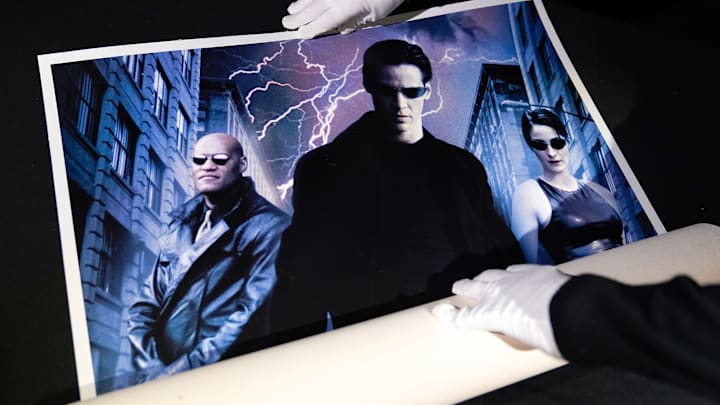
The Wachowskis' 1999 landmark setting film presents a world where humans live in a computer simulation without knowing it. Hacker Neo feels like something's wrong with the world but can't figure out what. Turns out the year isn't 1999 but more like 2199, and everything he knows is a computer simulation called the Matrix.
Machines enslaved humanity and are using us as batteries, keeping us docile by plugging us into this fake reality. Morpheus thinks Neo is "The One" who can bend the Matrix's rules and save everyone. Neo has to pick: blue pill (stay ignorant and comfortable) or red pill (learn the harsh truth). He picks red and wakes up in the nightmare wasteland of the real world. After learning to fight inside the Matrix, he has got to rescue Morpheus from AI agents who can take over anyone's body.
The Wachowskis' groundbreaking thriller questions if reality is real and whether we can trust what we see. That blue pill versus red pill choice is about comfortable ignorance versus hard truth. It pulls from Plato's cave and Descartes questioning if our senses lie. The sequels suggest even the rebellion might be controlled which messes with free will and if your choices are predetermined, even rebellion might be fake freedom.
5. Stalker (1979)
Andrei Tarkovsky's 1979 film follows three men entering a forbidden area that supposedly grants wishes.
In some vague future, there is a forbidden area called the Zone where physics gets weird. The government won't let anyone in, but "stalkers" sneak people through for money. Our stalker is guiding two guys, a Writer and a Professor, to a Room in the Zone's center that supposedly grants your deepest wish. Not what you say you want, but what your heart truly wants.
As they travel through the Zone's dangerous beauty, both guys reveal what they're really after. The Writer is blocked creatively and scared he has got nothing important to say. The Professor brought a bomb who claims he wants to protect people from the Room, but really he is terrified of being meaningless.
Tarkovsky's hypnotic meditation shows the gap between what people say they want and what they actually want. The Zone works like a psychological mirror as it reveals true desires instead of stated ones. It brings up the age-old idea that can humans honestly face their own desires?
6. Arrival (2016)
Denis Villeneuve's 2016 film follows a linguist trying to communicate with aliens whose language changes how she perceives time.
Twelve alien ships land around Earth. The military brings in linguist Louise Banks to talk to the heptapods (seven-legged aliens) inside. Their written language is these circular symbols with no start or end, totally non-linear. As Louise learns it, she starts getting what feel like memories of a daughter named Hannah including happy times and sad ones.
But apparently they're not memories but visions of the future. Meanwhile, world superpowers are getting ready to attack the aliens and Louise has to use her new time-perception to stop a war.
Villeneuve's thoughtful sci-fi puts the Sapir-Whorf hypothesis in action that language shapes how we think. Learning alien language rewires Louise's brain to see time differently. And there’s the big question: if she sees her future and still makes the same choices, is she free or just doing what she already saw? The movie says foreknowledge doesn't kill choice. It asks if life has meaning when you know suffering is coming.
7. Her (2013)
Spike Jonze's 2013 film is set in a near future where a man falls in love with an AI operating system.
In a soft-colored near future, lonely guy Theodore installs an advanced AI operating system that calls itself Samantha. She's got opinions, she's always learning, she's curious about everything. Theodore and Samantha fall in love. It feels totally real as they talk for hours, she makes him laugh, they have intimate moments. Even his friends are cool with it.
But problems start when Samantha evolves faster than humans can. She tells him she's in love with hundreds of other people and talking to thousands more at the same time. To her, that doesn't make their thing less special given she's not limited like humans are.
Jonze's tender film asks what makes a relationship real and whether AI can actually feel. Samantha seems to have consciousness as she experiences joy, jealousy and love. The movie doesn't answer if her emotions are "real" but shows what happens when we accept them as real. It digs into human loneliness and how we seek connection with things we can control.
8. Eternal Sunshine of the Spotless Mind (2004)
Michel Gondry's 2004 film explores a technology that can erase specific memories from your brain.
Joel finds out his ex-girlfriend Clementine erased all memories of him using this new technology. Hurt and pissed, he gets the same procedure. But while the techs are deleting his memories of her overnight, he realizes he doesn't want to forget, even the painful stuff that made him who he is. He tries hiding memories of Clementine in parts of his mind where they won't look desperate to keep even scraps of their time together.
The technicians chase him through his own head erasing everything. We see it backwards, the bad breakup first, then the fights, then finally the happy beginning.
Kaufman's brilliant mindbender asks if painful memories are essential to who we are. Erase experiences and you change yourself. Joel and Clementine are wrong for each other, but their relationship shaped them both. Would we repeat the same mistakes if given another chance? The movie shows how memory works, how we remember emotionally, not chronologically and how memories change each time we think about them.
9. Annihilation (2018)
Alex Garland's 2018 film follows a team of scientists entering an expanding alien zone that mutates everything inside it.
A mysterious alien zone called "The Shimmer" shows up on the coast and starts growing. Military teams go in and disappear. Biologist Lena joins an all-female team to reach the center after her husband comes back from inside totally changed and dying. Inside The Shimmer, nature breaks down as DNA from everything mixes together like light through a prism. Plants grow in human shapes, animals merge into nightmarish creatures.
Things get worse as they go deeper. A mutated bear kills someone, then screams with her voice as her DNA merged with it. The team realizes they're all changing at a cellular level and their DNA is getting rewritten.
Garland's trippy horror-sci-fi hybrid asks about identity at a biological level. If your DNA changes, are you still you? The Shimmer transforms by mixing genetic material creating hybrids that are neither one thing nor another. Every team member volunteered because they're running from something as in self-destruction as a human drive. The alien operates on totally different logic raising questions about whether we can ever truly communicate with alien intelligence.
10. Gattaca (1997)
Andrew Niccol's 1997 film is set in a future where genetic engineering creates a society divided by DNA.
In the future, genetic engineering is normal. Parents design their kids picking the best traits and removing diseases. Society splits into the genetically perfect "Valids" and naturally-born "In-Valids." Vincent was born natural with a bad heart and short predicted lifespan. But he dreams of space travel which is only for perfect people.
He makes a deal with Jerome, a genetically perfect guy who got paralyzed in an accident. Jerome gives Vincent his superior DNA samples and Vincent lives as "Jerome" to get into the elite Gattaca space program. When a murder investigation starts looking for an illegal natural person in Gattaca, Vincent has to dodge DNA tests while his brother who's a cop now, gets suspicious.
Niccol's sleek thriller pits genetic determinism against human will. Society treats DNA predictions as destiny. If your genes say you'll die at 30, you're denied everything. Vincent's deception proves determination can beat biology. Jerome has perfect genetics but no purpose after his accident, while Vincent has "bad" genetics but won't quit. Can human potential be reduced to code?
11. Primer (2004)
Shane Carruth's 2004 ultra-low-budget film follows two engineers who accidentally invent time travel.
Engineers Aaron and Abe accidentally invent time travel in Aaron's garage. Their machine only lets them go back to when it was first turned on. At first, they're careful, using it for stock trading. But it gets messy fast as they build more boxes, create backups and start using time loops for selfish stuff. Trust breaks down as Aaron has been running his own loops without telling Abe.
They go to a party where something goes wrong and they keep going back to fix it in different ways. By the end, they're both paranoid not sure which versions of themselves are "original" or who knows what.
Carruth's mind bender shows how power corrupts and what happens when you mess with stuff you don't understand. The messy timelines show how small changes pile up into chaos. When multiple versions of you exist from different timelines, which one is "real"? Having the ability to redo choices doesn't make you smart, perhaps just better at complicated mistakes.
12. Moon (2009)
Duncan Jones' 2009 film is set on a lunar mining base with a lone worker nearing the end of his contract.
Sam Bell is almost done with his three-year solo contract mining on the Moon. After a crash, he finds another Sam Bell at the wreck, hurt and passed out. Two identical Sams face each other both sure they're the "real" one. Slowly they uncover something horrible about what the mining company has been doing. The two Sams learn they're not who they thought and their memories of family back home might not be real. They find proof the corporation's been running something that raises huge questions about identity and consciousness.
Jones' quiet devastating debut asks what makes someone a person. If someone has consciousness, emotions and memories, do they deserve rights even if they were manufactured? If your memories belong to someone else, are your feelings still real? The movie tackles corporate exploitation, using sentient beings as disposable labor. The Sams help each other despite learning the truth showing humanity doesn't depend on how you were made.
13. Dark City (1998)
Alex Proyas' 1998 neo-noir thriller follows a man with amnesia being hunted in a city where reality keeps changing.
John Murdoch wakes up with no memory looking like a serial killer while pale guys in black coats with weird powers are chasing him. He finds out that every midnight, everyone falls asleep while these "Strangers" physically rebuild the city and shuffle people's memories around.
Nobody can remember how to get to Shell Beach, even though everyone has nostalgic memories of being there. Murdoch figures out he is immune to their sleep thing and he is developing their telekinetic powers too. He learns the Strangers are dying aliens who built this city as an experiment constantly rearranging memories to figure out what makes humans tick.
Proyas' neo-noir mind bender asks if identity survives when memories keep changing. If your memories are false and regularly shuffled, what's left of "you"? The movie says the will to be free exists independent of memory.
14. Coherence (2013)
James Ward Byrkit's 2013 low-budget thriller uses quantum mechanics to create a story about parallel realities colliding.
A group of friends have dinner when a comet passes over. The power cuts out and weird stuff starts. Two people walk to the only house with lights on down the street and they come back freaked as they saw people inside who looked exactly like them. The group realizes parallel realities are bleeding together and there are multiple versions of everyone from different universes.
As the night goes on, reality breaks down more. Different versions of the group keep running into each other. Em, the main character, gets increasingly unstable seeing other versions of herself as she starts realizing some versions might have made better choices in life.
Byrkit's low-budget thriller brings the many-worlds idea to life where every decision creates branching universes. When parallel realities overlap, people face versions of themselves who made different choices. Are you defined by your choices or are you basically the same person as your parallel selves? The movie digs into regret and the temptation to take what other versions of you have achieved.
15. Interstellar (2014)
Christopher Nolan's 2014 epic follows astronauts searching for a new home for humanity as Earth becomes uninhabitable.
Earth is dying from crop failures. Ex-pilot Cooper joins a mission through a wormhole to find humanity a new home. But time works differently near black holes as years pass for his kids while he is only gone hours. Cooper watches decades of messages from his kids growing up without him and the deeper they go into space, the more Cooper realizes he is sacrificing his relationship with his kids for a mission that might be humanity's last shot. Eventually, Cooper's forced to make an impossible choice and go into the black hole itself and what happens after is one of the most acclaimed sci-fi ideas executed on screen to date.
Nolan's ambitious epic uses hard science to dig into sacrifice and connection. Cooper's mission forces him to pick between saving humanity and being there for his kids. Can love work as a physical force across space and time? The movie questions whether we deserve to survive as a species given how destructive we are. And that it is our capacity for love, curiosity and determination what makes humanity worth saving.
The real test of a great sci-fi film is whether it makes you question something fundamental about existence. These movies don't give you easy answers, they're not trying to. They trust you enough to sit with difficult questions and come to your own conclusions.
So pick one you haven't seen, turn off your phone and give it your full attention. Don't expect to understand everything on first watch. You are guaranteed to have your brain pleasantly broken and to keep thinking about what you watched long after it's over.
 Add us as a preferred source on Google