

In the modern entertainment landscape, it is not surprising to see a several decades old franchise being dusted off, repackaged, and resold to audience en masse. What is surprising though, is to see a legacy follow-up as bold as Danny Boyle’s 28 Years Later. Reuniting everyone from screenwriter Alex Garland to cinematographer Anthony Dod Mantle to Boyle himself from the seminal 2002 horror hit 28 Days Later, the 2025 follow-up was released to critical acclaim and commercial success. Rather than seeking to retread familiar territory, as so many decades-later follow-ups do, 28 Years Later opted to chart a course entirely its own, and the results were astounding. When that film ended on a cliffhanger, it begged the question: could the sequel deliver results that felt similarly fresh and new?
Now, mere months later, the resulting sequel is Nia DaCosta’s 28 Years Later: The Bone Temple. Filmed in conjunction with Boyle’s prior installment, The Bone Temple picks up directly where that film left off, both in terms of narrative and theme, and plows right on forward without missing a beat. All of this is pretty well expected stuff that has been reiterated over and over again in the press for this overarching 28 Years Later sequel trilogy for years now, but what isn’t so standard is the film itself. Rather than retread old ground or stick more closely to the tone and pace set by the first chapter of this trilogy, Nia DaCosta’s film is entirely her own and is all the better for it. 28 Years Later: The Bone Temple is an eccentric, existential, and esoteric film that takes the baton from the prior movie and doesn’t just run with it, but soars.
One of the most striking things about The Bone Temple is just how intimate the whole thing feels. With a script written by franchise scribe and award-winning filmmaker Alex Garland, The Bone Temple doesn’t feel the need to be grander in scope, size, or scale than any of the other films in the franchise. Instead of worrying about such superfluous things, Garland homes in on some of the most interesting story threads, characters, and themes established in the prior film and cuts deep into the material therein.
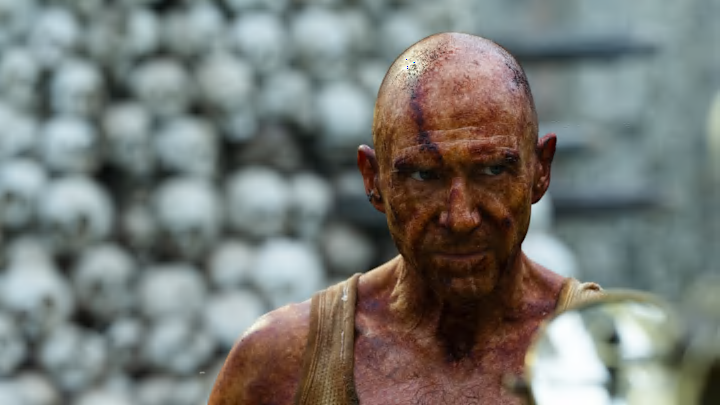
This results is a film that keeps the young Spike (as played so incredibly by Alfie Williams) as the de facto main character, but spends the vast majority of its runtime and lion’s share of its story with characters such as Jimmy Crystal (an incendiary Jack O’Connell) and Dr. Ian Kelson (a truly transgressive Ralph Fiennes). These characters were introduced in the prior film, but predominantly kept to periphery. Here, they each get to occupy center-stage in fittingly off-kilter fashion, and the film very much meets them on their own frequency.
In addition to this, as the story evolves in unexpected ways and pushes beyond the perceived confines of this franchise, the infected character of Samson (a revelatory Chi Lewis-Parry) gets elevated to a primary position within the story. Not only are all of these performers incredibly game, delivering work that is full of electric energy and big gonzo swings, but DaCosta’s direction is there to meet them every step of the way. For what is objectively the fourth installment in a long-running horror franchise, many of the greatest and most unforgettable moments in 28 Years Later: The Bone Temple are simply two characters onscreen together having a conversation. It’s just that between Garland’s writing, DaCosta’s direction, cinematographer Sean Bobbitt’s gorgeously tactile work, editor Jake Roberts’ deft balance of tones, and this smorgasbord of great performers, these quiet moments take on a life all their own.
On top of all of that, DaCosta and co. also absolutely deliver when it comes to film’s setpieces. The horror-indebted action is brutal, uncompromising, and incredibly taut. There’s a sequence in the middle of the film, in which O’Connell and his merry band of Jimmies all convene on a safe-house full of other human survivors, and it is white-knuckled in every sense. So many films released today are packed to the brim with action beats that leave little to no impact, but every single movement within 28 Years Later: The Bone Temple’s sequences feels endlessly motivated by character and theme, and is thus all the more impactful and unforgettable. In tandem with these genre elements that the film delivers in spades, it’s also incredibly funny. That might sound like a strange thing to say about a film titled The Bone Temple, but it is; the film is full of organic and affecting humor that works wonders for the tone as a whole.
The film I keep coming back to when thinking of the ways in which 28 Years: The Bone Temple is able to fluctuate the perceived boundaries of its form and operate on this subversive level within both its genre and franchise, is none other than James Whale’s Bride of Frankenstein. That iconic horror sequel also picked up in the immediate aftermath of its predecessor, kept the same on-paper protagonist, but further developed and explored the more eccentric corners of the previous film in a way that felt meditative and phenomenally satisfying. I will also simply add that I saw a lot of Kaloff’s performance as the monster in that film in Chi Lewis-Parry’s incredible performance in this The Bone Temple.
Verdict
28 Years Later: The Bone Temple is a staggering cinematic accomplishment, one that manages to not only live up to the high bar set by Boyle’s prior installment but earn the title of a great film completely on its own merits. Nia DaCosta’s film is simultaneously all the better for being a part of this overarching franchise, and makes the franchise all the better by being within it. It is a glorious oddity of a film that simply works on every level; it had the screening I was in hooting and hollering several times over, and it’s easy to see why. It provides a compelling, incredibly satisfying genre narrative while giving viewers a feast full of ideas to marinate upon. As a huge fan of both Nia DaCosta and Alex Garland as filmmakers, it felt as though 28 Years Later: The Bone Temple got the best elements of each of them, resulting in a knockout success.
Movie grade: A
 Add us as a preferred source on Google