

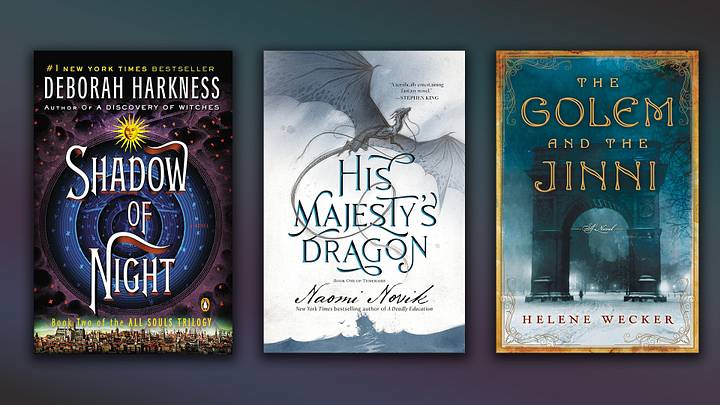
When reading fantasy or science fiction, we find ourselves in one of two moods. We're either looking for a complete escape from reality into a new world, or we want to see the mystical and fantastic existing in our world. The first might seem harder to write since the author has to create a new universe from scratch, but merging fantasy with reality is a challenge all its own.
A magic system in a fictional world already has the readers' suspension of disbelief. Things work the way they do because that's how the author established them within their world. However, building a magic system into our world is met with scrutiny. Books are only able to pull off historical science fiction or fantasy because the authors seamlessly weave their stories into the fabric of our real-world history, allowing us to believe the extraordinary exists within the mundanity of life.

Time and Again by Jack Finney
Jack Finney, author of many classics such as Invasion of the Body Snatchers, is known for his compelling science fiction. But Time and Again was unique for the incredible detail and accuracy Finney used to describe New York in the 1880s. New Yorkers especially loved getting to experience what their city was like in the time of gas lamps and horse-drawn carriages, through the eyes of Si Morely.
When the government presents Si Morely with an experimental mission to travel back in time to help solve a mystery, he jumps at the chance. Arriving in 1882 is a shock in itself, but Si finds himself fitting into this past better than his present. He falls in love with a 19th-century woman and then must decide where and when he truly belongs.

A Midsummer Tempest by Poul Anderson
In Poul Anderson's A Midsummer Tempest, he asks the question: What if Shakespeare was a historian and his writing was non-fiction? This alternate history novel takes Shakespearean characters and events, specifically the fairies and elves, and drops them in the middle of the English Civil War. Anderson tells a tale of historical figures coming face-to-face with the magical elements of Shakespeare's A Midsummer Night's Dream and The Tempest.
The protagonist, Prince Rupert of the Rhine, was a real person and the nephew of King Charles I. During the Battle of Marston Moor, A Midsummer Tempest veers into fiction when Rupert is captured by the Parliamentarians instead of evading them as he did in 1644. He is able to escape and meets the fairy king and queen, Oberon and Titania, and they join forces to stop the Puritanical Parliamentarians from winning the war.

His Majesty's Dragon by Naomi Novik
The first book in the Temeraire series, His Majesty's Dragon, wonders what the Napoleonic Wars would have looked like with aerial troops riding dragons. Just imagine how epic Jacques-Louis David's painting, Napoleon Crossing the Alps, would have been with Bonaparte on a fire-breathing dragon!
His Majesty's Dragon follows Will Laurence, naval captain of the HMS Reliant, who finds a dragon egg. The dragon that hatches from the egg becomes bonded to Laurence, and he must now learn aerial combat to stop France's dragons from reaching British soil. Laurence and his dragon, Temeraire, have a steep learning curve and very little time to defeat the Emperor of France.

Johnathan Strange & Mr. Norrell by Susanna Clarke
Another novel set during the Napoleonic Wars is Johnathan Strange & Mr. Norrell. Instead of focusing on the war, however, it deals with two Englishmen with magic powers. Susanna Clarke uses the rivalry between Strange and Norrell to symbolize not just the war between England and France, but the divided ideas between traditional and revolutionary thinking happening in England at the time.
Magic used to exist in abundance, but is rare by 1806. One man, Mr. Norrell, was believed to be the last magician left, and he basked in the fame and prestige that came with that title. But when a new magician, Johnathan Strange, appears with a vastly different approach to the dark arts, Mr. Norrell feels threatened. Thus begins a rivalry that could destroy more than just the two men, but England itself.

Shadow of Night by Deborah Harkness
Deborah Harkness, or Deb to her friends and fans, studied and taught occult sciences and the history of science and medicine, specifically in Elizabethan London. The professor-turned-author wrote the All Souls series about a vampire and a witch whose love is forbidden. In the second book, Shadow of Night, Matthew and Diana go into hiding by traveling to the past.
One of the coolest parts of Shadow of Night is seeing just how intricately the story fits within Elizabethan history. As a vampire, Matthew has had to change his last name several times throughout the years, and while living in London in the 1590s, he used Matthew Roydon. Harkness used the fact that very little is known about the real Matthew Roydon, a poet and friend to Sir Walter Raleigh and Christopher Marlowe, to create a very believable tale of Matthew and Diana researching alchemy to find the origins of their species.

The Golem and the Jinni by Helene Wecker
The Golem and the Jinni is a story of two immigrants coming to America. The fact that both are magical beings from different cultural mythos only makes their immigration story that much richer. Arriving in New York in 1899, Chava and Ahmad band together as friends when the world around them is hostile to strangers.
Chava is a golem, a being from Jewish folklore that is made of clay but looks human. Ahmad is a jinni, an Arabic fire spirit that can appear as human. Neither one chose to come to America, but their circumstances led them there. Their new friendship is tested when Chava wants to blend in with the humans, but Ahmad resents his human form. It's a story that, even with the magical elements, is relatable to immigrant families.
 Add us as a preferred source on Google