

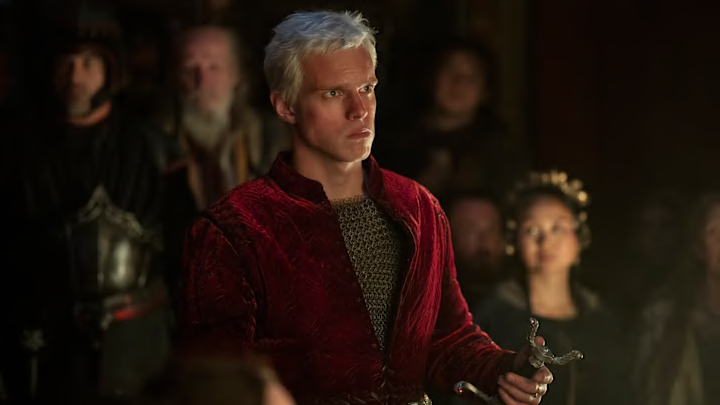
The main conflict of House of the Dragon leads directly to the Targaryens' downfall, but the Game of Thrones prequel gives us an idea of what things were like when the Great House of Westeros was still fearsome and strong. By contrast, A Knight of the Seven Kingdoms highlights just how far it has fallen — and Episode 3, "The Squire," really drives this home.
FULL SPOILERS ahead for A Knight of the Seven Kingdoms season 1 Episode 3.
We already know from Game of Thrones that the future of House Targaryen is grim. The dragons disappear shortly after the Dance of the Dragons, and the Targaryens lose the Iron Throne — and many remaining members of their House — during Robert's Rebellion. A Knight of the Seven Kingdoms takes place in the middle of these events, and it captures the steady decline from one to the other perfectly, particularly in its latest installment.

Prince Aerion's joust in A Knight of the Seven Kingdoms Episode 3 shows how far the Targaryens have fallen
Prince Aerion Targaryen is one of the most detestable characters introduced in A Knight of the Seven Kingdoms, and even the people around him seem to think so. To be fair, he gives them good reason to look upon him with anger and disgust. But most wouldn't be bold enough to do so just a few decades earlier, when House Targaryen was more feared and respected. (And, you know...had fire-breathing dragons to wield against their enemies.)
A Knight of the Seven Kingdoms underscores just how much the perception of House Targaryen has changed over time. The reaction to Episode 3's joust is the perfect example. When Prince Aerion kills Ser Humfrey Hardyng's horse and cripples his opponent to win, the onlookers are understandably upset. They go so far as to throw stones at the prince, something they'd never dare to do during House of the Dragon's timeline.
The riotous response to the prince's actions show that the Targaryen royals aren't loved by the people — and that they have to answer for that to some extent. At the height of Targaryen power, commoners and lesser lords may have been unhappy with the Great House, but they wouldn't risk retaliation over an injustice like this one. The tides seem to be turning, with the rest of Westeros viewing the Targaryens as humans who can be toppled rather than people who "are closer to gods than men."
You can see this in the way that Raymun Fossoway talks about the Targaryens to Dunk as well. He calls them "incestuous aliens," which is something he's probably not bold enough to say to their faces. But even whispering it where people could overhear would be unthinkable a few generations earlier. Scenes like this highlight how the Targaryens eventually lost their power. And A Knight of the Seven Kingdoms Episode 3's ending proves they're not oblivious to the shift.

Aerion's reaction to the puppet show highlights the cracks in House Targaryen's reputation
A Knight of the Seven Kingdoms Episode 3's joust reveals that the people of Westeros aren't as afraid of House Targaryen as they once were. And Prince Aerion's reaction to Tanselle's puppet show reveals his frustration with that.
The puppet show itself is another example of House Targaryen being less respected; the production shows the royal House losing and sees a fake dragon being slain. But it's not as though it's intended as a rebellious act. Aerion is the one who treats it as such, clearly wanting to regain some of the power he feels slipping.
Finn Bennett, who plays Aerion in A Knight of the Seven Kingdoms, even told The Hollywood Reporter that his character is all too aware of the tenuous position House Targaryen is in:
"I think the weight of history weighs very heavy on Aerion and there’s this sense that there’s a rebellion on the horizon — that the Targaryens don’t have the firm grasp on power they used to have — and that’s a nervous place for House Targaryen to be."
This may be worrisome for Aerion and his ilk, but it makes for an interesting thread for A Knight of the Seven Kingdoms to pull on. Both Game of Thrones and House of the Dragon quickly jump into outright war. This spinoff captures the unrest simmering beneath the surface before such conflicts arise. It makes for an intriguing story, the kind that's often overlooked in favor of larger, more epic confrontations.
Of course, Ser Duncan the Tall may not benefit from this glimpse into the state of House Targaryen. After striking Prince Aerion at the end of "The Squire," he's poised to be on the receiving end of the villain's quest to regain power. That doesn't bode well for him, even with Egg in his corner.
 Add us as a preferred source on Google