

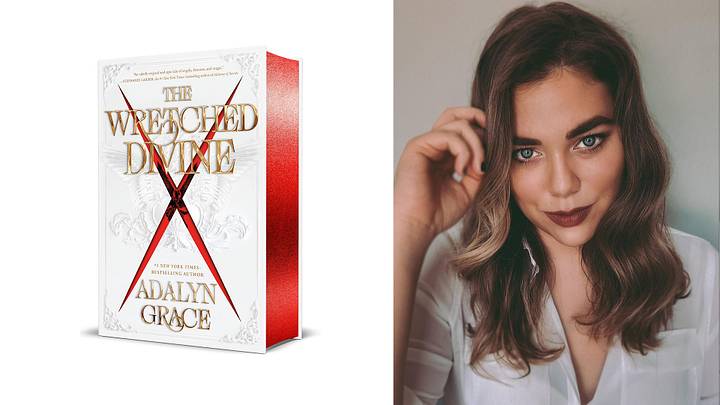
Adalyn Grace is one of the most adored authors in romantasy, and with good reason. The #1 New York Times, USA Today, Wall Street Journal, and Sunday Times bestselling author made her name with the All the Stars and Teeth duology and the beloved Belladonna trilogy, winning over legions of fans with her lush, romantic and darkly inventive YA worlds. Now, with The Wretched Divine, she is making her long-awaited move into adult fantasy, and the anticipation has been enormous.
The Wretched Divine is out from FEIWEL in the US and Gollancz in the UK on September 22, and Grace was kind enough to sit down with us over email ahead of release to answer some of our questions about her work.
The book follows Aurelie Chantelune, a knight raised in a kingdom ravaged by demons, driven by the memory of the monsters who tore her family apart. When she claims her first kill, she inherits a soulbond with Yuriel, an angel whose power is vital to her kingdom's survival. But when those she loves begin turning into the very creatures she has sworn to destroy, she is forced to forge a second and far more dangerous bond with Severin, a demon she can hardly trust, who claims to know how to end the war for good.
What makes the book such a fantastic adult debut is how deliberately Grace has expanded her canvas. Where her YA work was fast-paced and propulsive, The Wretched Divine is high fantasy at its core — bigger in scale, slower to build, richer in lore, and significantly more mature in both content and voice.
The sin-based demon bloodline system with its lustborn, greedborn, and wrathborn bloodlines and the ever-present threat of humans turning into the monsters they fear, gives the world a theological quality that connects directly to Aurelie's crisis of faith at the heart of the story. And then there is Severin, who had already become an absolute fan favourite before the book even officially hit shelves. We asked Adalyn about the jump to adult fiction, how she finally cracked Aurelie as a character, and what readers can expect from book two.

ASH ANJUM for Winter Is Coming: Congratulations on your adult debut! We are VERY excited for this one. The Wretched Divine feels so different from Belladonna in terms of scale and stakes. What made this the story you wanted to tell when you decided to write for an adult audience?
Adalyn Grace: Thank you so much! I think Belladonna was already starting to ride that line between YA and adult, especially as the series matured further with each book, so making the jump into adult with The Wretched Divine felt very natural to me. And since the world I wanted to build for Wretched was much larger in scale, the shift also felt necessary.
YA is known to be very fast paced, which is something I love about it, but Wretched is high fantasy at its core. I wanted to give the story permission to breathe and let the tension build slowly to give readers time to really sink into the world before everything starts unraveling.
Also, this story is a lot more mature in both content and writing style. So much of the language, jokes, and character actions would have been flagged in YA, so writing it for the adult audience gave me the freedom to tell the story exactly as I envisioned it.
WIC: We already love Aurelie. Where did she start for you as a character? Did you know from the beginning how much her worldview would be tested?
AG: I’m someone who almost always figures out the world and magic system before I figure out the characters. I tend to have only a loose idea of who they are when I begin drafting, and it’s not until I’ve spent a while writing them that I really start to understand what makes them tick
Aurelie was especially tricky. Severin and Yuriel came to me much faster, while I went through a bunch of different versions of Aurelie’s role and upbringing before I landed on who she is now. In one of the earliest versions, she owned a tavern. Then she was a barmaid at a tavern where demons frequented. They were fun ideas, but none of them felt quite special enough for her.
A big part of finally figuring her out was deciding how much I wanted to lean into her relationship with religion. It can be a tricky subject to explore in fantasy, and for a while I wasn’t sure how directly I wanted to engage with it. But eventually I realized I couldn’t really tell Aurelie’s story without it. Her beliefs are such a fundamental part of how she understands herself and the world around her, and so much of the book is about inherited beliefs and what happens when the line between good and evil starts to blur.
I knew fairly early that her worldview was going to be challenged, but I didn’t know exactly how deeply until I understood her better. What ended up becoming most interesting to me was watching her reach a point where she can no longer rely on the beliefs she’s always had. She has to start asking questions for herself, and I think that struggle became one of the most important parts of who she is.
WIC: The dual soulbond is such a cool and clever structural choice with all that narrative tension. What came first for you, Yuriel, Severin, or the bond mechanic itself?
AG: The bond mechanic came first. I knew from the beginning that I wanted to write about angels and demons, and the bonding system was one of those rare parts of a book that seemed to arrive almost fully formed.
I also had a sense of the roles I needed Yuriel and Severin to play, but they both became much more fully formed once I started actually writing them. Then, as they developed, the bond did too. Once I understood the main trio better, it became obvious how much tension I could create through this bonding mechanic. It just makes the whole story and every situation and relationship so messy and fun!

WIC: Severin sounds like he might be an absolute joy to write. Readers are already quoting his nicknames for Aurelie and we cannot wait to meet him properly. Was he always meant to bring some levity into such a dark, war-torn world or did his humor sneak up on you as you wrote him?
AG: Yes! Severin has always had that humor to him, which was so fun to write. He’s very aware of how short life can be, and how quickly the people he loves can be taken from him. He could have easily become someone very brooding and sulky because of that, but instead he went in the complete opposite direction. His whole philosophy is basically that if you’re alive, you should be celebrating and having a good time.
That’s a big part of why I always saw him as a bard, too. He loves music, wine, people, crude humor, and generally making himself everyone else’s problem. I’m so glad the nicknames and his more ridiculous lines have been landing with readers, because I absolutely thought I was the funniest person alive while writing some of them. It’s always both very satisfying and a huge relief when other people actually laugh.
The songs were the only part that really surprised me. I always knew he was a bard, but for some reason I didn’t initially think I would actually write out the music he performs. Once I started drafting, though, it felt strange not to. Now his songs, along with the jokes and ridiculous nicknames, are some of my favorite parts of the book.
WIC: The sin-bloodline system for the demons with lustborn, greedborn, wrathborn, and so on is such a rich piece of worldbuilding, especially with the idea that everyone carries some demon blood and risks turning if they give in too far. How did that mechanic come together, and did it change the plot in ways you didn’t expect?
AG: This really came together while I was trying to figure out how to make the demons feel more distinct from one another. I knew they all had different magic, but I wanted there to be something more immediate that tied each bloodline together and made them easier to recognize. I actually tried building the system without using the seven deadly sins at first, but it started getting confusing very quickly. There were too many different types of demons, too many abilities, and not enough of a clear framework holding them together.
Once I brought in the sins, everything started clicking into place. It gave me a familiar structure to work from, but still left me a lot of room to make each bloodline feel like its own thing.
From there, I started fleshing out what it actually meant for humans to carry demon blood and how people turned into demons. That ended up shaping the story in huge ways. There’s this constant threat that any human could become the exact thing they’ve been raised to fear if they fail to keep themselves in line.
I really loved how naturally that connected back to the religious themes in the book, too, and the question of what makes someone good or evil.
WIC: Multiple POVs and chronological storytelling with past interludes is an ambitious structure for a series opener. What made you choose to tell the story this way rather than sticking closer to Aurelie alone?
AG: This really came from wanting the world to feel bigger than any one person’s understanding of it. There’s this ancient, brutal war happening between angels, demons, and mortals, and Aurelie is only ever going to see one small piece of that. She has her own beliefs, and her own very limited understanding of the world around her, which is important to her character, but it also means there are so many things she just can’t show us.
Even though Aurelie has the most chapters, I never really thought of The Wretched Divine as only her story. It belongs to all of the main characters equally. Each of them offers a different perspective, and I felt that all were needed in order for the story to feel whole.

WIC: You’ve built entire worlds before with Belladonna and All the Stars and Teeth, but an “ancient war” implies centuries of history behind this one. How much of that backstory did you have to develop before you could even start writing Aurelie's present-day story?
AG: Quite a good chunk of it! There are still plenty of things I know that haven’t made it into the books yet, and there will likely be a lot that never does. That’s just part of building a world like this. You end up knowing far more than the reader ever needs to.
Before I started writing, I needed to understand things like how the demons make a space for themselves in the mortal realm and how Sanctuary, the angel realm, functions. Aurelie’s people are also only one small part of a much larger mortal world, so I wanted to have some sense of the kingdoms beyond Rhovar, what those cultures might look like. Do they interact with each other? Do they share similar beliefs? Even if readers never see all of it, I think having at least some of that history in my head helps the world feel like it exists beyond whatever is happening on the page.
WIC: Did you plan that ending from the start, or did it reveal itself as you wrote Aurelie’s relationships with Yuriel and Severin?
AG: I have always, always been working toward the ending. That was one of the few things I had from the very beginning, and the interludes were actually the first part of the book I wrote. In the earliest version, they were all condensed into one prologue, but it just wasn’t landing the way I wanted it to. Once I realized I could break that material apart and let it unfold throughout the book, everything started clicking into place.
The interludes and the ending are probably the parts of the story I’m most proud of. One of my biggest pet peeves with stories in all forms is when they build and build and build, only for the landing to completely fall apart. I was very determined not to do that here. I spent a lot of time making sure the final stretch hit exactly the way I wanted it to, so seeing people respond so strongly to it has been incredibly satisfying.
WIC: Last question (we promise!) — this is book one of a new series, and we are already desperate for more. Without giving too much away, what can readers expect to be chasing in book two?
AG: I’m still very much in the middle of working on it, so I have to be a little careful here because plenty can still change! But I can say that book two is going to open the world up even more. We’ll be meeting new characters, visiting new places, and getting a few new POVs along the way.
There’s also a lot more magic, a lot more demon shenanigans, and plenty of fallout from everything that happens in book one. I’m really excited about where the story is headed, especially now that so many pieces are finally in motion.
A huge thank you to Adalyn Grace for taking the time to talk The Wretched Divine!
The Wretched Divine is available now in multiple formats, including a gorgeous deluxe hardcover edition with metallic stenciled edges in the U.S. Find out more about the book at Adalyn Grace's website.
 Add us as a preferred source on Google