

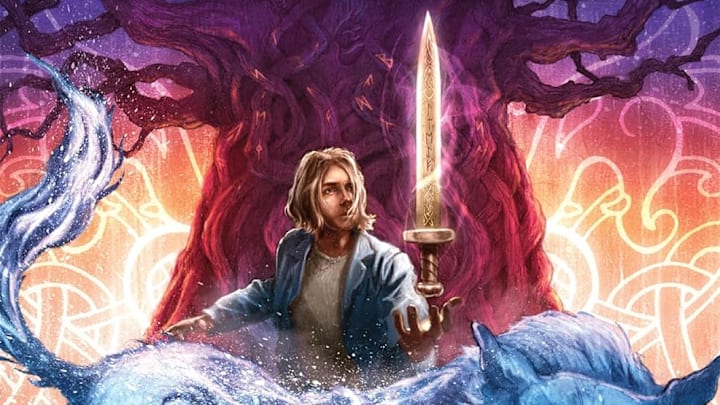
Author Rick Riordan has made ancient god mythology fun for a whole generation of readers. He's brought the pantheon of Greek and Roman gods to life in his various Percy Jackson series and made dusty, old Egyptian deities pop off the pages with his Kane Chronicles.
Maybe his most light-hearted series is Magnus Chase and the Gods of Asgard. Like all of his books, Riordan instills a high degree of whimsy into his tales about the Norse gods. Not surprisingly, Riordan's world doesn't look anything like the swashbuckling Marvel movie representations of Thor, Odin, and Loki.
Like all the gods in his other works, the Norse deities are merely exaggerated reflections of humankind, with all the same flaws and foibles. And like Riordan's other heroes, Magnus Chase is a demigod, and in a nice twist, Annabelle Chase's cousin. There is another aspect, however, that Magnus does share with his cousin—he's dead!
Magnus is an orphan and homeless, living on the streets of Boston. Very early in the first book, The Sword of Summer, a confused, scared, and unwitting Magnus dies in a battle against a fire giant and is saved as a hero by a Valkyrie, Sam al-Abbas. Sam delivers the fallen hero to Hotel Valhalla, and there the story really begins.
Magnus is an Einherjar, a warrior who dies bravely and is delivered by a Valkyrie to be a warrior in Odin's eternal army to fight their eventual Armageddon, which the Norse call Ragnarok. From this premise rise three books, each detailing a quest in which Magnus and his friends must prove themselves and help postpone Ragnarok.
Each book in the trilogy details a different quest, told with the same whimsical chapter titles that Riordan is known for from his other series. The tone tends to be light-hearted, but Riordan deals with some in-depth issues that exist in our present world.
Sam al-Abbas is Muslim and must juggle her faith with her knowledge of the Norse pantheon. She is also a demigod. In books two and three, Alex Fierro joins the group as a gender-fluid demigod. Riordan also deals with such topics as abusive or absentee parents, deafness, and other things people in our world deal with every day.
All three books are entertaining, and it is a joy to discover the depths of Riordan's creative imagination. Let's look back on the trilogy, and rank the books from worst to best.

3. The Ship of the Dead (Book #3)
The Ship of the Dead isn't a bad book, but it is the ending that earns it this spot. And it isn't even because of the end of this particular story, but rather how the end of the series as a whole was handled. The series just came to an abrupt halt as this book wrapped up. In hindsight, loose storylines were tied up, but it just felt that there was more story to tell with these characters.
Riordan tends to revisit his characters with series extenders, but it's been nearly a decade since this book was published, and he hasn't returned to this particular world, apart from a book of short stories from eight years ago.
The story itself carries on with the overall theme of the series. Sam's father and Alex's mother (both are the scheming god, Loki) are free of their prison and hastening the end of days. Magnus and his friends must travel across dimensions of Asgard to stop Loki from sailing his ship of the dead (made from toenails and fingernails—ew!) and launching Ragnarok.
This book delves the deepest into Sam dealing with his Muslim faith while working on a quest in Asgard. It is an interesting line she must navigate. Magnus also realizes he has feelings for Alex and what it entails to love a genderfluid person. Lastly, Hearthstone, Magnus' deaf elf friend and protector, has to return home and come to grips with his crazed, abusive father.
The heroes, who include Magnus, Sam, Alex, Hearthstone, Blitz (a fashion-loving dwarf who is another of Magnus' friends and protectors), plus fellow Einherjar TJ, Mallory, and Halfborn, all have tasks to perform to ensure the quest succeeds. All have personal problems of their own they must deal with as they save the world.
In the end, Magnus and his friends save the world (of course), then the book and series end in a tidy fashion (too tidy).

2. The Sword of Summer (Book #1)
Like the first books of most fantasy series, it takes a while to get acclimated to the world being created. Riordan doesn't mess around much with this one. Readers are introduced to Magnus and his homeless situation, caused by an absentee father and a mother who was killed two years earlier.
Quickly, though, Magnus is thrust into a situation he was totally unprepared for when a fire giant attacks him on a bridge. During the fight, Magnus is killed (right!?) but tries to sacrifice himself to save his homeless friends Heath and Blitz, as well as innocent bystanders. Sam, the Valkyrie, sees this as heroic and delivers him to Hotel Valhalla, where dead hero demigods spend eternity.
Riordan established the Nordic Valhalla as a place where all these heroes prepare for one thing—the eventual coming of Ragnarok, a great battle between good and evil, in which prophecy says good wins to protect mankind but all perish in the effort. Heroes in Valhalla have massive battles every day and die over and over again. They regenerate as long as they die in Valhalla. If they die outside of Valhalla, they perish for good.
The first quest for Magnus, Sam, Hearthstone, and Blitz is to prevent the fire giant who killed Magnus, a pleasant fellow named Surt, from freeing Fenris Wolf. Fenris would then set the world aflame and into chaos, hastening Ragnarok and the end of the world.
Behind the scenes, from his prison, Loki is pulling the strings. Loki is imprisoned, bound to a stone, with snake venom dripping on his face for millennia, but he can touch the world through dreams and visions. Fenris Wolf also happens to be a child of Loki, as is Sam. If Fenris is free, he can then free his father.
This plot is the weakest of the three, but it helps introduce the different aspects of Asgard and lets readers get familiar with the characters. It also establishes Loki as the trickster and the villain and sets up the other two books.

1. The Hammer of Thor (Book #2)
This book is probably the most fun of the three, as the warrior god Thor (do not think Chris Hemsworth!) has lost his hammer, Mjolnir, and Magnus and his friends are tasked to find it.
A giant named Thrym has the hammer hidden deep in the earth, and Loki arranges a marriage of his daughter Sam to Thrym in exchange for the hammer.
First, however, Loki needs the Skofnung Sword. Only this sword can sever the bonds that hold him. He tricks Sam and Magnus into retrieving it from a wight. After many adventures, the day of the wedding arrives. Alex trades places with Sam, trying to deceive Thrym while still grabbing Thor's weapon. The plan is to escape with hammer, the Skofnung Sword, and Sam still single. Once at the secret wedding location, Thrym announces that the actual wedding will take place in Loki's prison.
The giants take the wedding party through the earth to Loki's prison, and a fight breaks out. In the course of events, Loki is freed, though Magnus is able to retrieve Thor's hammer. The quest is successful in that Thor's hammer was returned to him, but Loki is free again to create chaos and to hasten Ragnarok.
This book has some of the more entertaining moments in the seires, like meeting the god Heimdall, who loves taking selfies of himself, and our heroes having to prove themselves as worthy by competing in games in the giants' bowling alley. It is a light-hearted moment in a book with some dark scenes.
Readers get a peek into Hearth's tortured childhood. Hearth must bear his father's blame for the death of Hearth's brother. Hearth earns more disdain from his father because of his deafness.
The Hammer of Thor certainly fleshes out the characters much more than the first one, and Riordan adds more weight to the lives of the heroes.
Magnus Chase and the Gods of Asgard is a good series, and there seem to be plenty of other stories that could be told if Riordan ever decides to revisit Magnus, Alex, Sam, and the Asgard world.
 Add us as a preferred source on Google