

Sci-fi books rarely come more game-changing and iconic than William Gibson's Neuromancer. Published in 1982, it's often cited as ground zero for cyberpunk. The sci-fi subgenre, which champions high-tech body mods in a setting where quality of life is actually quite low, has gone on to serve as the blueprint for other great stories like The Matrix and Altered Carbon.
Finally, 42 years later, Neuromancer is getting its moment to shine in live-action for the first time. Exciting as that thought might be, the upcoming Apple TV adaptation has a unique challenge ahead. Because the source material has been so influential to sci-fi and cyberpunk at large, countless spiritual successors have already adopted and bettered some of Gibson's best worldbuilding patterns. As such, Apple TV has a very specific overhaul to make.
Neuromancer needs to find a new and modern way to showcase its version of cyberspace
William Gibson created the word "cyberspace" specifically for his Neuromancer books. It's a term that has spread throughout sci-fi and is even used in various other corners of popular culture. Personally, I think that's a Shakespeare-esque achievement.
All that being said, although the author described Case's exploits in cyberspace in a way that felt exciting and groundbreaking, it reads as fairly dated by modern standards. Take a look below at an excerpt from the book during one of Case's key moments in cyberspace:
"Case's virus had bored a window through the library's command ice. He punched himself through and found an infinite blue space ranged with color-coded spheres strung on a tight grid of pale blue neon."Neuromancer, William Gibson (1982)
There are a bunch of other examples of similar passages where Gibson leans heavily on vague colors and shapes to communicate how different cyberspace is from reality. It's not entirely ineffective imagery in 2026, but movies and TV shows made since have built on this visualization in a way that doesn't make everything seem so abstract. Cyberspace is now more commonly represented as reality with an off-beat filter on the camera.
This raises a problem I referenced earlier: Apple TV has been beaten to the punch by other sci-fi projects that have clearly taken inspiration from Gibson's work. The Neuromancer TV show will need to find a way to both honor the source material. At the same time, a new way to visually portray cyberspace that doesn't rely too much on its spiritual predecessors must also be a priority.

Apple TV's Neuromancer has already borrowed an updated version of its own lore
Gibson's accidental invention of an entire sci-fi subgenre was pretty much defined by the idea of a human mind being able to directly access a massive, shared digital space that's separate from the real world. It was revolutionary at the time, but has since been replicated and parodied on countless occasions by other projects. Neuromancer's spiritual successors have also refined the idea.
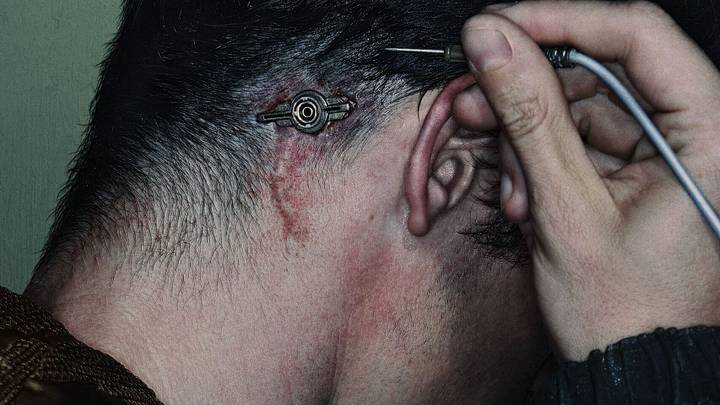
In the source material, Case and the others who would enter cyberspace didn't literally "jack" themselves into anything, despite that being the term of choice. It was more of a figure of speech. Instead, a series of "dermatrodes" were applied to the head, which allowed characters access to cyberspace. What's particularly interesting about this is that the world of Neuromancer is packed with characters who have augmented their bodies with various pieces of tech, but never jack ports.
When cyberpunk as a genre started to expand outward from Neuromancer, other writers started to add their own stamps. Among the most prominent was the furthering of Gibson's idea by having a physical port installed in a character's head where a wire was literally fed in. This enhanced the already dystopian vibe of cyberpunk while also feeling like a logical next step.
This is now most commonly associated with the Matrix franchise, although cyberpunk projects before those beloved sci-fi movies actually got there first. Apple TV has clearly seen the merit in abiding by this new cyberpunk standard. The show has done away with dermatrodes and instead given Case the jack port he arguably should always have had in the Neuromancer source material.
Neuromancer premieres on Apple TV on Jan 22. 2027.
 Add us as a preferred source on Google