

We're currently living through what feels like the later days of the AI craze, where tech companies do their best to convince consumers AI will reorient their entire lives, while signs to the contrary accumulate that the sector's bubble is getting ever closer to bursting. In 10 years, will we rely on AI for everything, or will it be a cautionary relic of corporate greed run amok? Only time will tell, and it very much seems an open question still which way that coin will drop.
The film industry has been at the heart of the AI debate from its early days, with guilds like SAG-AFTRA and the WGA fighting for AI protections as part of the Hollywood strikes of 2023. From fears of likenesses being used without an actor's permission, to writers having their work scraped against their will to fuel AI training and more, the examples of how this technology is causing disruptions are too numerous to list them all.
Yet there are those who see these tides shifting and look to capitalize, becoming more controversial in their own fields in the process. One such actor and producer is Ben Affleck, whose AI startup InterPositive was founded in 2022 as a way to integrate AI tools into the filmmaking process in ways that were custom-built to cater to the nuances of the film industry. Earlier this year, InterPositive was bought by Netflix for $587 million, ushering in the next phase of its life as a leader in the AI-filmmaking space. News of InterPositive's pricetag made waves when it was revealed by an SEC filing this week, mere days after Netflix laid off 6% of its workforce, or roughly 1,000 people. The acquisition and the layoffs happened months apart, but having news break about these two polar opposite ends of Netflix's business practices on the same week makes it hard for consumers not to examine the company's values.
A clip of Affleck discussing AI during a 2024 interview on CNBC has resurfaced this week (h/t CinemaBlend), and it's bringing about new discussions about the technology — and how it could have been used in relation to shows like HBO's House of the Dragon and Succession.
Ben Affleck says the day will come when someone can order up an episode of Succession with a plot they have in mind.
— Yashar Ali 🐘 (@yashar) October 17, 2026
He says that could create an extra revenue stream to replace lost DVD revenue.
Affleck says AI isn’t going to end the film and TV business, but certain parts of… pic.twitter.com/33UPMue6Nx
Ben Affleck thought AI would give us two seasons of House of the Dragon a year
Affleck is staunch in his belief that AI cannot replace things like actors on set, or the writing of visionaries like Shakespeare. Aspects where human judgment is key are things where AI simply is not equipped to fill the void, and he anticipated that it would remain that way "for a meaningful period of time." We're now two years on from that prediction, and it has borne out.
He calls AI a "craftsman," saying it can only copy what exists but not create anything new. "Craftsman is knowing how to work, art is knowing how to stop. And I think knowing when to stop is going to be a very difficult thing for AI to learn, because it's taste," he said.
So far, I can only agree with him. However, things get interesting when Affleck gets into the places he thinks AI could stand to totally disrupt other parts of the industry; namely, that it would even out the "more laborious, less creative, more costly" parts of the filmmaking process. He singles out visual effects.
"I wouldn't like to be in the visual effects business," he said. "They're in trouble, because what used to cost a lot of money is now going to cost a lot less."
Affleck went on to use HBO's tentpole Game of Thrones prequel series, House of the Dragon, as a prime example for where AI could drive costs — and production time — down, saying, "You might be able to get two seasons of House of the Dragon in a year instead of one." In his view, this would lead to companies making more shows, and certainly not companies pinching those pennies saved in ways that squeezed their already beleaguered workforces.

First off, let's just pour one out for the fact that Ben Affleck ever thought we were getting even one season of House of the Dragon a year. It's been a season every two years from the jump, much to the sorrow of fans everywhere. And really, it makes sense that Affleck's attitude here would be something that might align with Netflix's values, since a report released in August 2026 found that multi-year waits between seasons of a show have a negative impact on its viewership.
This interview with Affleck came out shortly after the release of House of the Dragon season 2. Suffice to say, AI has not made us get this show any faster than we already have; and I'd go a step further and say it was never going to do that, either. Even if AI could speed run the post-production for House of the Dragon, writing and filming two seasons in a single year is not even remotely tenable; even trying it would be all but guaranteed to lead to a massive dip in quality for the series.
Ahead of the release of season 3, showrunner Ryan Condal explained at a press conference why the show takes so long to create. He said that "prep and shooting" takes roughly a year on its own, followed by another seven to eight months for post-production. “It’s not possible to come out every year. I’m very sorry, but you guys decided to be fans of the show called House of the Dragon," he joked.
No matter how efficient AI is at cutting down render times for VFX, it's never going to close the gap on a production of that size, where the pre-production and filming alone takes an entire year to pull off.

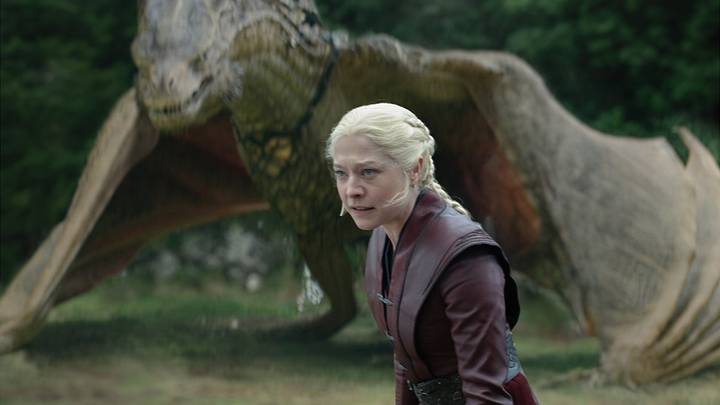
The dragons on House of the Dragon are art, just as much as the sets and acting
All that is aside from one glaring flaw with Affleck's example: aren't visual effects art, too? Before House of the Dragon, the best dragons we had ever seen on television came from Game of Thrones, and while Drogon, Viserion, and Rhaegal were spectacular, they were essentially the same model of dragon with a slightly different color scheme. The amount of work the artists and visual effects workers on House of the Dragon put in to differentiate beasts like Syrax, Caraxes, Vhagar, and Silverwing cannot be understated. There's a reason the show won an Emmy for Outstanding Special Visual Effects for it second season, which featured the breathtaking Battle at Rook's Rest and the Red Sowing.
While the bubble has also seemingly burst on infinite budgets for massive fantasy shows at streaming platforms, I don't know that AI is the way to even it all out. If it were, no doubt we would have seen it manifest already at studios like Amazon and Apple, which are already tech-driven enterprises in the first place. Instead, the more time goes on, the more we see viewers respond to carefully constructed filmmaking that was done with intention and craft; look no further than Christopher Nolan's The Odyssey, which was done with tons of practical effects, putting Affleck's longtime collaborator Matt Damon in real-world locations around the globe, and using the largest, clunkiest cameras imaginable to film it all for IMAX. AI could never.
But hey, in Affleck's eyes, you may still one day be able to get AI to make you your own custom episode of Succession, where Kendall Roy takes over the company and runs off with Stewie from Family Guy. Surely that's better than the meticulously crafted ending that creator Jesse Armstrong spent years working toward, even if that ending may have given viewers some complicated feelings to chew over, right? Because what is art if not there to reinforce our lamest impulses.
If you want to watch all three seasons of House of the Dragon and feast your eyes on the spectacle that was created by HBO's human artisans at work, they're streaming now on HBO Max. And if you want to take things a step further and see how it was made, the behind-the-scenes series The House That Dragons Built is streaming there as well.
 Add us as a preferred source on Google