

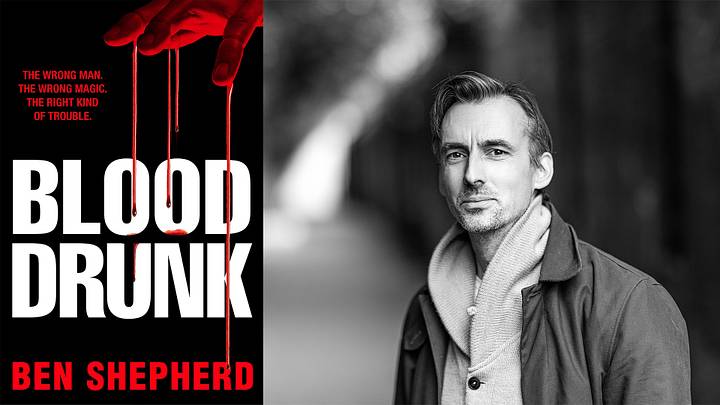
Ben Shepherd is not your typical debut fantasy author, and Blood Drunk is not your typical debut fantasy novel. Before turning to fiction, Shepherd spent 20 years as a diplomat, editor, and policy analyst for the Foreign Office and Chatham House, specializing in conflict and politics in Central Africa _ and all the while writing a book about magic, vampires and organized crime set on the streets of South London. The result is one of the most distinctive and confident debuts urban fantasy has seen in years, and we were thrilled to sit down with him over email ahead of release to ask him about it.
Blood Drunk is out from Tor in the UK on September 24 and from Grand Central Publishing in the US on September 8, and it introduces Freddie Burns — former South London gangster with a supernatural talent for giving vampires a kicking, and zero interest in being anyone's chosen one.
When a routine hit goes catastrophically wrong, Freddie stumbles into a secret London he never knew existed where vampires are very real, where a ruthless power broker known only as Hawkins keeps the whole supernatural underworld under control through a web of regulations and carefully managed terror, and where Freddie's particular gift makes him suddenly, inconveniently, very important indeed.
It has been described as Slow Horses meets Empire of the Vampire, and that pitch sells it both perfectly and slightly short because what Shepherd has done here is very much its own thing.
We can confirm that Blood Drunk stands out in a very crowded genre with the combination of its setting and its sensibility. Shepherd's South London is gritty, specific, semi-mythical and captured with the kind of detail that only comes from someone who has spent a lifetime walking its streets.
And Freddie himself is exactly the kind of protagonist urban fantasy has been crying out for. He is funny, cynical, dangerous and utterly unbothered by the grandeur of the world he has stumbled into. The Firm, the shadowy organization that keeps vampires in line, has been compared by Shepherd to a cross between a boutique intelligence agency and a medieval guild, and that particular combination of bureaucracy, paranoia, dark humor and extremely unglamorous monsters is what gives the book its voice.
Blood Drunk has already drawn blurbs from Jim Butcher, Dan Abnett, Catriona Ward and RJ Barker, and early readers have been unanimous that Freddie Burns is a character worth following wherever he goes next. We asked Shepherd about the 20-year journey to publication, the South London he wanted to capture and what Freddie's head is going to look like at the start of book two.

ASH ANJUM for WINTER IS COMING: Freddie Burns has already taken up permanent residence in our heads, and we suspect he's going to do the same for a lot of readers. Our protagonist feels like someone we've known for years by the end of page one. Was he fully formed when he arrived in your head, or did you have to go looking for him?
BEN SHEPHERD: I didn't have much idea where I was headed when I started Blood Drunk back in 2014, beyond vampires that felt right for London and a story that I'd be happy to stumble across in a bookshop, but I was sure I didn't want a typical hero — no long-lost prince-that-was-promised. I just got my head down and started writing and I think the tone probably came first — dark jokes, a thick layer of cynicism and a bit of hard-hitting action — and he emerged to embody it. But it was so long ago I don't really remember — I think he just turned up fully formed!
WIC: The Firm has a whole internal bureaucracy and politics of its own. How much of that world did you build out beyond what appears on the page?
BS: I didn't build an organigram for the organization but I have a fairly clear idea of how it functions; something like a cross between a boutique intelligence agency — with all the back-office support systems and paperwork that would need — and a medieval guild. Freddie is new to this hidden world so only really scratches the surface in this book — I'll hopefully get to pull the curtain back a little bit further in the next.
I think Terry Pratchett's Discworld was floating around in the back of my head (as it does most of the time to be honest) with Hawkins playing the Vetinari role — Vetinari made crime self-regulating in Ankh-Morpork; Hawkins has bound vampires into a system of rules and regulations and everything is ticking along quite nicely until someone throws a great big rock into the pond.
WIC: South London is almost a character in itself here. Were there specific streets, pubs, or corners you had in mind while writing, and do you think the book could have been set anywhere else?
BS: I've lived in South London my whole life, across a bunch of different neighborhoods, and wanted to catch a kind of concentrated essence of the place — Londoners will often say that North and South London feel different, though can never really say why; there's something distinct about it, beyond the (slightly self-imposed these days) sense of being the scrappy outsider, the poor relation to those posh folk over the river. So I deliberately didn't place a lot of the action in specific places — I wanted to evoke a sort of semi-mythical ur-South London. I've hopefully caught something of the feeling.
But yes, the river in the opening scene was definitely written with the Wandle in mind, one of the few Thames tributaries that hasn't been buried — I was living very close to it at the time — and there's a scene in a pub toilet later in the book that was directly inspired by hazy memories of a grotty boozer in East Dulwich that would sell us beer despite being (and definitely looking) about 15. I won't name it; it is now very far from grotty, gentrification being what it is. Blood Drunk probably could have been set somewhere else — London doesn't have a monopoly on history and half-remembered tradition and organized crime; Rome, maybe? — but someone else would have had to write it. I wasn't about to do that much research.
WIC: Vampire fiction is extremely crowded. What was the thing you decided early on you would absolutely not do with vampires in this world?
BS: They definitely weren't going to sparkle! I absolutely didn't want them to be remotely glamorous — vampirism is endless and repeated murder-cannibalism, when you get right down to it, which is about as unglamorous as it gets, in my opinion. I also hadn't seen versions of vampires that took seriously how hard it would be to arrange a regular blood supply without being, for example, mobbed to death by a crowd of gibbering peasantry or arrested; you'd need a lot of resources, which would in turn need organization and paperwork and systems and all that tedious stuff. I didn't want my vampires to be able to wave logistics away on a perfumed waft of hypnotism, cleavage and an exotic middle-European accent. I wanted them to be boring.
WIC: You spent 20 years working in conflict and politics in Central Africa before writing this! Does any of that experience bleed into how you wrote The Firm's power structures and the way the magical underworld operates?
BS: To an extent I suppose the Firm was somewhat influenced by working for the Foreign Office — an old organization with ingrained habits, working in an old building and preferring to mostly stay behind the scenes — but the main thing was a sense of how power operates in environments where the rule of law is weak and institutional checks and balances have been undermined; it's all about relationships, patronage and reputation rather than anything you can easily measure, and tends to make people very paranoid about being usurped by a rival and very careful to protect their status. That definitely shaped how I tried to portray vampire society in the book.
WIC: Blood Drunk is so confidently its own thing. Do you have ambitions to explore other genres at some point, or is Freddie's world going to keep you busy for the foreseeable future?
BS: I'm currently working on book two and have plans for a third; there are plenty of seeds planted in this book that are going to be a lot of fun to watch grow. But I currently have no ambition to make it into an open-ended series — I want to bring Freddie's story to a satisfying conclusion. Longer term I definitely have ambitions to try other genres — I have been sketching out an epic fantasy and there is a half-finished historical thriller gathering dust in a drawer somewhere that I'd love to go back to. Lots of possibilities!
WIC: Freddie ends the book having saved the world but clearly not having cleaned himself up. Where does his head need to be at the start of book two, and how much trouble has he already gotten into between the two novels?
BS: I can't say too much as the text of book two hasn't been finalized — and it would spoil the fun! — but by the end of Blood Drunk Freddie has succeeded in alienating basically everyone in his life and has never really been what you'd call a people-pleaser… As a starting point for book two, try and imagine something like an urban hermit and you'd probably not be far off; Luke Skywalker sulking on his island (though Freddie's dressing gown is significantly more disgusting), or a monk dedicated to the sacraments of lager, fried food and some very unlikely uses for earth-shattering magical talent. I'll say no more.
A huge thank you to Ben Shepherd for taking the time to talk Blood Drunk, and to Chloe Davies at Pan Macmillan for arranging the interview!
Blood Drunk is out now, wherever books are sold.
 Add us as a preferred source on Google