

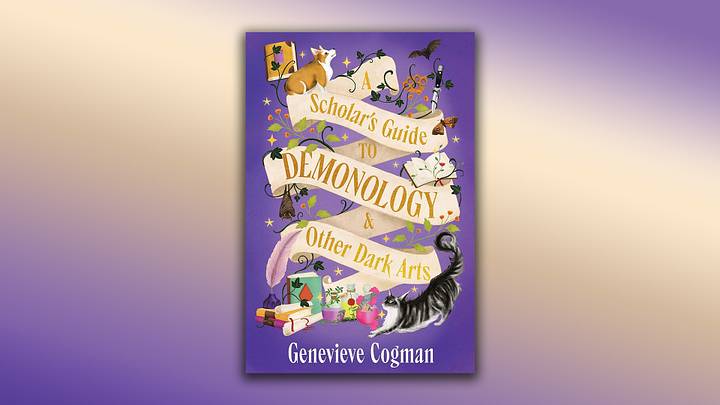
Genevieve Cogman has spent the better part of a decade building one of the most consistently enjoyable fantasy series in British genre fiction. The Invisible Library ran to eight books and never once lost the plot, tonally or literally. It was smart, funny, propulsive and warm in a way that a lot of more overtly comedic-leaning books are not.
Her latest novel, A Scholar's Guide to Demonology & Other Dark Arts, out now from Pan Macmillan on October 8, is the first book in her new Grayne's Academy Trilogy, and it reads like someone finally gave Cogman the exact premise her sensibility was made for.
Welcome to Graynes
Our protagonist Philomela—Phil—was nearly a Cambridge Classics PhD. Then her father's gambling debts made that future unavailable, and she took the only teaching job she could get as Latin mistress at Graynes, an all-girls school on the Yorkshire Moors that is remote and staffed by people she very quickly identifies as not quite right.
The students are worse. The pranks go well beyond what schoolgirls with ordinary resources could manage, and Phil is still adjusting to this when she discovers that the students have been summoning demons in the cellar! This turns out not to be a disciplinary matter so much as a revelation that Graynes is not a school in any conventional sense but a training ground for England's elite demonologists, the secretive force responsible for keeping the country safe from whatever comes through the cracks in the metaphysical order.
Guarding the realm from the forces of hell was not in Phil's job description. She does it anyway, partly because she does not have much of a choice, and partly because something in her — the Classics scholar who spent years reading about crossroads deals and pacts with ancient things — finds it impossible to look away. What she uncovers eventually is a threat that reaches Graynes, England, and the entire magical framework the demonologists work to protect.
Cogman's strengths land perfectly in A Scholar's Guide to Demonology & Other Dark Arts
The Invisible Library series made it very clear that Cogman can take an absurd premise absolutely straight while never letting you forget how funny it is. That balance is harder than it looks, and she is one of the few authors who pulls it off reliably.
A Scholar's Guide to Demonology & Other Dark Arts gives her a premise that is almost perfectly tuned to this. Phil is an academic dropped into a world of dark arts and talking familiars, and Cogman plays the fish-out-of-water dynamic for everything it is worth — comic, dramatic, and frequently both at once.
Phil's Classics background, her knowledge of ancient texts dealing with demons, pacts, and the contractual terms of magical agreements turns out to be satisfyingly and practically useful. That is the sort of thing Cogman does well in her works by making the specific expertise of the protagonist feel like a real asset to the world.
The school itself is one of the book's quieter pleasures. Graynes has the vibe of an institution with a very long and very strange history where rules have accumulated across generations and nobody remembers why some of them exist but everybody follows them anyway.
The students are terrifying in precisely the way girls at boarding schools have always been terrifying in fiction, which is completely and with full commitment. They are also, by the time the book is done with you, exactly the characters you care about more than you planned to.
The talking familiars are a genuine highlight. The custard creams are a running joke that earns itself every single time.

Verdict
The Invisible Library fanbase has been looking for something to read since that series wrapped. This is it.
A Scholar's Guide to Demonology & Other Dark Arts is smart, funny, and precisely calibrated. Phil is a protagonist built for this kind of story, and Graynes is a world that feels like it has more in it than one book can hold. Needless to say, the Grayne's Academy Trilogy is off to a very strong start.
Rating: 4.5/5 stars
 Add us as a preferred source on Google