

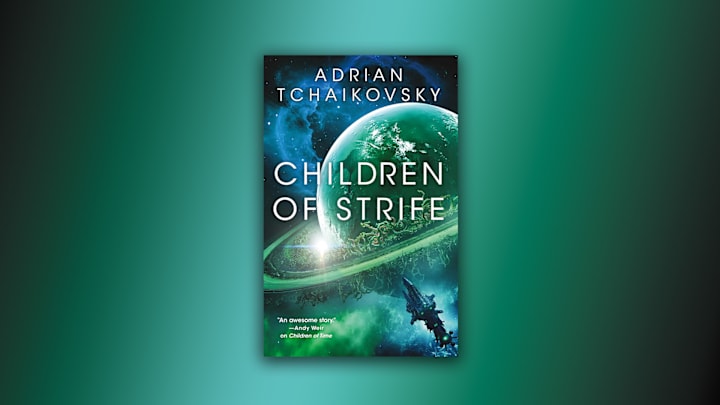
Adrian Tchaikovsky's Children of Strife hits shelves in March 2026 as the fourth installment in his acclaimed Children of Time series. It's an ambitious, multi-layered story that spans thousands of years and brings together everything fans love about this universe while introducing bold new ideas.
The book releases on March 17, 2026 in the United States and March 26, 2026 in the UK. At around 684 to 704 pages, it's a substantial read that rewards the time investment. While it's the fourth book in the Children of Time series, newcomers can jump in here. That said, reading the previous books will definitely enhance the experience to certain moments and character returns.
The series so far
The Children of Time series explores humanity's future across three distinct eras. Earth is dying or already dead and humans have scattered across the galaxy. Along the way, they've created uplifted species — as in creatures given intelligence through human technology. The first book gave us spiders who inherited a world meant for humans. When ark ships full of survivors finally reached these prepared planets thousands of years later, they found civilizations they never expected.
The uploaded mind of scientist Avrana Kern became a bridge between species, guiding an unlikely alliance between desperate humans and advanced arachnids. That partnership grew stronger in Children of Ruin when they discovered a water world with intelligent octopuses. But they also encountered something terrifying: a microscopic entity that copied and replaced living beings at the cellular level, essentially erasing whoever it touched. Only through communication and compromise did they find a way forward, turning a parasitic nightmare into a cooperative partner.
Children of Memory took a darker turn. Explorers arrived at a colony that seemed real but was actually an elaborate simulation. A powerful computer had been running countless versions of a failed colony mission, unable to accept that everyone died before even landing.
A story told across three ages
Now Children of Strife builds on all of this, bringing back familiar faces while introducing new disasters born from humanity's oldest sin of playing god without understanding the consequences.
Tchaikovsky uses an ambitious structure here. Each chapter jumps between those three different time periods. It's like watching three separate movies that slowly reveal they're all connected.
Age of the Terraformers with a branch story of the original
Meet Gerry Hartmand, a billionaire terraformer who lost out to the famous Avrana Kern in the competition for the best planets. Bitter and arrogant, Hartmand takes his team of five flawed scientists off the grid to create their own world.
But things go horribly wrong. Team member Pils discovers a technique that essentially turns the planet into a living computer, something programmable at the biological level. The planet develops consciousness, but not a healthy one. It absorbs the toxic personalities of its five creators, becoming something dangerous and unstable.
This timeline shows us the roots of disaster. Hartmand is portrayed as deeply flawed, egotistical, self-centered and willing to cut corners. The terraforming that should have been careful and measured becomes chaotic experimentation.
Age of the ark ships is perhaps the most unsettling
Centuries later, ark ships are fleeing a ruined Earth. Lamya Cosimir leads one such vessel carrying thousands of humans in suspended animation toward Hartmand's planet. They don't even know if it exists or if it's habitable.
This timeline gives us a gut-wrenching look at the desperation of leaving Earth behind. There's no return trip. The loss of a certain percentage of the "cargo," frozen humans who might never wake up, is simply expected. It's survival at its most brutal.
We see the aftermath of rebellions and wars that destroyed humanity's home. The crew members grapple with conflicting emotions and the weight of carrying the future of their species.
Age of the Panspecific explorers done best
Fast forward to the final age of the series. The research vessel Dissenter arrives at Hartmand's planet with a diverse crew that includes Alis, a human scientist haunted by nightmares from events in the previous book. Captain Cato is a Stromatopod, an uplifted mantis shrimp who is aggressive and hierarchical but surprisingly philosophical. Avrana Kern returns as the ship's AI, still snarky and manipulative but less unhinged than before. The intelligent spiders from earlier books, the Portids, are also aboard. Rounding out the crew is Mira, a Nodal organism with the ability to assimilate other living things.
The planet looks like Eden from orbit and lush, green, Earth-like. But it's anything but safe. The vegetation is so aggressive it can survive in the vacuum of space and colonize ships in orbit.
When the crew investigates an ancient ark ship, something goes terribly wrong. Alis wakes up to find herself, Cato and Kern alone on the Dissenter. Everyone else has vanished. The rest of the book follows their desperate attempt to understand what happened and survive.
The three timelines do converge quite wildly in the final chapters. Tchaikovsky ties together plot threads, showing how decisions made thousands of years ago ripple into the present. Characters who survive come to terms with their situations and there are scenes of genuine awe.
Characters that break the mold
Tchaikovsky excels at creating non-human characters that feel real and relatable. Captain Cato, with barely repressed violent instincts, tries to be nice while instinctively wanting to kill everyone around him. He's hilarious, scathing, and surprisingly tender at times.
Avrana Kern, once an unhinged megalomaniac, has evolved into something more nuanced as an AI. She's still cynical and manipulative, but now she's protective and surprisingly endearing. She brings humor and sharp wit to tense situations.
The Portids return with their fascinating dynamics. A dominant Portia and a subservient Fabian navigate their relationship during the story finding unexpected equality and understanding.
Not all characters land perfectly though. Some feel slightly underdeveloped, but the core cast is memorable and emotionally engaging, each representing different aspects of what it means to be "human" even when you're not human at all.

Final verdict
If you've read the previous Children books, this is a must-read. It brings back beloved characters and delivers the same mix of hard science and emotional storytelling you expect from Tchaikovsky.
If you're new to the sci-fi series, Children of Strife can work as a standalone, as Tchaikovsky includes a "What Has Gone Before" summary and a character list. However, you'll miss emotional connections and callbacks that make certain moments more powerful.
This is very much a return to form after the third book, which in my personal opinion felt slightly less impactful. The split narrative and complex structure require attention, but the payoff is so very worth it. I'd easily score the fourth installment in the series 4.5 out of 5 stars.
For fans of thoughtful, character-driven science fiction with genuinely alien aliens and big philosophical questions, Children of Strife delivers. It's space opera with substance, accessible enough for newcomers but rich enough to satisfy longtime fans.
 Add us as a preferred source on Google