

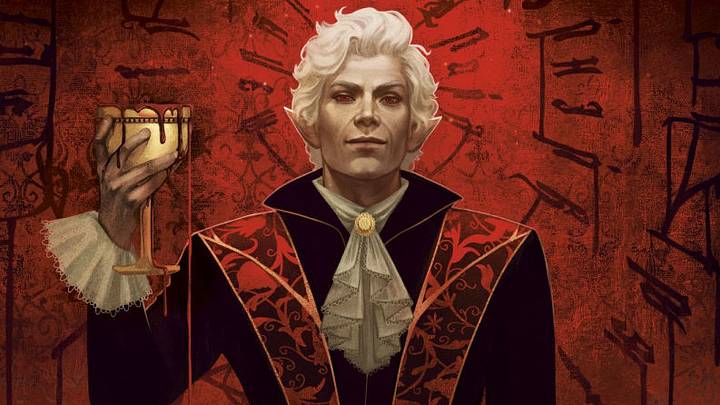
Fans of Baldur's Gate 3, the award-winning, bestselling RPG developed by Belgian-based game makers Larian Studios, can now dive into some readable content instead of DLC (which we'll never get), if they so choose. Random House Worlds announced that four tie-in books were set to release for the game, including a prequel novel featuring our favorite eccentric, high elf, rogue vampire spawn, Astarion. The author to act as dungeon master leading his early campaign would be no other than T. Kingfisher (Swordheart, Wolf Worm, What Moves the Dead), with Stephen Rooney, a Baldur's Gate 3 senior writer, to help with lore.
Writing a media tie-in novel comes with its own challenges, as you cannot break canon, or upset the timeline of what comes after your story. Moreover, one has to adhere to character consistency, and finish their journey with enough room to change into the character we know from their mainline media. Despite these limitations, T. Kingfisher had lots of freedom to create new characters, villains, and even a religious order. But how well does this translate into a memorable, compelling story for Astarion?

Light shed on Astarion's past before it could turn him to dust
Astarion Ancunín (once Astarion Ra'tchashar) was a normal high elf before becoming a vampire spawn of Cazadar Szarr—a much more normal high elf, at that. He lived with his parents, Miriana, a druid, and a Ra'tchashar male in a quaint house on the countryside. It wasn't until he was 12 that Bajia, a servant of Lady Erikinia, Miriana's grandmother, came to retrieve Astarion because of a bargain his mother made. Miriana, in exchange for leaving the family, was to introduce her son to his Ancunín heritage. Lady Erikinia was left without an heir, so she saw it as only fair.
The dainty boy was always infatuated with the city and high fashion. He longed for a sophisticated life, so when he learned his place in the family tree, it was impossible to resist. The book transitions back and forth from Astarion's childhood, adolescence, and young adult life to his horrifying later years as a vampire spawn. All those privileges and riches were stripped away from him like his soul and warmth; now nothing but a cold husk who could no longer embrace the sunlight.
Are there really worse things than death?
T. Kingfisher does not hold back from the gut-churning, "living" nightmare that was Astarion's unlife as Cazadar's thrall. He went through some disgusting scenarios I can't even say I remember from the game, but it's entirely reasonable that he never, ever wanted to return. Hearing Astarion talk about his trauma is different than reading and experiencing it. Cazadar Szarr was a ruthlessly conniving, manipulative, devilish man. Kingfisher shows how Astarion and the other spawn had crippling anxiety about every possible social interaction, gesture, and placement in the room to stay on Cazadar's good side or out of his sight entirely. Where they sat at the table, what they said while walking down the hall — any of it could have led to a surprise torture game.
Cazadar Szarr, a true vampire, controlled his "children" absolutely, including Astarion, Dalyria, Yousen, Aurulia, Violet, and Petras. Violet was the most eager to please, hating that Astarion had more favored attention than she did. The social, familial politics of the House of Szarr are wonderfully written, and perhaps my favorite part of the novel. Many would ask why Astarion didn't try to end himself, but he thought that a waste. Despite all the torture, abuse, and assault of all kinds, Astarion hopes he'll somehow outlive the old man. Death would make it all meaningless.
Cazadar's family reminds me of the Sith of Star Wars, since one is eventually chosen to be a true vampire along with the head, and then they eventually take their place, whether by grace of force. In Cazadar's case, it was the violent latter. If you played the game, you know that Astarion's ultimate fate is for you to decide. The vampire spawn are each desperate to prove they can be a true vampire, which means better treatment by some measure, and power over the spawn.

The Quest
Cazadar Szarr announces a contest for his children: find him the most exotic blood in Faerûn in five days. Spawns Dalyria and Yousen come to Astarion, offering him a path to obtain the blood of a dead god. Astarion never does the right thing; he does what benefits him. He justifies his "heroic" actions because it may save his skin from being flayed later. When Yousen tells Astarion that he was nicer than other spawn, Astarion denies it. Yousen concedes and says they'd rather Astarion win, since everyone thinks becoming a true vampire is the prize, and Petras or Violet being promoted sounded like torture. That Astarion understood. It wasn't out of compassion, but survival. That's how he sees the world. They would have asked Aurulia, but they were too late. She had already left the building on her quest for rare blood. Astarion, being the opportunist that he is, took the deal.
Without giving too much away about the surprises, twists, and turns that keep this novel fresh, Astarion is well-written as a rogue. He knows his way around stealing, but also sweet-talking people, which saves him later. His background in legal work comes in handy as he finds loopholes in people's contracts, oaths, and promises. Astarion's relationships are more like tools; he still justifies his kindness and affection because it could give him a better prize, even if he's "in love" with them. He tells himself these things because it's easier to accept that he's evil instead of a good person who's struggling and dealt a bad hand.
Where T. Kingfisher falls short in Astarion is justifying the story itself. Compared to other media tie-ins, it's not the most memorable or important. In the moment it is, but it seems too afraid to reach out and interact with other stories in Baldur's Gate. It's a prequel that is self-contained, but almost had no reason to be told. In the end, nothing changes, which is the tricky thing about using pre-existing characters. I believe Ambessa: Chosen of the Wolf by C. L. Clark did a better job at this, introducing new characters that will have a purpose later, and telling the origins of a magic system we only saw glimpses of in the show.
Cazadar's horrible games were also the cornerstone of Astarion's backstory, but most of them are mentioned in passing, brief flashbacks, or short scenes. We don't spend a lot of time in those uncomfortable moments to grasp the toll it took on Astarion's mind, exploring the limits of a spawn's healing capabilities. While some scenes were thankfully short, due to the subject matter, there were missed opportunities in how Astarion dealt with these punishments. More attention is given to trivial, almost overexplained details and witty mental dialogue, which slowed some scenes and was sometimes overused.
Verdict
Baldur's Gate 3: Astarion offers an intimate, gritty story of low scale and somewhat low stakes, but with a decent punch of emotion. It's worth getting to spend more time with the vampire rogue, but its story and plot beats follow a predictable pattern, with sometimes choppy action scenes. But if you're that hungry to get to know Astarion better, you should sink your fangs into this tale at least once.
Rating: 7/10
 Add us as a preferred source on Google