

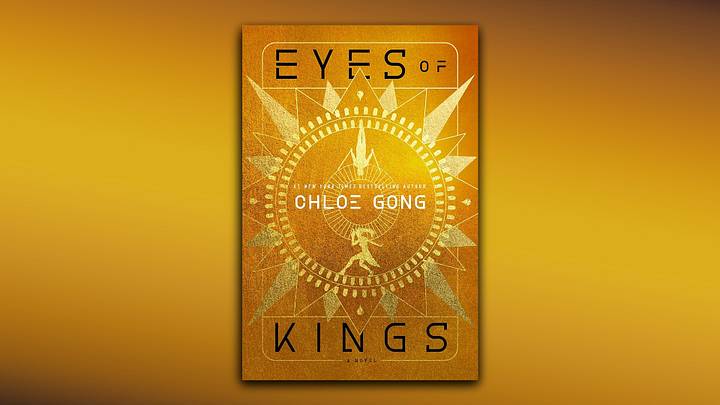
Chloe Gong's Flesh & False Gods trilogy has officially come to an end, with Eyes of Kings closing things out in spectacularly tragic fashion. Following Calla's coup at the end of the previous book, this one opens with higher stakes and a new challenge to grapple with: keeping ahold of the kingdom of Talin while August and Otta scheme and the Crescent Society waits for the opportune moment to oust her.
As you'd expect from that premise, the third and final book in the series is rife with political intrigue — and it balances it with urgency and action. From the moment Eyes of Kings opens, there's a sense of tension and dread that readers won't be able to escape. Calla and Anton can't quite shake it either. For fans of Gong's work, this will be one of the most gripping fantasy books arriving in August. The conflict and world-building shine, and it ends the only way it possibly can. It's a genuinely wild ride throughout.
The political intrigue and war for the crown reaches new heights in Eyes of Kings
With the Flesh & False Gods trilogy drawing inspiration from Shakespeare's Antony and Cleopatra, continued power grabs and betrayals are expected throughout. They get bigger and more intense as the series continues, so it's no surprise that Eyes of Kings brings the fight for Talin's throne to its highest point yet.
Calla, Anton, August, and Otta all have far too much pride to accept defeat, so they continue to desperately cling to what little power they can. As each side tries to get a leg up in the book's civil war — while dealing with their own individual machinations — there's the bloody action and political back-and-forth readers have come to love and expect.
That tension keeps the book moving along nicely, though it can still be a bit dense in places. That's a gift and a curse, as it can slow the momentum at points. Yet it mostly stems from Gong opening up the world-building in fresh and interesting ways, a decision we can't really complain about.
Chloe Gong expands the world to the heavens in Flesh & False Gods book 3
Eyes of Kings expanding on the political intrigue from previous books is to be expected, but the true surprise is the way it continues to flesh out Gong's fantasy world. Geographically, we see much more of it in Vilest Things. However, Eyes of Kings introduces a whole new layer to contend with: the gods.
Gong uses the pantheon to solve some of the series' biggest mysteries. The result is lore that feels even more impressive and ambitious. Still, it's not a seamless introduction. Although the storylines surrounding the gods are fascinating, especially where they collide with the main characters' stories, some of the subplots surrounding them feel rushed at times. Such is the risk of introducing a major element so late in the game, but it mostly works. It certainly doesn't prevent the series from tying up its biggest loose ends satisfactorily.
And that's because the most important and compelling part of this series continues to be its characters. The deeply flawed, tragic individuals that Gong introduces in Immortal Longings continue to frustrate and falter. They feel deeply real, though, and speak to the larger corrupting force of power. You won't know who to root for, or what these characters plan to do next. That's part of this series' charm, and it's alive and well in Eyes of Kings.
The characters continue to be the highlight of Gong's fantasy series
Eyes of Kings' excellent character work extends to its main cast and supporting players, all of whom get proper send-offs before the book is through. That's one way this finale fully succeeds: readers won't find themselves wondering what happened to so-and-so, as every fate is accounted for (even our beloved Mao Mao).
Gong does a good job with her characters on an individual level, but the romantic tensions in the series also continue to shine. Calla and Anton's dynamic remains deliciously complex and toxic. Those who enjoy the unpredictable and sometimes off-putting nature of it will continue to eat it up. The true highlight of Eyes of Kings is the August and Galipei subplot, however, which accomplishes a lot with so little. It's incredibly compelling, especially given how the novel ends.
Eyes of Kings ends in the only way it can
Flesh & False Gods takes a bleak approach to power and people from the beginning, offering tiny nuggets of hope and goodness throughout. For a series like this one, a bittersweet conclusion feels natural. And Eyes of Kings ends in the only way it really can, especially given the Shakespearean tragedy it draws from.
The good news is that it allows everyone to go out swinging, whether they survive the sequel or not. In that sense, the final chapters fully do justice to this story and its characters. It keeps the twists, rage, and action going until the very end. It proves this is still a survival story, as much as it's spun out into something much larger.
But while the book's ending is fitting, readers may be unsure what to take away from it. The characters' motivations are often muddled by their own pride and desire for power, which is a point in this story's favor — but could also be unpacked a little more. It makes it so that any of them ending up in power is not exactly optimal. If Gong is hoping readers leave with the message that power is inherently corrupt, even when it starts with positive intentions and idealism, I'd call Eyes of Kings a success. If we're supposed to see a glimmer of hope in those final moments, however, it gets lost in the darker turns.
As someone who appreciates the former type of story, Flesh & False Gods is a convincing dissection of power, whether it intends to be or not. Each book gets bigger and better, and Eyes of Kings continues that trend. Those who have stuck with this series will appreciate it as a finale, and I'd argue those on the fence should push through to see how it ends. Book three is the story at its best, as devastating as it is.
Eyes of Kings is available now from Saga Press, wherever books are sold.
 Add us as a preferred source on Google