

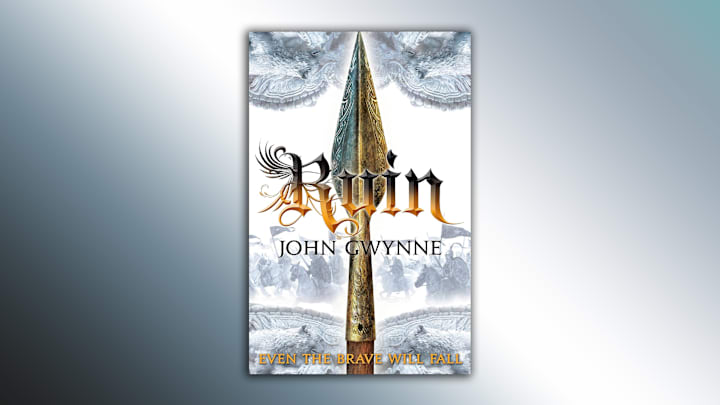
In the first two volumes in John Gwynne's debut series, The Faithful and the Fallen, he set the bar incredibly high for storytelling and character development. Fortunately, the third volume, Ruin, maintains and even tops those excellent standards.
The first book, Malice, was dedicated to world-building and character development. In the next volume, Valour, the story moved forward at a quick pace, with plenty of battles and action.
Ruin maintains the growth arc for most characters and moves the story along faster than expected. Gwynne is a master at not wasting words on the minutiae of “the getting there.” This means that while characters are moving from one place to another, he focuses on other characters who have a perspective that moves the story along the set path.
High fantasy has always had an issue figuring out “the getting there” problem. How do characters get from one place to another, especially when the distances are substantial? Some writers figure out a way to incorporate some workaround, sometimes using the established magic of their world.
For instance, Robert Jordan used various methods for his characters to travel long distances in a very short time in The Wheel of Time. In other instances, like Dennis L. McKiernan's Mithgar series, the journey is the story. It's more about the quest and what happens to the characters en route.
Gwynne doesn't use either of these methods. The journeys are mostly irrelevant to the overall story. He makes it about the events that lead to the journey and what happens at the end. It creates a story that never stalls.

Deceptions are revealed in Ruin, and the final pages culminate in a surprising ending
From early in Ruin through most of the book, things that were hidden from the characters were finally revealed. The readers were aware of some of these things, but keeping them from the major characters added drama and intensity to the story.
One major character discovers that he is the opposite of what he thought he was, and it nearly crushes him. Though he learns the truth, he eventually chooses to embrace his new reality.
While that seismic revelation is a cornerstone to the story, there are other, smaller threads that greatly affect the characters. While some of these things, such as love being revealed, don't have the same impact on the greater story, they do alter the characters individually. Again, the build-up to these revelations adds drama.
For readers, the biggest surprise is the ending of Ruin. While this particular confrontation has been expected for a while, the event happened quicker than most might have guessed. And in typical Gwynne fashion, it unfolds in an unexpected, incomplete manner.
It causes a nice cliffhanger going into the final book, as if one was needed! The event doesn't unfold in a clean, orderly, expected way, but in a chaotic way that makes the reader want to grab the final book as soon as possible.
As in the first two books, the points of view continue to change rapidly, but in doing so, Gwynne is painting a complete picture and doesn't slow down the narrative on insignificant things. Past favorite characters like Corban, Veradis, Maquin, and Camlin get plenty of focus.
Others like Rafe, Uthas, Envis, Ulfilas, Haelan, Cywen, Coralen, and Fidele still offer great perspectives to the story around the main characters. Their combined plotlines fill in the time while other characters are “getting there.” These multiple viewpoints are terrific for added character development, and they all have their story to tell.
If you were enthralled with Malice and Valour, Ruin won't disappoint. At this point, readers should be fully engaged with the characters and the overall narrative. All that is left is to read the finale.
Take a look at our reviews for the first two volumes of The Faithful and the Fallen:
 Add us as a preferred source on Google