

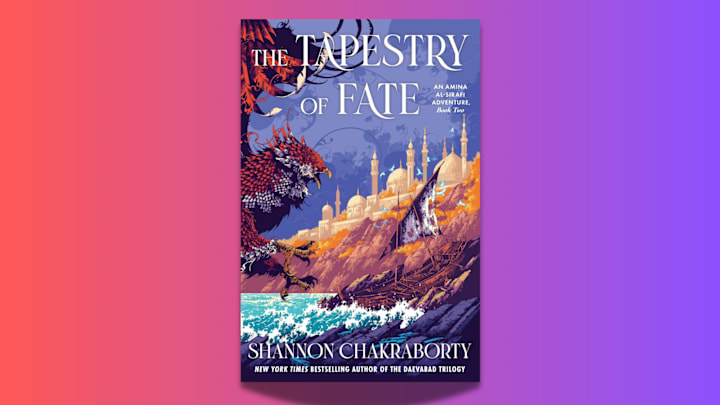
There is a particular kind of dread that comes with picking up a sequel to a book you loved. You want it to be good. You need it to be good. And sometimes—too often—it isn't. The Tapestry of Fate, the second installment in Shannon Chakraborty's Adventures of Amina al-Sirafi trilogy, is the rare exception. It lives up to the first book and in several important ways, even surpasses it.
If you haven't read The Adventures of Amina al-Sirafi yet, I'd strongly recommend doing that before picking this one up. Here's the short version. Amina al-Sirafi is a retired pirate, a legend actually, who is dragged out of her quiet life by the promise of a big payday and a sense of old loyalty (there is also some blackmailing at play). She reassembles her crew: Dalila, the unnerving Mistress of Poisons; Tinbu, her devoted first mate; and Majed, her sharp-eyed navigator. Their job is to track down a kidnapped girl named Dunya, who has gotten tangled up with a dangerous Frankish sorcerer named Falco.
The mission escalates in ways nobody expected. Amina's demon husband Raksh resurfaces (yes, demon husband, keep reading), the crew runs headlong into forbidden magic, and Amina ends up on an enchanted island ruled by a council of immortal beings called peris. To be allowed to leave, she cuts a deal: hunt down five magical artifacts on their behalf. She defeats Falco, saves Dunya (who later takes the name Jamal and embraces his identity as a trans man), and returns to her family. The book ends with Amina having traded one retirement for a new, stranger kind of life, sailing the seas on peri business, crew by her side.
That is where The Tapestry of Fate begins.
Higher stakes, darker waters
At the start of book 2, Amina seems to have actually found a decent rhythm. She gets to sail, do the occasional dangerous errand for the peris and still come home to her daughter Marjana. It's not exactly the peaceful retirement she'd imagined, but it's manageable.
Then Raksh, the spirit of discord she is unhappily magically bound to in marriage, goes and causes a scene with the peri council. Suddenly Amina's comfortable arrangement is in jeopardy and to make it right, the peris hand her what sounds like a suicide mission: travel to a remote island ruled by a powerful sorceress and steal from her a spindle that is said to be capable of rewriting fate itself.
The problem is that nobody who sails to that island comes back.
Amina has no choice. She leaves Marjana behind, and Marjana, now old enough to sense she's being kept in the dark about her mother's life, is not happy about it.
The voyage is, predictably, a disaster from the start. Once the crew reaches the island, the story shifts gears in a fascinating way. The sorceress at the center of it all is not quite what she seemed from the outside, and the peris turn out to have their own tangled, far less noble history. Layer by layer, the real game behind everything comes into focus and it is much bigger and much darker than a simple artifact retrieval.
What works, and works exceptionally well
The friendship between Amina and Dalila. This was the emotional heart of the book for me and I didn't expect it to hit as hard as it did. Dalila is someone we've always seen as composed, sharp, slightly terrifying with all cool efficiency and deadly competence. In The Tapestry of Fate, Shannon peels back those layers and shows us who Dalila actually is underneath all of that armor. Her past, her vulnerabilities, her deep and complicated love for Amina.
The two women have the kind of bond forged through shared danger and long years of knowing each other better than they know themselves. Their dynamic carries the middle section of the book when the crew is fractured and it's largely just the two of them, and it absolutely delivers.
The magic feels bigger and stranger this time. Book 1 introduced us to a world where jinn, peris and ancient spirits are real and present. Book 2 takes that world and expands it considerably. The island they're trying to infiltrate operates on its own rules, the sorceress commands power that feels genuinely unknowable and the mythology behind the peris is much richer and more complicated than it first appeared.
For fans of Chakraborty's earlier Daevabad Trilogy, there are also subtle hints throughout that this world and that one may share more than geography. Longtime fans will catch those easter eggs and enjoy them tremendously.
I love that Chakraborty refuses to make her protagonist easy. Amina makes questionable choices in this book. She underestimates the people who love her. She is brave and resourceful and also, frequently, her own worst problem. She's not a wise, battle-hardened mentor figure just because she's middle-aged. She's still learning. That's rare in fantasy and it makes her feel completely real.
Pacing is fast, but does the story justice
This book moves faster than the first one. The world has already been built and Chakraborty can afford to just go. Once the mission kicks into gear, the story rarely lets you breathe.
The crew spends a significant portion of the book separated, and I genuinely missed them when they weren't together. Tinbu and Majed bring a warmth and a bit of comedy to the group dynamic that is noticeably absent in the stretches where Amina is largely on her own with Dalila.
Raksh, chaos creature that he is, also tends to keep things lively whenever he shows up. Though at some parts of the story even he feels off (there is an eerie reveal to that!). The ensemble really is one of the best things about this series, and the book is slightly lesser in the moments when they're not all in the same place. It's a minor complaint and the payoff when the crew reunites makes it worthwhile, but if you go in expecting constant ensemble energy like the first book, just know the middle section is more of a two-hander.
Verdict
The Tapestry of Fate is a genuinely excellent sequel. The world is richer. The characters have grown in ways that feel true to who they are. The plot goes somewhere unexpected and leaves you desperate for the next book.
Shannon Chakraborty continues to be one of the best voices in fantasy today. Her writing is confident and warm and funny and occasionally heartbreaking, often all within the same chapter. This series is a pleasure to inhabit, and The Tapestry of Fate is a powerful reminder of why.
If you have been on the fence about starting this trilogy, start it. And if you have been waiting to find out whether the sequel lives up to Book One, the answer is yes. Emphatically, and then some.
Rating: 4.5/5 stars
The Tapestry of Fate, published May 12, 2026, from Harper Voyager is available now wherever books are sold.
 Add us as a preferred source on Google