

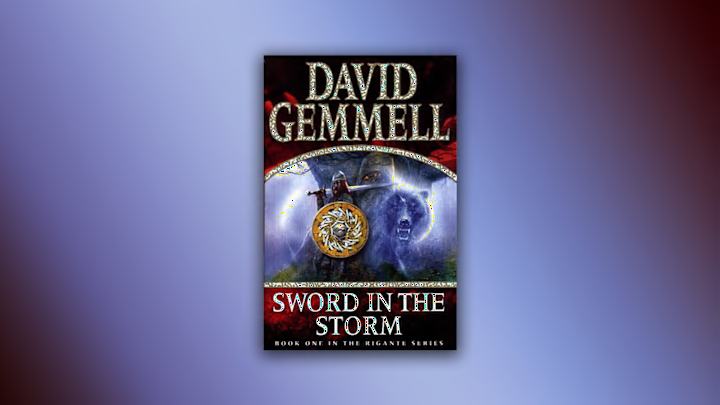
David Gemmell was a pioneer author for heroic fantasy. His Drenai series was a bellwether example of the genre when it wsa first published in the 1980s. It wasn't his only superb work. Among others, his Rigante series carried on his terrific writing style established in earlier works.
Sword in the Storm is the first book in Gemmell's Rigante series. It is the story of the rise of a warrior, from childhood to adulthood, and how his journey made him the person who would be instrumental in saving a people.
Connavar's father was killed in battle days after Connavar's birth. He was raised by his mother and his father's best friend, and he had to deal with the whispers that his father died a coward. While Connavar is an intriguing, layered character, the setting of the series is just as much a character as the novel's protagonist.
Time and setting are important aspects in David Gemmell's Sword in the Storm
The Rigante are a clan of the Keltoi people, set in a land that symbolizes Iron Age England. The Rigante themselves seem to be based on the Brigantes, a tribe in Northern England, centered around present-day York.
The looming threat that is always present is the empire of Stone, which closely resembles Rome. The Stone armies march through kingdoms, efficiently and brutally conquering all. They then build roads on which they can quickly move their armies and supply them as they attack the next kingdom.
There is also a threat from the Storm Raiders, who are analogous to the Vikings and other Nordic invaders. This skews the pre-Roman timeline somewhat, because those invasions from Northern Europe took place mostly after the Romans left England early in the fifth century.
Sword in the Storm unfolds in a land of mysticism and earth magic. Druids, Wiccans, and Seidh play a big role in the story, especially the latter, which is a race of mysterious faerie folk who seem to take an interest in young Connavar.
As a youth, Conn (short for Connavar) saves the life of a crippled boy. A massive bear chases Conn and his friends as they return from an afternoon of swimming. Connavar carries his friend until he realizes he can't outrun the bear. He sets his friend down and charges the bear with only a knife. He is badly mangled in the attack, but he distracts the beast long enough for others to come to his aid.
His injuries are life-threatening, but he is slowly nursed back to health by a witch in a cave deep in the forest. When he returns to his village, he finds he is a hero, and word of his heroic charge at the bear has made him famous — and not just locally.
While still in his teens, Conn decides to travel to other lands because he knows the armies of Stone will eventually cross the water from the continent and attack not only the Rigante, but all the Keltoi tribes. He travels with a Stone merchant who he'd been friends with for years, named Banouin.
Banouin has described to Conn how the Stone armies fight, and the youth decides he needs to see for himself. During their travels, Banouin is captured and killed by a king, and Conn swears vengeance.
Conn eventually joins the Stone army as a scout. The army is set on conquering the same kingdom whose king killed Banouin. During his time with the Stone army, he sees firsthand the ruthless efficiency with which they make war. Conn eventually gets his vengeance and returns home.
Because of his travels and knowledge of a future enemy, and for his legendary courage, he quickly gains the attention of the Rigante laird. Eventually, the laird names Conn his successor.
Conn works to modernize the tribal fighting methods of the Rigante. He thinks he can organize all the tribes and defeat the Stone army when it eventually arrives. Before that happens, however, Conn must first deal with an attack from the Sea Raiders, and it is a costly battle for the Rigante and for Connavar personally.
Sword in the Storm is light on character development, but has deep worldbuilding
Gemmell does a fantastic job building the world and developing Connavar. While readers will certainly pull for Conn, he isn't a particularly beloved character. He's serious and standoffish, and provides very little humor.
Outside the lead character, however, Gemmell doesn't dig too deeply into the other characters around Conn. There are a few, like Banouin, Vorna (the witch who heals him), Ruathain (Conn's stepfather), and, to some extent, Braefar (Conn's half-brother), that readers get to know, but only superficially.
The battle scenes, while relatively few, are intense, and the story moves at a nice pace. Still, Gemmell's lack of development for the secondary characters was more superficial than it should be.
The heroic fantasy genre has several examples of authors who are incredible at developing secondary characters. Robert Jordan, George R.R. Martin, Joe Abercrombie, John Gwynne, and Patrick Rothfuss are just a few of these.
Sword in the Storm is an excellent fantasy novel from a writer who knows how to build a world and develop a narrative. Connavar isn't a character that readers will instantly connect to, but his goal to protect the lives and culture of his people is something to embrace.
If you like the genre, you will still enjoy the story and its incredible setting based on a real world long in our past.
 Add us as a preferred source on Google