

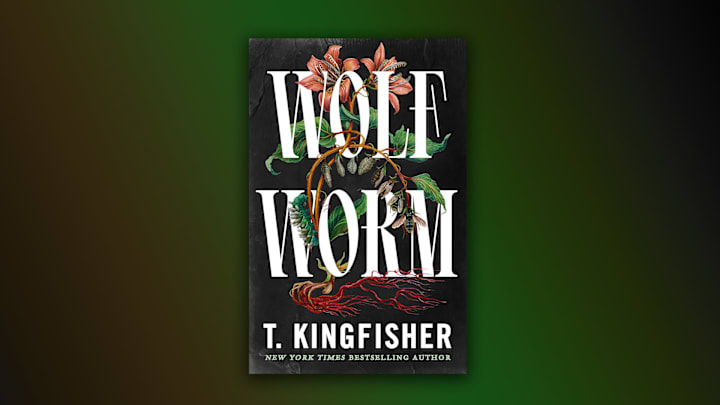
There's something uniquely disturbing about horror that comes from the natural world. T. Kingfisher understands this implicitly. After terrifying readers with fungal nightmares in What Moves the Dead, she has turned her attention to something else this time in parasitic insects. Her latest novel Wolf Worm (out March 24) takes the botfly, a real creature whose lifecycle is already the stuff of nightmares, and pushes it into territory that will haunt you long after you close the book.
Set in 1899 North Carolina, the story follows Sonia Wilson, a thirty-year-old scientific illustrator whose career prospects have evaporated along with her father's posthumous reputation. Women in science occupy a precarious position in this era and when the reclusive entomologist Dr. Halder offers her a position illustrating his collection of parasitic and necrophagic insects, Sonia accepts despite every instinct screaming at her to refuse. She needs the work. And she's fatally, wonderfully curious in the way that Kingfisher's protagonists always are.
What follows next is a slow-burn Gothic mystery that begins with unsettling whispers and ends in genuine body horror.
Lived-in scientific detail
Kingfisher has almost always done her homework but Wolf Worm feels like it came from an obsessive research spiral. The novel is saturated with entomological detail, from the lifecycle of parasitic wasps to the specific feeding behaviors of necrophagic beetles.
For readers who love this kind of granular specificity, it's catnip. Sonia's painter's perspective adds another interesting angle to the prose. She notices the exact color combinations needed to render a botfly larva's translucent segments or the iridescent sheen on a carrion beetle's carapace. These passages are simultaneously beautiful and revolting, which feels like exactly the right emotional register for the book.
The wolf worm itself (the colloquial term for botfly larvae) is the novel's grotesque centerpiece. If you're unfamiliar with how these parasites function, Kingfisher will educate you in excruciating detail. They burrow under the skin of a host animal, creating a breathing hole, and grow fat on the host's flesh until they're ready to emerge. In the novel's early chapters, we see this happen to woodland creatures including squirrels and rabbits. It's unsettling enough when it's happening to animals. When it starts happening to humans, the book crosses into territory that genuinely earns its horror classification.
Gothic atmosphere and staple Southern horror
The North Carolina setting does considerable atmospheric heavy lifting. Halder House is everything a Gothic manor should be. The overgrown gardens teem with things that buzz and crawl. The woods beyond whisper with local folklore about "blood thieves" that may or may not be vampires, werewolves or something else entirely.
Kingfisher excels at creating spaces that feel wrong. The house is falling apart despite the best efforts of Mrs. Kent, the put-upon housekeeper. Chickens go missing. The air feels heavy. And then there's the shed in the woods which is locked, forbidden, the subject of nervous evasions whenever Sonia asks about it. Every element conspires to create a sense of creeping wrongness and the feeling that something fundamental is out of joint.
The 1899 setting also allows Kingfisher to explore the constraints Sonia operates under. She is a woman alone in a male-dominated field. Her desperation for work is vivid but she can't afford to be too curious, too demanding or too much of anything. And yet her scientific training won't let her ignore the mounting evidence that something is deeply wrong.
Characters are done mostly right
Sonia Wilson is quintessential Kingfisher protagonist material. She is intelligent, anxious, prone to catastrophizing but fundamentally competent when the situation demands it. Her internal monologue veers between scientific observation, social anxiety and some dark humor. She's relatable in her fears and impressive in her resilience.
Dr. Halder is magnificently awful. He's the kind of scientist who views other people as inconveniences at best and test subjects at worst. The household staff including Mrs. Kent, her husband Jackson and their maid Sally are also important characters in the plot. They know something is wrong but they're caught in their own webs of dependence and fear.
There is one other character readers could totally love. Suffice to say that Kingfisher manages to weave an unexpected love story into this horror narrative and it works better than it has any right to.
The horror is human
What sets Wolf Worm apart from pure creature-feature horror is that the real monster isn't the botflies or the blood thieves or any of the supernatural elements lurking in the Carolina woods. The real monster is perhaps the conviction that scientific knowledge justifies any action, that some lives matter less than others.
Kingfisher has always been interested in the ethics of knowledge and power. In What Moves the Dead, the horror was from natural processes gone wrong. In Wolf Worm, the horror is deliberately engineered. Dr. Halder's experiments represent a particular kind of entitlement that his intellectual curiosity outweighs any moral considerations, that his work is too important to be constrained by something as trivial as consent or human dignity.
Pacing is a deliberate crawl
Wolf Worm is a slow burn and some readers will find that frustrating. The first half of the novel is concerned with establishing Sonia's daily routine. The painstaking work of scientific illustration, her awkward interactions with Dr. Halder, her gradual integration into the household. Kingfisher takes her time building the mystery. What happened to Halder's wife? Why are the animals acting strange? What's in the shed?
For readers willing to settle into the rhythm, this deliberate pacing sets up the mounting dread. We know something is wrong. We can feel it in the spaces between what people say and what they mean. The slow accumulation of wrongness is part of the experience.
When the reveals come, they hit hard because you've been waiting for them and because Kingfisher doesn't flinch from showing us exactly how bad things have gotten. The novel's final third shifts gears into more active horror and the payoff feels earned.
Humor in the darkness
Despite all of this, Wolf Worm is funny. Kingfisher has mastered the art of leavening horror with humor. People facing horrible situations still have sarcastic thoughts.
But beneath the bug horror and Gothic atmosphere, Wolf Worm is deeply concerned with questions of bodily autonomy and the ethics of scientific inquiry. Who gets to decide what experiments are acceptable? What happens when the pursuit of knowledge tramples over the rights of the subjects being studied? How do power imbalances between men and women, between classes, between the educated and uneducated enable abuse?
Sonia's position is precarious throughout. She needs this job. She can't afford to anger Dr. Halder. Even when she suspects something is wrong, her ability to act is constrained by her economic dependence and her gender.
The treatment of the supernatural elements in the story raises similar questions about consent and exploitation. Kingfisher is interested in who gets classified as human, who gets afforded dignity and choice and who gets treated as a resource to be used.
Minor quibbles
If I have a complaint, it's that the novel's ending, while emotionally satisfying, wraps things up a bit too quickly. The climax delivers the horror and catharsis you've been waiting for, but the resolution feels slightly rushed given the deliberate pacing of everything that came before. A little more time with the aftermath might have strengthened the landing.
Some readers may also find the entomological detail overwhelming. Kingfisher clearly loves this research and Sonia as a character would naturally think in these terms, but there are extended passages about insect anatomy and behavior that, while thematically relevant, may test the patience of readers who just want to get to the horror.

Verdict
Wolf Worm is T. Kingfisher doing what she does best by taking real scientific phenomena, pushing them into nightmare territory, and using the resulting horror to explore questions about power, knowledge and autonomy.
It's not her most immediately gripping horror novel (that's still probably What Moves the Dead), but it's arguably her most thematically rich. This is a book for readers who appreciate slow-burn Gothic horror and who can handle genuinely disturbing body horror. I would happily rate Wolf Worm a solid four out of five stars.
Wolf Worm releases on March 24 from Tor Nightfire, wherever books are sold.
 Add us as a preferred source on Google