

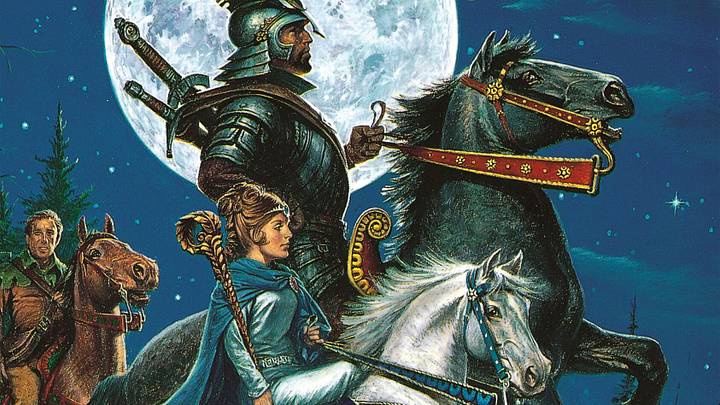
Not many fantasy series are as vast as The Wheel of Time, Robert Jordan's magnum opus. Featuring thousands of named characters and dozens who get viewpoint chapters, The Wheel of Time is one of the best examples of a long-running fantasy story told across multiple doorstopping tomes, which inspired an entire generation of up-and-coming authors.
Counting the prequel book New Spring, Jordan penned 12 novels in the series before his death in 2007. Afterward, a young upstart named Brandon Sanderson was tapped to complete the saga, on account of his love for the series and the strength of his own Mistborn novels. Sanderson wrote three novels to finish what Jordan started: The Gathering Storm (2009), The Towers of Midnight (2010), and A Memory of Light (2013).
Given his work on the books, it's no surprise that Sanderson spent quite a bit of time coordinating with Robert Jordan's team, including his widow and editor, Harriet McDougal. Sanderson has often spoken fondly of Team Jordan, and in recent interview with Collider's Maggie Lovitt at FanX, he reflected on a little-known anecdote that McDougal shared with him once about Robert Jordan's writing process, revealing just how deeply Jordan immersed himself in his work.

Brandon Sanderson on the mental challenges facing writers
The story in question came up as part of a wider discussion about the mental health of authors, after Lovitt brought up the difference between how fans treat the ever-prolific Sanderson, as opposed to his peers with long-overdue books like George R.R. Martin.
"It is really hard. It's been hard to watch," Sanderson said. "So, George and Pat Rothfuss are friends of mine, and I just have a natural psychology that lends itself well to slow and steady writing. I'm not really fast, I'm really steady. And that's not because of anything about me, it's just I was born with a psychology that is good at getting up every day and doing a little bit. A lot of my writer friends work more by powerful bursts of inspiration. And that sort of thing can be a lot harder to wrangle."
"Beyond that, you know, some of my writing friends...not to get into any details, but they've had some mental health challenges," Sanderson added. "And man, having some family members who deal with the same things, I can't imagine mixing that with the pressure of millions of people waiting to read the thing you have to produce when you're inspired, but then the mental health challenges make it hard and then the stress of everyone waiting makes it much harder. I just think remembering the person, as you pointed out, is a really great thing to keep in mind."
19 years ago today, we lost Robert Jordan. He left us Randland, and the Wheel that never stopped spinning stories, art, discussions, communities, friendships, relationships, cons and meetups. What a giant and what a legacy. May he always shelter in the palm of the Creator's… pic.twitter.com/42uuSCunpS
— WoT Series ❤️📖📺🤞 (@WotTVSeries) September 16, 2026
Robert Jordan deeply emodied his characters as he wrote
It's then that the conversation turned to Jordan. While Sanderson and Lovitt didn't discuss what The Wheel of Time author's daily habits were, and whether he was closer to a workhorse like Sanderson or a writer who courts the muse like Rothfuss and Martin, they did touch on one fascinating aspect of Jordan's psyche as a writer I've never heard about. Lovitt pointed out that in addition to the challenges Sanderson mentioned, there's also presumably a "mental toll" for writers that comes with having so many different characters living in their heads for their books.
Sanderson agreed that this is a whole other side to the mental health discussion of writers. "My favorite story along that is, Harriet, who is the wife of Robert Jordan...she was also his editor, and I finished that series, Wheel of Time," he said. "She told me once that she could tell which character he'd been writing by how he acted in the half hour after he got done writing. Because he'd so come to embody the character that he started to act like them and talk like them."
It's pretty entertaining to imagine Robert Jordan walking around his house spouting archaic, in-world swears like Mat Cauthon, quietly brooding like Rand or Perrin, or being extra prickly like Nynaeve al'Meara. It's a shame he didn't have a braid to tug for those days when he wrote the Wisdom.
The Wheel of Time is a fantastic series that stands the test of time, and a huge part of why that's the case is how thoroughly realized Jordan's world and the people living in it were. Hearing stories like this one feel extra special now that he's gone, because any additional insight into how Jordan went about his work is something we readers can't take for granted.
Last weekend marked Robert Jordan's birthday, October 17. He would have been 77 years old this year. It's as good a time as any to reflect on the author's life and his beloved fantasy story, The Wheel of Time.
 Add us as a preferred source on Google