

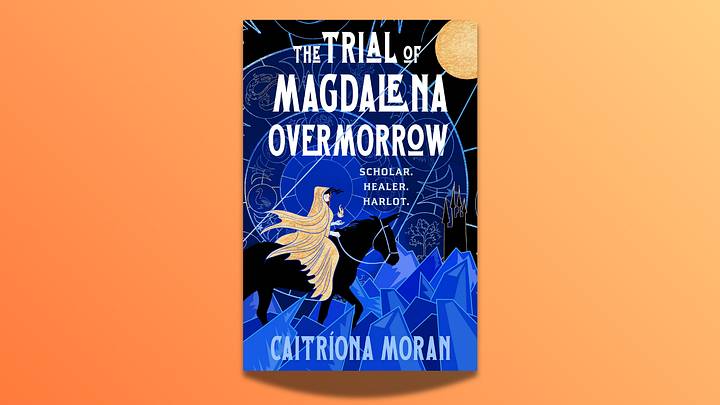
Caitríona Moran has made an extraordinary debut with The Trial of Magdalena Overmorrow, a novel that is as fearless in its convictions as it is beautiful in its execution.
It is a story about a woman who refuses to be ashamed of who she is, a society determined to punish her for it, and an achingly tender romance that develops against the most unlikely of circumstances.
With its wintry atmosphere and unforgettable characters, The Trial of Magdalena Overmorrow is a must-read this winter, and we need to talk about it.
Meet Magdalena Overmorrow, and try not to fall in love
The story follows Magdalena Overmorrow, known as Magda, a scholar, healer, and magician whose work helping women access abortions has made her a target of the religious authorities in Astoleyn. When a betrayal leads to her arrest, she is accused of heresy and black magic, offenses that carry the possibility of being burned at the stake.
Magda is then sent to Cair Gramora, the realm's northernmost stronghold, where she must spend the 11 months leading up to her trial under the supervision of its Lord Proctor. It is not quite the fate she would have chosen for herself, but Magda has never been particularly good at accepting the circumstances others decide she deserves.
I have to say, Magda is an absolute delight. One of my favorite things about her is that she knows what she believes in, she knows the work she does, and she has absolutely no intention of pretending otherwise to make other people more comfortable. She is also not a young heroine discovering her convictions for the first time but has already lived a life around them, and watching her hold on to that sense of self when almost everything else is taken away makes her such a wonderful character to follow.
There is something particularly refreshing about a heroine who is allowed to be so thoroughly comfortable in her own skin. Magda is intelligent, outspoken, occasionally rather impertinent, and wonderfully unwilling to let anyone dictate what sort of woman she ought to be. She is also compassionate, and the novel never loses sight of the women behind the work that has brought her to this predicament.
A very inconvenient attraction and the slowest of burns
Of course, Cair Gramora also introduces us to Morgan Mallander, the Lord Proctor himself. Magda expects an elderly, humorless religious official, only to discover that the man responsible for overseeing her confinement is considerably younger than anticipated.
He is handsome, reserved, deeply scholarly, and, at first, about as welcoming as the northern mountains surrounding his home.
But there is so much more to him than his initial severity suggests, and Moran does a wonderful job of gradually allowing us to see the person beneath the position he occupies. He is a man of faith, with responsibilities and loyalties that are not easily reconciled with what he increasingly comes to understand about Magda and the institution he serves.
What I think makes their relationship work so beautifully is the intellectual connection between them. These are two people who enjoy talking to one another, who can challenge each other and who gradually discover just how much they have in common.
And goodness, the slow burn. I absolutely adored it. Moran understands the value of restraint, and every little moment between these two feels intimate. Their conversations, the growing familiarity, the small gestures, and the things left unsaid all contribute to a romance that is wonderfully tender.
There is something incredibly lovely about watching two scholarly, rather stubborn people find someone who can keep up with them. Morgan and Magda were an absolute joy to read, and I would happily spend considerably more time in their company.
The Jula-Magda friendship is just as beautiful as the romance
I also have to talk about Jula, because I would be doing this book a disservice if I didn't. Magda's best friend, confidante and fiercely loyal advocate, Jula is one of the most wonderful parts of this story.
While Magda is in Cair Gramora, Jula is working tirelessly to secure her pardon and defend her against the charges brought against her. Their correspondence is particularly lovely, giving us glimpses of the life Magda has left behind and the friendship that continues to sustain her even when they are separated by so much distance.
I found their relationship incredibly moving. There is so much familiarity and affection between them that it tugs at your heart. Jula is determined to bring her friend home, and Magda's letters to her carry so much of the warmth and history they share.
Honestly, I might have been just as invested in their friendship as I was in the romance. It is a wonderful reminder that love stories need not always be romantic, and Jula is exactly the sort of friend everyone deserves to have in their corner.

A world with something important to say
Beyond its characters, Moran has created a wonderfully atmospheric setting in Astoleyn. Cair Gramora, with its northern landscape, distinctive customs and seasonal celebrations, gradually becomes much more than the place where Magda has been sent to await her fate. The festivals and rituals give the community a life of its own, and I particularly enjoyed watching Magda find her footing among people in the new place.
The novel also has a great deal to say about the relationship between religious authority and political power. The Doomsingers and the institutions surrounding them seek to determine what women can do with their bodies, what they can learn and how they should conduct their lives. Magda's trial becomes a much larger confrontation with a system that has decided it knows better than the women it claims to govern.
And then there is the ending. I am still not entirely over it. Without giving too much away, it is devastating and all the more affecting because of the care Moran has taken in building the story. The conclusion leaves plenty to look forward to in the next installment, but it also gives this first book a closure and emotional weight that I suspect will stay with us for a long time.
Verdict
I loved The Trial of Magdalena Overmorrow! From Magda's unapologetic defiance to Jula's unwavering friendship and the wonderfully tender slow burn between Magda and Morgan, there is so much in this book that worked for me.
This is a debut that feels remarkably assured in what it wants to say and how it wants to say it. It is funny, tender, infuriating, romantic, and, at times, absolutely heartbreaking. Most importantly, it is a story that advocates the importance of allowing women to make their own choices, even when the world around them insists otherwise.
Caitríona Moran, you have given us something truly special. I cannot wait to return to Astoleyn, and if I could, I'd already be counting down the days until the second book.
Rating: 5/5 stars
 Add us as a preferred source on Google