

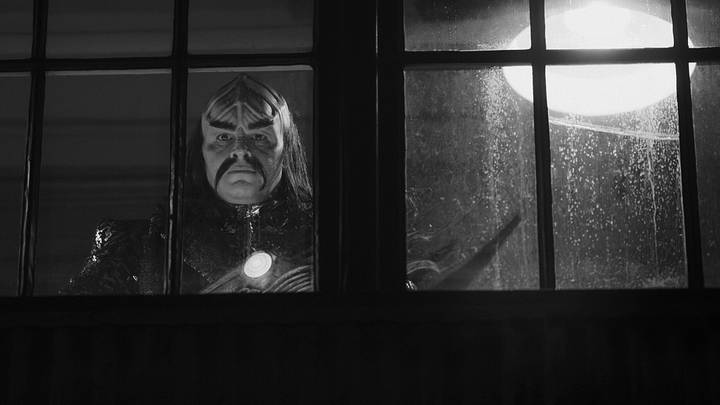
Star Trek: Strange New Worlds just brought back a Klingon character who debuted 59 years ago, but hasn't been seen on-screen since 1998. Those particularly knowledgeable about the franchise's sprawling timeline might have noticed that the villain's return presents something of a potential inconsistency when Klingon lore is specifically delved into. First played by John Colicos in The Original Series, Dahar Master Kor returned in The Animated Series, although he was voiced by franchise legend James Doohan (Scotty) when in 2D format.
Colicos would then go on to reprise the role in live-action to give Kor something of a heartfelt redemption arc that spread itself across three episodes of Deep Space Nine over four years. Due to behind-the-scenes reasons, he looked very different in DS9 compared to his previous appearances, and it took another Star Trek series entirely to eventually explain this inconsistency. Strange New Worlds has brought Kor back and thrown another Klingon spanner in the works, continuity-wise. Thankfully, the same explanation that solved the Klingon visual disparity that plagued the classic era can be applied once more for his Star Trek comeback.

Star Trek: Enterprise's Klingon forehead disparity explanation
The first thing to know about Star Trek's Klingon retcon is that it was immediately divisive among Trekkies, and remains a topic of some debate. While Klingons are commonly recognized for their distinctive ridged foreheads, they didn't actually look that way until 1979's Star Trek: The Motion Picture. Before then, they had smooth, human-like foreheads. Other than a behind-the-scenes budget increase to help make the Klingons look alien rather than problematic Asian stereotypes, Star Trek initially provided no canonical explanation for why one of the sci-fi saga's most iconic alien species looked so different in The Motion Picture and beyond.
Then, in 2005, a divisive Star Trek: Enterprise two-parter, "Affliction" and "Divergence," officially updated this part of the lore. Set at the earliest point in the Star Trek timeline, Enterprise decided it was responsible for clearing up the biggest Klingon mystery. In short, the Klingons had forehead ridges at the start of "Affliction," but by the end of "Divergence," there was an explanation for why the Klingons in The Original Series had smooth foreheads.
In short, the Klingons were experimenting by splicing the DNA from genetically augmented humans into their own genome, in an attempt to boost their strength and intelligence. It worked, for a time, but then the augmented human and regular Klingon DNA proved incompatible, and one of the earliest symptoms of a fatal illness the experiments caused was a smoothing out of the forehead. It was the human-ness coming through. The illness became airborne, and while a cure for the virus was developed, the only possible workaround was that the symptoms could be halted after that first stage. The loss of the ridges couldn't be biologically reversed.
The virus continued to spread throughout the Klingon race, but the cure that was developed meant the only lasting impact was a smooth forehead. The physical trait was then genetic, but it would eventually go on to be bred out over the next few generations, and that virus would also vanish in time. This explains why the Klingons in The Original Series were smooth-headed, and also allows for the canonical possibility that ridge-headed Klingons did also exist off-screen during that era — as Strange New Worlds has since proven. Kor is an odd case, though.

Why Enterprise's Klingon virus explanation allows Kor to have cranial ridges in Strange New Worlds
My knee-jerk reaction when seeing Kor (Demore Barnes) in "A Case of Chiaroscuro" was that he should have a smooth forehead. The episode, and all of Strange New Worlds, is set before The Original Series, which is when the character made his franchise debut all those years ago. Enterprise had since quietly established (albeit retroactively) that Kor had been affected by the forehead virus by the time of TOS, and that, by extension, he had undergone the elective surgery mentioned in Enterprise to have his cranial ridges restored by the time he returned in Deep Space Nine.
It's a physical trait that, after all, Klingons value. Problem solved, right? Maybe not. Strange New Worlds seems to alter Kor's timeline, or at least flesh it out. While it could once have been assumed that Kor had been born with a smooth forehead, or had at least been infected with the virus at some point before TOS, "A Case of Chiaroscuro" offers an alternative. Because this is the youngest we've ever seen Kor, it's probably more logical to assume he was born of parents who had their cranial ridge genes intact, and that we're seeing his forehead as it naturally exists in Strange New Worlds.
So, what Kor's ridged forehead in Strange New Worlds suggests is that he was born that way, was infected with the virus before we see him in The Original Series, and then he has his ridges surgically reconstructed by the time we see him again in Deep Space Nine. Otherwise, he would have a smooth forehead in Strange New Worlds, which would have been consistent with the time we saw him in The Original Series. That's the only way it really makes sense. The only other option is that Kor was born with a smooth forehead, had surgery before SNW, reversed that surgery for TOS, and then restored his ridges again before DS9. That just wouldn't happen.

The more likely explanation for Kor's updated appearance in Strange New Worlds
Setting "A Case of Chiaroscuro" in Klingon space immediately made me think we were going to get a familiar Klingon character involved. I turned out to be correct when Kor showed up. He's era-appropriate, so including him is a great piece of fan service that doesn't feel forced. While I was aware that he didn't look "right" for that time in his life, I also wasn't all that surprised. I'd have been more shocked if Strange New Worlds opted for his original appearance.
As I mentioned earlier, how Klingons were portrayed in The Original Series was very of its time. It wouldn't fly today, given that the Klingons were played by white actors but were in what could easily be described as yellowface. By modern standards, the character design choices could be considered racist, or at least racially insensitive.
Still, Kor is a well-written character who was perfect for the recent episode. If only there were an alternative Klingon design that could allow him to show up again in that era...Oh, wait. There is. Sure, it might cause debates, theorizing, and the analysis of the lore for it all to make sense, but that's better than the alternative. In a way, the decision almost retcons the Star Trek: Enterprise twist and invites fans to assume that Klingons always had ridges in-universe, regardless of how they looked on-screen in TOS — which I'm sure many Trekkies would rather do.
Star Trek: Strange New Worlds season 4 is streaming now on Paramount+.
 Add us as a preferred source on Google