

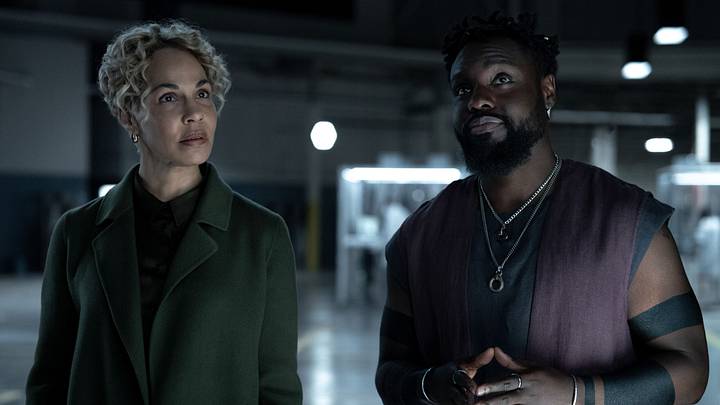
Apple TV's Dark Matter adapts Blake Crouch's 2016 novel of the same name, with season 2 continuing to follow Joel Edgerton's Jason Dessen through an oddly grounded multiverse. Season 1 already introduced realities that never existed in the source material, but they all felt very authentic to the original canon. While less "realistic" takes on the multiverse allow for some worlds that are wildly different from one another, Dark Matter refuses to let things get too untethered. For the most part, anyway.
There is one universe, which originated in the book and featured in season 1, that sets itself apart from the others. It's where Jason left Amanda (Alice Braga) and where Jason2 dumped Ryan (Jimmi Simpson). While it's never been given a canonical designation, as that isn't standard Dark Matter practice, I've always called it the Futuristic Chicago Universe. It offers some unique elements to the story at large. The thing is, the more I think about it, the less sense it makes in the context of the Blake Crouch epic. Let me explain.

Futuristic Chicago is significantly different from the rest of the Dark Matter multiverse
I think it's reasonable to assume that Chicago isn't unique in its utopian nature in this universe, but because Chicago is where the box lands in all realities, it's the only corner of that version of Earth we've seen so far. So, please forgive the Chicago-centric label. It's just the easiest way to refer to this universe. What isn't easy is believing that the box could travel here at all, and that the city would share so many similarities with its less enlightened counterparts.
Dark Matter's multiverse rules dictate that not all realities can be reached via the box. They need to be at least vaguely similar to each other, which explains why Jason and company haven't ended up in a world where everything is made of bananas, or something equally bizarre. There's nothing to suggest realities like that don't exist off-screen, but they're off-limits due to how the box works. So, even though Futuristic Chicago is still quite tame by those standards, it still sticks out for how drastically different it is.
In the other worlds, Chicago is largely unchanged from the city Jason left behind, with only relatively minor and/or recent changes to the timeline that have manifested things that are pretty easy to latch onto right away. Jason2's universe, for example, where he and Daniela (Jennifer Connelly) broke up. There are, of course, universes where widespread disasters have run rampant, but it's far from unrealistic to believe those worlds are very closely related to our own.
Futuristic Chicago, on the other hand, has a profoundly different society where positivity seems to spread like some sort of contagion. The people there aren't acting the way humans generally do, and it all feels unnatural and a little bit creepy. This was hard to pick up on in season 1, but the season 2 premiere makes it far more obvious. For this society to be so divergent from our own, something significant must have happened long before the era we're witnessing in Dark Matter. So, how has the box landed there? It doesn't quite seem to add up.

Futuristic Chicago has too many familiar characters
To repeat a point from above, Futuristic Chicago quite obviously exists in a timeline that diverged from ours long ago. It's still aligned with ours in terms of when it exists, meaning it's not actually in the future. It just feels like it is. Still, whatever version of events transpired to make this universe turn out the way it did should have altered the trajectory of who exists there. The butterfly effect would likely mean most couples who got together in other universes wouldn't even meet in this one. Even if they did, the chances of them having the exact same baby as in our world are slim at best. Even one generation of disruption in this respect would send things spiraling off in a different direction.
However, Futuristic Chicago has confirmed that native versions of characters like Jason, Amanda, and Ryan all exist or have existed there in some fashion, even though their lives are different. I know this is a common trope in things like Star Trek multiverse episodes, but in the context of Dark Matter's canon, which largely steers clear of realities with histories that are too different from our own, the presence of familiar doppelgängers feels like an oversight. Sure, it keeps the threat intact of a box pilot running into a version of themselves, but it still doesn't make all that much sense when carefully considered.

Problems aside, Dark Matter needs a world like the Futuristic Chicago Universe
Even though it sounds like I'm bashing Futuristic Chicago, I actually really like it. There's a lot that it offers to Dark Matter, and it's not so totally out there that it feels like it's from another show entirely. Furthermore, it's one of the few notably different universes that can be freely explored. The Giant Wasp Universe in season 1 was interesting, but not being able to leave the safety of the lab made it an incredibly restrictive setting.
The same can also be said about the apocalyptic universes that can no longer support human life, like the totally flooded reality from season 1. I understand the need to keep the various realities as similar as is reasonable in a sci-fi show like this one, but Futuristic Chicago is a breath of narrative fresh air thanks to its willingness to push Dark Matter's rules almost to the breaking point. The fact that author-turned-showrunner Blake Crouch has given the setting an expanded role in the TV show compared to the book means he's clearly also aware of Futuristic Chicago's untapped potential.
Dark Matter season 2 is streaming now on Apple TV.
 Add us as a preferred source on Google