

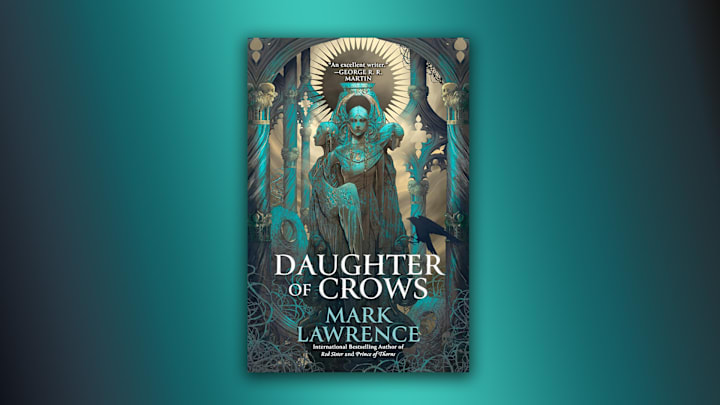
Following 2025's conclusion to The Library Trilogy, Mark Lawrence is back with the dark opening to a new fantasy book series — and Daughter of Crows is fueled by rage and grief, spinning a compelling tale from both. Told from multiple POVs and timelines, the novel opens with two primary narratives: one centered on 100 girls attending an academy for assassins, where only three will "graduate," and another following an older woman seeking vengeance on the heels of a village massacre.
The older woman, Rue, is clearly connected to the earlier timeline — a fact that becomes increasingly obvious as she returns from the dead, cuts through her enemies with relative ease, and uses necromancy against her opponents. However, Lawrence keeps us guessing about who we're following and how she got there, incentivizing readers to plow through his novel for answers.
The author also weaves in a third storyline part of the way through, which better connects all that's happening. This is easily the darkest of the three narratives, which is saying something. Lawrence's skill at penning grimdark fantasy is on full display here, and Daughter of Crows is at its best when it leans into its brutality. Its approach to everything from anger to aging is refreshing, though it would benefit from a clearer direction at times.
Daughter of Crows is at its best when it leans into its darkness
Daughter of Crows is not an easy read, as its story is heavily wrapped up in themes of abuse, trauma, and violence begetting more violence. It takes a hard look at the humanity that's so often scraped away in pursuit of survival, offering a deeply flawed cast of characters who you can't help but feel for — even knowing a few of them won't make it out of this story, and others may not deserve to.
The novel is at strongest when it leans into its darkest elements, whether it's the profound grief and rage that come from a life of hardship or the grotesque descriptions of necromancy scattered throughout its chapters. Lawrence doesn't pull his punches, and he doesn't go easy on his characters. It makes for a gutting read, yet Daughter of Crows is a book you won't be able to tear your eyes from.
And thanks to Lawrence's stunning prose, Daughter of Crows' exploration of its darkest topics lands incredibly well. The descriptions of violence and gore are enough to leave readers squirming. And the number of highlight-worthy lines conveys the depths of these characters impressively. Here's one example, though there are many quotes you'll have to take a moment to appreciate and digest: "I'm worried that this anger might be all I am, not just the sea I drowned in. I'm worried that even if none of this had ever happened to me, I would still be this rage and nothing else."
Daughter of Crows is ruthless, but there are bright spots throughout the novel. The bonds forged at the Academy of Kindness are compelling and provide a nice driving force throughout the story. The book offers a found-family of sorts, but it highlights love as a double-edged sword. It can save you from the darkness, but it can also be the reason you're thrust headfirst into it.

Rue's perspective is the most refreshing part of Mark Lawrence's book
Daughter of Crows' unflinching look at humanity is refreshing on its own, but Rue's perspective, in particular, makes this book stand out. While the Academy of Kindness narrative is the most gripping, it follows a setup most of us have seen before: young girls facing deadly trials, with only the best emerging alive.
By contrast, following an elderly woman in an action-heavy, revenge-fueled fantasy is far less common. It pushes back at the idea that women's stories are over after a certain age, and it proves that even characters past their prime can make kickass anti-heroes.
And aging is a prominent theme in Rue's story, with time acting as both a gift and a curse. As the book's lead seeks revenge, she laments at how age limits her. It makes her less physically capable, and this consistently surprises her. After all, our souls don't decline alongside our bodies.
Rue's reflections on aging feel relatable, even at half her age. And though I feared Lawrence's book would inadvertently push the idea of aging as some terrible fate, I'm happy to report that it doesn't. Its ending sends a powerful message to both Rue and the reader: to forgo aging is to sacrifice the wisdom that accompanies it.
Daughter of Crows is gripping but lacks direction at times
The trouble with any book that has three separate narratives is that, even when they're well-wrought and collide in a satisfying way, it's easy to prefer one over the others. That's certainly a risk here, as the three storylines driving Daughter of Crows are so incredibly different. And when the timeline of the Academy is at its most intense, Rue's journey is just getting off the ground. When the former begins to meander, the latter picks up. It makes for an awkward pace, arguably the book's biggest flaw.
And while the lore of Daughter of Crows' world is fascinating — who doesn't love political games driven by supernatural beings, with a dash of necromancy for good measure? — a lot is thrown at readers toward the end. The latter half of Daughter of Crows contains many reveals about the world and the main threat plaguing Rue. It sets up larger stakes for the sequel, but it shows us this overarching plot a little late. It adds to the book feeling structurally off, though it doesn't make it less enjoyable.
Final Verdict
Overall, Daughter of Crows is an action-packed, merciless read that will keep readers flipping the pages in spite of minor shortcomings. Lawrence's latest blends familiar tropes with unique elements, which sets it apart from 2026's other fantasy books (and indeed, many fantasy reads in general). There's a lot to love about this story, from its morally dubious characters to its unsettling lore.
The concepts that Daughter of Crows centers are the most memorable parts of the book. Its portrayals of rage, aging, and the aftermath of trauma are all masterfully done, leaving a strong impression. It's clear this story has something to say — a lot of things, actually. Lawrence does a great job conveying them, giving readers plenty to chew on.
And while it takes time for the larger plot to unravel, the ending of Daughter of Crows will leave readers wanting more. There are lingering questions and new schemes unveiled, which demand a follow-up to this story. With everything introduced at the end, one gets the sense that Lawrence's The Academy of Kindness series is about to get better from here. Book one lays a solid foundation, so that's a promising prospect.
More book content:
 Add us as a preferred source on Google