

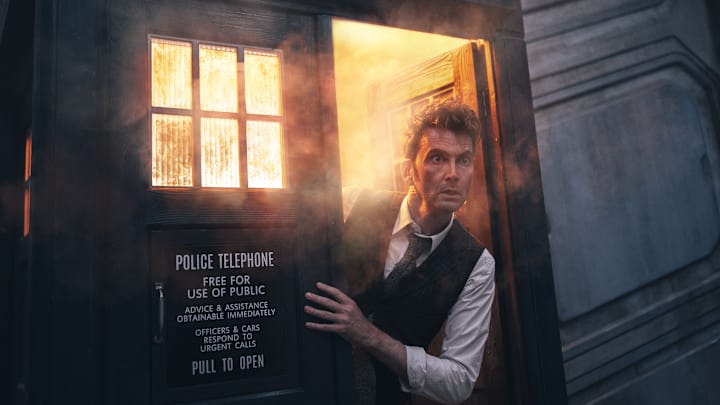
David Tennant's Tenth Doctor is essentially the exact same character as the Fourteenth, but of all the small ways Doctor Who changed him upon his 2023 comeback, one massive trait stands out for being the complete opposite of what it once was. Tennant is my favorite actor to lead the show in either of Russell T Davies' eras as showrunner, and is probably my favorite overall. So, I was ecstatic when Davies returned and also brought Tennant with him to star as the Fourteenth Doctor in all three of the episodes that celebrated Doctor Who's 60th anniversary.
It was incredibly cool to see a character who was functionally the Tenth Doctor, but acting with the additional memories and experiences of the three versions of the Time Lord he had been since. Still, Tennant played Fourteen identically when held up against Ten, adding a strong sense of well-earned nostalgia to proceedings. However, at probably his biggest moment in the anniversary trilogy, Fourteen acted in a way that caught me off guard, and it was incredibly out of character for Tennant's original version of the Doctor.

Fourteen's feelings about regeneration are the exact opposite of Ten's
The Tenth Doctor was unique in that he had a notable fear of regeneration, and even likened the process to dying. Speaking with Wilf (Bernard Cribbins) in "The End of Time," Ten boiled his views on regeneration down to a stark sentiment: "Everything I am dies. Some new man goes sauntering away, and I'm dead."
When the time comes for him to regenerate, it's clear that he wasn't just spouting empty rhetoric; he well and truly didn't wanna go. His transformation into Matt Smith's Eleventh Doctor was especially emotional and unusually explosive as he tried in vain to avoid regenerating.
When Tennant returned, his Doctor was unexpectedly resurrected, basically giving Ten what he wanted — a chance at a longer life. After immediately returning to the Doctor's signature heroics, it was made to seem like Fourteen was about to have an even more upsettingly short lifespan when the Toymaker (Neil Patrick Harris) fired a laser through his chest, triggering another regeneration sequence. Given the similarities between Ten and Fourteen, I expected an especially emotional sendoff.
So, imagine my surprise when Donna (Catherine Tate) steps forward to tell the Toymaker that the Doctor won't "die alone," and Fourteen corrects his companion by telling her that regeneration is "not dying." As well as not being teary-eyed this time around, the Doctor embraces the inevitability of what he's about to experience with: "It's time. Here we go again. Allons-y!" Compared to how Ten's time ended, Fourteen's reaction to what he thought would be the end of the line for him is the exact opposite of what I expected.

Why it makes sense that Doctor Who changed David Tennant's Doctor this way
Every version of the Doctor is functionally the same person, although each iteration also has a distinct personality, with each new brain interpreting the accumulated memories in different ways. Ten and Fourteen are far more similar than most, but it would be unreasonable to assume that the centuries of experiences the Doctor has accumulated between the two Tennant-faced Time Lords would result in zero changes by the time Fourteen came around.
Besides, with Ten returning as Fourteen, Ten now knows what it feels like to regenerate, but is in the unique position of coming back and perhaps realizing that it wasn't as bad as he thought it might be. If so, then his level-headed approach to going through the same thing doesn't stand out quite so much. If anything, it makes perfect sense.
Another theory is that maybe the Doctor knew, on some level, that he was about to bi-generate. Although it's revealed shortly after by Ncuti Gatwa's Fifteenth Doctor that bi-generation is supposed to be nothing more than a myth, there could be something deep down in Time Lord DNA that subconsciously alerted Fourteen to the fact that he wasn't about to meet his end. This is, admittedly, something of a reach. But I can't rule it out, either.

Fourteen's tranquil take on regeneration makes Ten's exit even more tragic
If Ten could have found a way to prevent himself from regenerating in "The End of Time," he definitely would have done. After all, he'd already done so once before with the use of his spare hand at the beginning of Doctor Who's season 4 finale. Instead, he was forced through the process against his will when his time came again, which is a big part of what makes the scene so upsetting. If he had been in Fourteen's position, then Ten's distress would have been immediately soothed when he realized he could stay intact while also spawning his successor.
Inversely, Fourteen's stoic acceptance of what he thinks is going to happen is a trait that Ten could have benefited from, rather than Tennant's original Doctor becoming so distraught at something beyond his control. So, Fourteen got what Ten wanted so desperately, and he got it with friends by his side, while Ten was left all alone to deal with the harsh truth of his situation. I'm not sure how much of this dark parallel was intentional when Doctor Who's 60th anniversary episodes were being written, but it's a depressingly poetic thing to think about.
Doctor Who returns with a Christmas Day special in 2026, and a new season will follow.
 Add us as a preferred source on Google