

Fans of Outlander are often drawn to a very specific blend of storytelling: sweeping romance, richly detailed historical settings, strong-willed heroines, dangerous political conflict, and a touch of the fantastical.
Outlander occupies a unique place in modern fiction because it refuses to fit neatly into one genre. Yet several other novels and series capture similar emotional and thematic qualities while offering their own distinctive worlds and perspectives. Readers who fall in love with Claire and Jamie Fraser usually want another immersive world that offers the same emotional intensity and rich storytelling.
Here are five books that evoke the same sense of wonder, romance, and emotional depth that make Outlander unforgettable. These are perfect to enjoy while waiting for Outlander: Blood of My Blood season 2 to premiere in the fall, and for news of the next installment of Diana Gabaldon’s series, A Blessing for a Warrior Going Out.
- 1. All Souls trilogy by Deborah Harkness
- 2. Circe by Madeline Miller
- 3. The Invisible Life of Addie LaRue by V. E. Schwab
- 4. Jane Eyre by Charlotte Brontë
- 5. Poldark series by Winston Graham
1. All Souls trilogy by Deborah Harkness

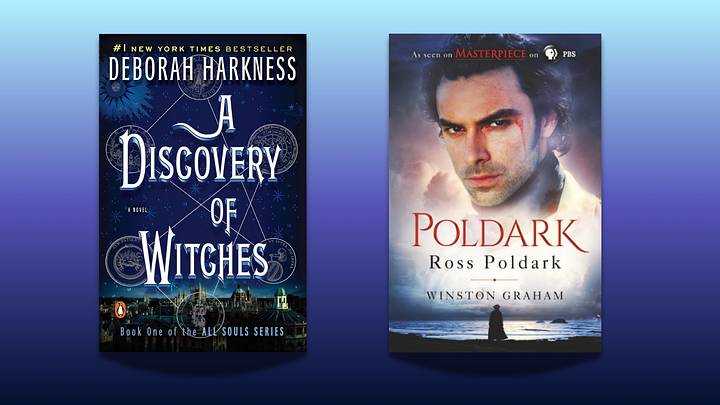
If you liked Diana Gabaldon’s Outlander, you’ll find much to love in the All Souls trilogy. A Discovery of Witches, the first installment, was published in 2011, followed by Shadow of Night (2012), and The Book of Life (2014). Written by historian and scholar Deborah Harkness, the trilogy perfectly balances fantasy and romance with historical realism.
The story follows Diana Bishop, a historian and reluctant witch who discovers an enchanted manuscript in Oxford’s Bodleian Library. Her discovery draws the attention of magical creatures, including the enigmatic vampire scientist Matthew Clairmont. As Diana and Matthew grow closer, they become entangled in ancient conflicts among witches, vampires, and daemons while uncovering secrets about Diana’s extraordinary powers.
One reason the trilogy resonates so strongly with Outlander fans is its combination of romance and historical immersion. Like Claire Fraser, Diana is intelligent, independent, and academically inclined. Both women are thrust into dangerous worlds that challenge their assumptions and force them to navigate unfamiliar social structures. Matthew, meanwhile, shares many qualities with Jamie Fraser: he is loyal, protective, and gentle as a husband, yet still capable of violence when circumstances demand it.
Diana Bishop and Matthew Clairmont share the same passionate, complicated chemistry that draws readers to Claire and Jamie Fraser. The trilogy also balances history, magic, politics, and family drama in a way that keeps readers emotionally invested from beginning to end.
Thematically, Harkness explores forbidden love, destiny, family legacy, and the tension between reason and magic. Diana’s struggle to accept her supernatural identity parallels Claire’s attempts to reconcile modern thinking with the realities of the past, as well as her supernatural abilities to travel through time. History itself becomes almost a living presence in both series. Harkness’s meticulous descriptions of European cities, alchemical traditions, and Elizabethan England (yes, there is time travel) mirror Gabaldon’s immersive historical detail.
However, the trilogy differs from Outlander in significant ways. Whereas Gabaldon’s novels are grounded primarily in historical fiction with speculative elements, Harkness leans fully into urban fantasy and paranormal lore. Vampires, witches, and magical politics play a central role throughout the narrative. The tone is also more scholarly and introspective, focusing heavily on intellectual discovery and supernatural mythology.
Still, readers who love Outlander for its passionate romance, historical settings, and emotionally layered characters will find much to admire in All Souls. And on the plus side, the trilogy was recently developed by Sky as the TV show A Discovery of Witches (3 seasons, 2018-2022).
2. Circe by Madeline Miller

Published in 2018, Circe by Madeline Miller reimagines the life of the famous witch from Greek mythology. The novel transforms a relatively minor figure from Homer’s Odyssey into a fully realized protagonist whose emotional journey spans centuries.
Circe, daughter of the sun god Helios, is initially dismissed and underestimated by the gods around her. After discovering her gift for witchcraft, she is exiled to the island of Aiaia, where she hones her powers and encounters legendary figures such as Odysseus, Daedalus, and Medea. Throughout the novel, Circe struggles to define herself outside the expectations of gods and men.
Like Outlander, Circe centers on a resilient woman navigating dangerous worlds dominated by power and violence. Claire Fraser and Circe are both healers in their own ways, and their intelligence and abilities make them both immensely valuable and threatening. They are both women who, despite everything that happens to them, continue to defy the societal norms they were born into, and decide to shape their own destiny.
Unlike Outlander, however, Circe is less focused on romantic partnership as the emotional core of the narrative. Although love and desire are important, the novel’s primary emphasis is Circe’s relationship with herself and her evolving sense of purpose. The prose is also more lyrical and meditative than Gabaldon’s often fast-paced, dialogue-driven storytelling.
Nevertheless, if you’re a fan of Outlander who appreciates strong heroines, emotional depth, historical atmosphere, and themes of female resilience, you will likely be captivated by Circe. Read it for its unforgettable heroine and her empowering character development.
3. The Invisible Life of Addie LaRue by V. E. Schwab

The Invisible Life of Addie LaRue was published in 2020 and quickly became one of the most celebrated fantasy novels of recent years.
Written by V. E. Schwab, the novel begins in 18th-century France, where Addie LaRue makes a desperate bargain with a dark supernatural entity to escape an unwanted marriage. The price of her freedom is devastating: everyone she meets immediately forgets her. Addie wanders through centuries of history, making her silent mark on the world while enduring profound loneliness… until, unexpectedly, a young man in a bookstore remembers her name.
The similarities to Outlander are immediately apparent in the historical settings, emotionally charged romance, and the fact that both novels span multiple time periods. Addie and Claire are intelligent women resisting restrictive social expectations, and both narratives emphasize endurance in the face of isolation and loss.
Schwab also explores themes of memory, legacy, and what it means to leave a mark on the world. Addie’s curse forces her to confront invisibility both in a literal and emotional sense. This resonates with Claire’s recurring tension between exercising her modern medical knowledge, and the historical society that doesn’t want her to.
Addie herself is characterized by resilience, curiosity, and quiet defiance. Though less pragmatic than Claire Fraser, she possesses a similar determination to shape her own fate despite overwhelming obstacles. The mysterious Luc, with whom Addie made her bargain, adds an element of dangerous attraction reminiscent of some of Outlander’s morally complex antagonists.
The major difference lies in tone and pacing. In Addie LaRue, historical happenings and political conflicts are merely the backdrop for Addie’s existential questions and emotional introspection. Yet its emotional intensity and fantastical aspect make it deeply appealing to fans of Outlander.
4. Jane Eyre by Charlotte Brontë

First published in 1847, Jane Eyre by Charlotte Brontë remains one of the foundational works of English literature. Though separated from Outlander by almost two centuries, the novel shares many qualities that continue to resonate with modern readers.
The story follows Jane Eyre, an orphaned young woman who becomes governess at Thornfield Hall, where she develops a deep connection with the brooding and mysterious Edward Rochester. As secrets about Rochester emerge, Jane must decide whether love can coexist with self-respect and moral integrity.
Fans of Outlander will recognize familiar elements immediately: a passionate romance, gothic atmosphere, and a fiercely independent heroine. Jane Eyre even contains a subtle supernatural element: Jane and Rochester’s bond, despite being at times problematic and tragic, is tightly woven by a mysterious power–typical of gothic novels–difficult to detect, but impossible to ignore.
Jane’s unwavering emotional and moral equality in her relationships feels very modern and close to Claire’s worldview. Both women are passionate, loyal, steadfast in their beliefs, and possess an inner strength that makes them remarkable. If you empathize with Claire, you almost certainly will love Jane, one of literature’s great heroines.
5. Poldark series by Winston Graham

Winston Graham’s Poldark series may be the closest match for readers who love Outlander’s historical realism and sweeping romance but don’t necessarily need the fantasy elements to enjoy a book.
The first installment of the Poldark series was published in 1945 by Winston Graham. Spanning 12 novels, the series follows Ross Poldark, a British Army officer who returns to Cornwall after the American Revolutionary War to rebuild his life amid social upheaval, a failing family business, and personal heartbreak.
Like Outlander, the Poldark novels combine romance, political conflict, historical realism, and family drama. Ross Poldark and Jamie Fraser share many characteristics while also being fairly distant as characters. They are both brave and stubborn, with a rebellious streak that often places them at odds with authority. Demelza, Ross’s wife, also resembles Claire in her intelligence, emotional strength, and refusal to conform completely to societal expectations.
The series explores themes of class division, justice, love, war, and economic inequality. Graham vividly portrays 18th-century Cornwall, creating a textured historical backdrop similar to Gabaldon’s recreation of Scotland and colonial America.
One of the strengths of Poldark is its morally complex characterization. Ross is heroic but deeply flawed, impulsive yet compassionate. Supporting characters are equally nuanced, contributing to the emotional realism of the series.
Unlike Outlander, however, Poldark contains no fantasy or time-travel elements: it is grounded entirely in historical realism. The romance is central but less all-consuming than Claire and Jamie’s legendary bond. Ross and Demelza’s relationship is a layered romance that evolves with time and matures alongside the characters and their ever-changing circumstances.
And if the books are not enough, Poldark also has two adaptations, both developed by BBC. The first started in 1975, while the more recent one premiered in 2015 and ended in 2019.
 Add us as a preferred source on Google