

Apple TV's ambitious approach to adapting Isaac Asimov's Foundation books has gone surprisingly well so far, and although several key changes have been made for artistic purposes, the saga's centuries-long timeline has somehow remained intact. When Foundation returns for its fourth season, the live-action version of Asimov's iconic space opera will faithfully acknowledge a vital choice made by the author over 70 years ago.
Originally published in 1953, Second Foundation concluded Asimov's original trilogy, although he would later flesh out his universe even further with various prequels and sequels. The in-universe events between the second and third books were notable for a pretty pedestrian reason, but their normalcy is what makes them so interesting. Asimov changed how he approached the story's timeline with Second Foundation, and the show's fourth batch of episodes will follow suit.

Foundation season 4's lack of a time jump mirrors Second Foundation
Because Foundation's central premise revolves around Hari Seldon's calculations predicting how the galaxy will change in the coming centuries, the story understandably requires some pretty big jumps forward. Without them, the timeline would be impossible to communicate to the audience. This isn't something that's original to the TV show. Asimov did it in his books, which is why Apple TV has adopted the same blueprint. So, fast-forwarding over a century at a time is pretty standard in both versions of Foundation.
That said, although every season of Foundation so far has been separated by lengthy time jumps, season 4 is changing course.
"I knew from the outset that we were going to break the pattern and not jump forward like 100 or 150 years, and that season 4 would be a direct continuation of season 3," Foundation creator David S. Goyer revealed when speaking with The Wrap.
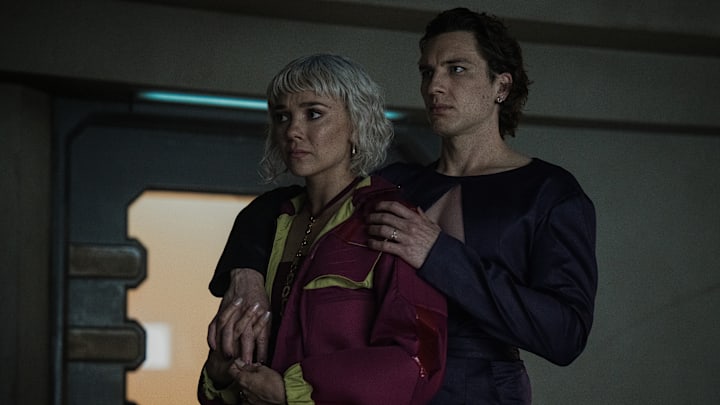
So, Foundation will welcome back the same core cast, playing the exact same characters. With both the books and the show often leaving many figures behind when the story shoots forward, this stage in the saga offers something more familiar.

Why the lack of a time jump makes sense for Foundation season 4 (& Second Foundation)
Even though Foundation's storyline taking place over such a long period of time is one of the biggest selling points, the fact that it features human characters adds something of a restriction to the creative decision. Humans don't live any longer than normal in the world of Foundation, so after each time jump, they're either dead or much older. The former is much more of a finite end to their arcs, but the latter can also present its own narrative challenges.
However, the Mule's introduction to the story brings its most notorious villain to the forefront, and the character is barely getting started by the end of book 2/season 3. If Asimov or the Foundation writers had opted to install another massive time jump after that, then much of the Mule's arc would be missed, or the villainous figure would simply have died of old age by the time the story resumed. It makes far more sense to pick back up immediately and carry on telling the Mule's story.

Apple TV's decision to honor Asimov's lack of time jump also hugely changes the source material
The reveal that Bayta was the Mule all along is a notable deviation from Asimov's Foundation books. In the source material, the Mule is Magnifico Giganticus, who had been pretending to be a victim of the Mule as the clown infiltrated the Foundation. In the show, Magnifico is a completely independent character, and actually is a victim of the Mule, while Bayta is revealed to be the true villain of the piece. This sets up Bayta to be a central figure in Foundation season 4, and it's not just her being revealed as the Mule that separates her from her literary counterpart.
Bayta Mallow, or Bayta Darell as Asimov named her, never returns after Foundation and Empire, which is book two. She lives the rest of her life in exile with her husband when the Mule strands them on an isolated world. The decision to make Bayta the Mule in the live-action adaptation not only changes her entire backstory but also means she'll continue to be a direct part of the saga for longer than she was ever originally intended. By extension, this also means more of Magnifico, who was never even a real person in the books. It's certainly a bold move, but considering how well other Foundation book changes have played out so far, I'm willing to give Apple TV the benefit of the doubt.
Foundation seasons 1-3 are streaming now on Apple TV. Season 4 is confirmed, and is generally expected to premiere in 2027.
 Add us as a preferred source on Google