

Most Game of Thrones fans agree that the once beloved series went downhill in its last few episodes. The six-episode-long season 8 is the butt of many jokes within the fandom. Sadly, the frustrating final season feels far too rushed, spending its first three episodes quickly sweeping the long-running White Walker invasion storyline under the rug, and using its last three to speed through the previously noble and heroic Daenerys Targaryen's descent into madness.
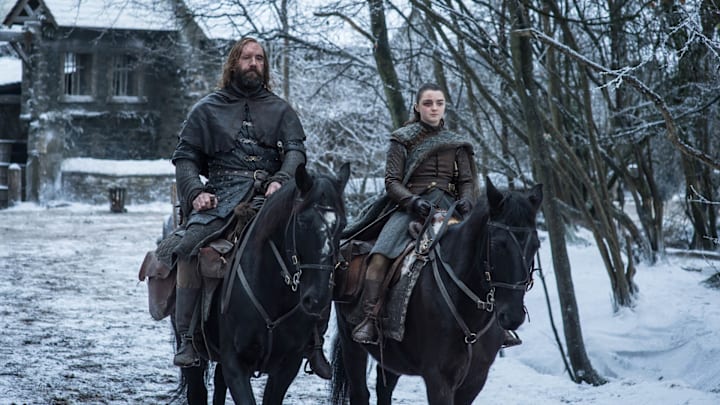
One of the most baffling, confusing, and flat out weird moments in the entire season occurs in the season's fifth episode, "The Bells." After Daenerys razes the city of King's Landing, drowning its residents in dragon fire and, in the process, killing several of the series' most iconic characters, such as Sandor "The Hound" Clegane and Jaime and Cersei Lannister, Arya walks through the carnage, eventually finding a lone white horse. She rides off on the horse, with the camera heavily emphasizing the animal, but the horse is never seen again.
Frustratingly, the symbolism of the horse remains unclear. Some fans believe it's the horse that belonged to Harry Strickland, the Captain of the Golden Company who was killed by Grey Worm earlier in the episode. Others think it represents the horse ridden by Death in the Christian Bible. However, the horse could also be a reference to a book that's even more relevant to the final season of Game of Thrones: A Dance with Dragons by George R.R. Martin.

Melisandre's prophecy of Arya on the horse
In A Dance with Dragons, the fifth and most recently published book in Martin's series, Jon Snow begins to worry about his sister, Arya Stark, after learning of Arya's marriage to Ramsay Snow, the vicious bastard of Bolton. Melisandre then reassures Jon that Arya is safe, saying that she has seen a "grey girl on a dying horse, riding to Castle Black" in a vision in her flames. She gathers that this girl is Arya. Ironically, this can't be Arya, since she is currently in Braavos, and Ramsay's marriage is actually to Jeyne Poole, Sansa's childhood best friend who has been passed off as Arya in order to solidify the Boltons' claim to the North. Still, this vision is a textual tie in the source material between Arya and a mystical horse.
However, Melisandre's prediction only partially comes true. Later on in the book, a grey girl arrives at Castle Black on a dying horse, but it's not Arya. Instead, the rider is Alys Karstark, who is escaping her arranged marriage to her cousin Cregan. While seeking refuge in Castle Black, Alys marries Sigorn, Magnar of the Thenns, marking an unprecedented marriage between a wildling and a northern noble.
It is worth noting that this entire plot line, including Melisandre's vision of Arya, Alys' arrival at Castle Black, and her wildling wedding, is entirely unique to the books. In fact, in the show, "Arya" never even marries Ramsay. Instead, Ramsay weds the real Sansa Stark, who later escapes Winterfell with the help of Theon and eventually does reach Jon at Castle Black. However, the show cuts the vision entirely, and when Sansa does find Jon, she is on horseback, but she's not alone, as Brienne of Tarth and Podrick Payne accompany her.

What does Melisandre's vision mean for Game of Thrones season 8?
If Arya's horse from "The Bells" is supposed to be a reference, even partially, to Melisandre's vision from A Dance with Dragons, what does that mean for the episode? Arya's season 8 horseback ride is an entirely separate situation than Melisandre's prophecy, with that vision taking place at Castle Black, a far cry from the episode's King's Landing setting.
Martin's work often discusses the role of prophecy. In A Dance with Dragons, he writes “Prophecy is like a half-trained mule. It looks as though it might be useful, but the moment you trust in it, it kicks you in the head.” Plenty of prophecies from A Song of Ice and Fire and Game of Thrones end up not coming true, being outright wrong, or including some ironic twist.
Melisandre's vision of Arya is among these many false prophecies in A Song of Ice and Fire. Although she assures Jon that she has seen Arya, it's someone else riding that horse. As such, connecting Arya and a horse on screen reminds book readers that some prophecies they've come to rely on can't be trusted.
One character heavily associated with prophecy throughout the series is Daenerys Targaryen. In both the show and books, Dany is both faced with and the subject of several predictions. In fact, many in-universe characters and out of universe fans believe that Dany is Azor Ahai reborn, the Prince (or in her case, Princess) That was Promised.

"The Bells" sees Daenerys make a controversial choice, as she burns King's Landing to the ground in her conquest. This act feels out of character for the mostly merciful Daenerys. However, some fans have made the argument that her fall had been foreshadowed subtly throughout the series, and this moment is the ironic realization of several Daenerys-centric prophecies.
If this is the case, then reminding book readers about Melisandre's inaccurate vision ties into the theme of how prophecies cannot be trusted. In mentioning another incorrect vision, the audience can reflect on how Daenerys' son being the "Stallion who Mounts the World" isn't necessarily something to celebrate. While this may just be a coincidental hand wave during the clunky ending to one of the weakest episodes of the series, it's nice to think that there may be more intention to this awkward moment than meets the eye.
For more from the world of Westeros, make sure to check out A Knight of the Seven Kingdoms when it airs on HBO Max on January 18.
 Add us as a preferred source on Google