

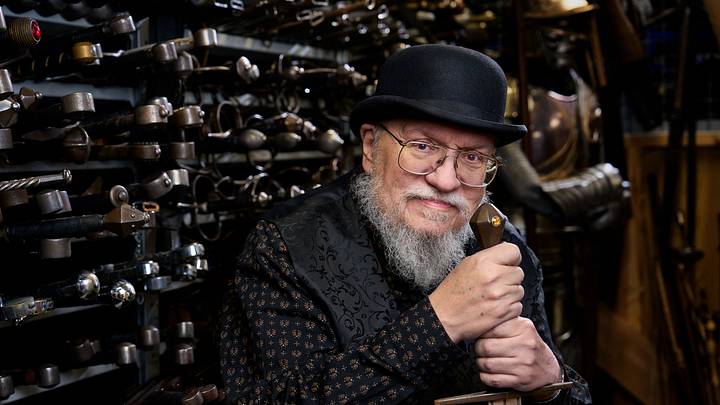
George R.R. Martin’s Game of Thrones: The Mad King premiered on August 8, 2026, at the Royal Shakespeare Theatre in William Shakespeare’s hometown of Stratford-upon-Avon, England.
The play, written by Duncan Macmillan and directed by Dominic Cooke, is a riveting adaptation of the story of the great tourney of Harrenhal held in 283 AC and the subsequent rebellion that led to the fall of the Targaryen dynasty. Author George R.R. Martin was “hugely involved” in the creation of the play, but also very “trusting” of the vision of his chosen collaborators Cooke and Macmillan, as revealed to us by the creators on the red carpet.
The result is a three-and-a-half-hour epic, one of immense scale and ambition, beyond that of any theatre production I’ve seen. Every aspect is orchestrated to perfection, with impeccable choreography well beyond fight and dance scenes. The show is incredibly immersive, which was one of Cooke’s non-negotiable aspirations: the main characters are often standing, sitting and speaking from the stands, amid the seats, making the audience feel as if they were real spectators of the tournament and the war. From a tech standpoint, the sounds and special effects conjure perfectly both the more complex dynamics of the war’s vivid reality and the oneiric visions that are at the core of the story.
Director Dominic Cooke explains his theatrical approach to @GRRMspeaking’s #GameofThrones: #TheMadKing.@TheRSC @GameOfThrones pic.twitter.com/aGX6MAFtDS
— Winter Is Coming (@WiCnet) August 9, 2026
The puppetry alone is deserving of a standing ovation: the audience does not need to go far to suspend their disbelief when seeing how riding is portrayed, with actors atop puppet horses, or how single combat is represented, with larger-than-life puppet knights being maneuvered by perfectly-in-sync members of the ensemble and the main actors themselves. This is especially effective in conveying the importance of these moments, particularly when we watch the final fight between Prince Rhaegar Targaryen (Noah Ritter) and Robert Baratheon (Callum Woodhouse) on the Trident.
The play builds on everything readers know from George R.R. Martin’s canon — using every single quote from the books from these characters — and builds on the story by delving deep into their psyches, exploring their drives and desires, investigating their conflicts, and navigating how those change throughout the two acts.

As with the best stories, the play is timeless and yet incredibly timely, speaking to and of our times: Rhaegar’s prophecy of extinction echoes our world’s climate emergency, and the mad king Aerys is not so different from some maniacal heads of state in our day and age. The play also winks at the audience through massive foreshadowing for events happening in the A Song of Ice and Fire books.
As revealed by Cooke during our interview on the red carpet, the play has long been in the works, as early as 2018 when Cooke and Martin began collaborating on the show’s conception. They approached Macmillan shortly after, with the Royal Shakespeare Company coming into the picture only a couple of years ago. That was all too apt, because the play takes some direct inspiration from the Bard himself. Just like Martin’s books, The Mad King is a cohesive twist of classic Shakesperean tropes: the right people being at the right place at the wrong time, the corruption that comes with seeking power, the danger of searching for truth in portents, to name a few.
As we watch the realm bleed and nearly all the main characters perish, the story asks itself whether the blame lies in their actions or in fate. There is a deep sense of responsibility to these characters, but we also watch them be helpless for long stretches of time. Rhaegar in particular is almost paralyzed by indecision, the inability to act, and it almost feels like the only real choice he makes is to crown Lyanna Stark at the end of act 1.
Lyanna (Harmony Rose-Bremner) is a much more active agent of change, and so are Princess Elia Martell (Elizabeth Ayodele) and Ashara Dayne (Tanisha Spring), who move armies and allegiances with the power afforded to them. This begs the question: was their tragedy predestined or was it brought about by self-determinism? What is wonderful is that the play does not attempt to answer this question, leaving it up to the audience to interpret. We asked Macmillan about how he went about this as he wrote the script, and his answer was: “Just like in the Scottish Play [Macbeth], prophecy is open to interpretation, sometimes it may be more destructive to follow than constructive. […] Was there magic or was it coincidence? […] Is this a delusion, is this a way of masking one’s ambition or is it genuinely from the gods?”
Playwright Duncan Macmillan talks about the first conversations he and director Dominic Cooke had with @GRRMspeaking on adapting #GameofThrones: #TheMadKing.@TheRSC @GameOfThrones pic.twitter.com/uZ8rYraznX
— Winter Is Coming (@WiCnet) August 9, 2026
Perhaps the most crucial sentiment permeating the play is grief, a state that readers know to associate with Rhaegar, but that plagues all characters, particularly and surprisingly Robert Baratheon, who cannot get over the death of his parents. The royal family bears the scars of Summerhall — King Aerys II (Michael Shaeffer) mentally, Queen Rhaella (Mariah Gale) physically, and Rhaegar spiritually — but grief belongs to all characters. Grief for dead family members, for missed opportunities and roads not taken, for the future. “We are citizens of the state of grief,” states Rhaegar at the beginning, a simple yet powerful line that Robert cannot help but echo at the end of the play.
Absorbing, compelling, engrossing as it is, the show does not feel long, and the three and a half hours fly by as you live through each character’s struggle. The play’s climax is not a battle, or the death of the titular mad king, nor of Prince Rhaegar’s; it is a scene between three women who, even when cornered, manage to claim back a tendril of power and write their own destiny. My favorite part of The Mad King may just be the agency it grants to Rhaella, Elia, and Ashara — something that does not necessarily go against ASOIAF canon, but simply sheds light on how the truth may be recounted. All three are afforded rage, love, and ambition, in the same way that willful Lyanna is.

There are countless essays I could write about each character and every astounding plot point in The Mad King — and perhaps I will — but nothing could come close to seeing it live, for the mastery of the actors and the brilliance of the directing and staging cannot be put into words. The entire cast and crew are owed infinite praise, and every fan of George R.R. Martin’s work deserves to see the show in person. While this run at the RSC in Stratford is set to end on September 5, the production will move to London eventually. We asked director Dominic Cooke at the premiere, and he confirmed they are looking to make the move happen, but nothing has been confirmed in terms of dates or locations. Word on the street is that the current actors have the right of first refusal, so this talented cast will stay the same unless the actors themselves wish to move on to other projects. Before the production expands to London and — maybe eventually internationally to Broadway — the play’s script will likely be released as a book, and hopefully a video recording as well.
The Mad King is a triumphant tragedy that perfectly captures the spirit of George R.R. Martin’s work and transposes it to a new medium — one where it is infinitely more complex to show realism, choosing instead to focus on symbolism and sheer human emotion. At its core, The Mad King is a story of the human heart in conflict with itself.
For more information about Game of Thrones: The Mad King, head over to the Royal Shakespeare Company's website.
 Add us as a preferred source on Google