

One of the most-watched classic horror films of all time is 1935’s The Bride of Frankenstein. A groundbreaking cinematic experience for its time, it blends gothic horror, dark humor, and emotionally resonant themes, and the appearance of Frankenstein’s bride in those few minutes on screen delivered one of cinema's most powerful moments.
That impression is why the film makes the cut on many horror fans' watchlists and why Maggie Gyllenhaal’s reinterpretation is a worthy addition. The Bride! (2026) is not only a great modern Halloween watch-list pick but also a creative examination of an iconic character whose few moments in classic cinema sparked interest in exploring feminine strength, her transition, her rebirth, a desire for love and acceptance, and a yearning to be unrestrained by the very boxes society often puts upon us based on gender.
The Bride! is a new experience built off a horror classic

What makes Gyllenhaal’s reinterpretation so striking is that it's not a remake; it's a brand-new experience with classic horror undertones, sewing together the fabric of classic monster mythology and dressing it in a modern social context.
But the film’s strength doesn’t come from breathing new life into a classic story, nor does it lie in its internal vitriol that paints such a masterpiece. It’s the emotional intelligence of understanding what it's like to be a lost woman and the painful, confusing, bittersweet liberation of finding her way back to herself.
What The Bride becomes isn’t just a symbol or a companion to a classic, nor is she the nostalgic image the 1930s gothic horror helped to create; she is a woman whose rage, desire, and independence drive her to form an identity that belongs uniquely to her, not someone else's or for someone else. It restructures and redefines what rebirth means for someone who has never truly belonged or been fully understood.
Such journeys aren't soft when you reach the final destination of internal transformation, and they often aren't kind. It’s violent, crushing, and at times mentally earth-shattering, a unique story that Frakenstein author Mary Shelley herself never fully realized in her career.
A ghost possessed by her own unfinished story
When we begin The Bride!, we see Shelley’s ghost and a woman possessed by her own unfinished story. This suggests that Frankenstein is only part of the story in this universe, and in many ways, she is right. For this story to be told, it has to be told from the point of view of someone at their breaking point, a woman who is on her last mental limb of survival.
Enter Ida, a 1930s Chicago gangster moll, serving as both the main character, a woman lost in a world more unforgiving under the guise of 1930s glitz and glam, and the vessel for Shelley’s repressed rage. Gyllenhaal’s creative portrayal of both minds in one body shows in Ida’s sudden shifts between British and Brooklyn dialects, her literary wit and sarcasm, and her refusal to submit. This shows that Shelley’s presence is deeply imbued in Ida, but to the men around her, her defiance represents madness, and in such a world, a woman who is "disobedient" or “obstinate” suffers the worst consequences imaginable, even death.
While Shelley’s personality gives her the power to speak the truth, that same unshakable existence causes her downfall. Shelley’s possession causes her death — but it also resurrects her both physically and from within. This becomes the first step in the story’s search for identity. A woman killed for defiance becomes the foundation of the subservient woman rebirthed.
A woman who refuses to be molded
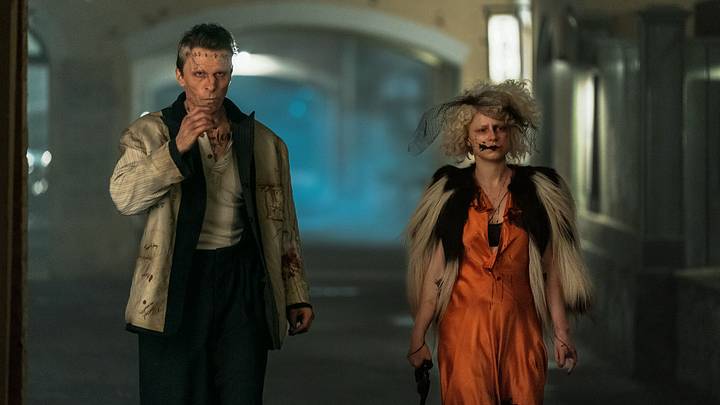
When Frank and Dr. Euphronious resurrect Ida, what emerges is not the woman she was, but a volatile, magnetic, electrifying presence, uncontained by the shell that once kept her from expressing herself freely. Her frizzy, bleached bob, black-stained tongue, and ink-splattered face marks change into a unique beauty. She is art and a monster, a woman whose body is not aesthetically defined by what society deems appropriate for a woman to look and behave as.
She is Ida, Shelley, and the Bride, and this battle for identity twists into unpredictable behavior and violence. She isn’t Frank’s companion; she isn't anyone’s idea of a romantic partner; she isn't someone who can be tamed. She has become someone reborn from every memory of injustice that was carved into her bones before she was murdered.
Violence as a story engine
Gyllenhaal’s creative decision to set her world in a time where women are murdered, mutilated, dismissed, and silenced serves as the perfect engine to project the film’s purpose forward. Where women are killed for sport in gang violence, a police officer can assault women without owning up to their behavior or actions, and women who voice their concerns are viewed as problematic and unnatural, this isn’t just a background for the story to breathe; it pulls the story forward and justifies Ida’s actions.
The Bride’s rage isn't metaphorical; in many ways, it's earned and reflects a deep, historical outrage women have endured for years. She is Shelley’s rage, her own rage, and every woman’s rage: the rage of being told your suffering is the natural order of things and isn’t important and that your resistance makes you a rebel. The Bride’s violence is not the product of monstrous behavior; it's correcting what has been wrong with society and its treatment of women and others that don’t fit society’s mold of what we “should be.”
Death in loneliness
While Frank isn’t the center of this story, he serves as an emotional counter to Ida’s actions. His tragic, tender, quiet suffering counteracts Ida’s loud, violent outcry of her own suffering. Older than 100, his priorities vastly differ from hers. His age has permitted him to see the world through old eyes, becoming jaded to the hatred he once had for his position in life and the physical lust and attraction that often come with relationships; he wants something deeper. He wants someone to love him, not revenge, and that loneliness is killing him from the inside.
Frank and Ida mirror each other, but in different ways: one shaped by abandonment, the other by violence. Try as he might to make Ida love him, their connection isn’t romantic; it's topical, two beings tied together by grief, longing, and the emotional weight of being made by someone else’s desires or purpose rather than born.
A genre-bending fever dream
Gyllenhaal’s film doesn’t try to commit to one genre to tell her story. It's a gothic horror, classic gangster film, surrealist comedy, romantic tragedy, and feminist journey all at once. In this way, she rejects putting her story in a single-genre box, suggesting life isn’t linear and that there are multiple ways to tell a story about one’s transformation.
Specialized, ultra-high-resolution motion picture cameras, adamantine color palettes, and Depression-era glamor create a world that feels both grounded and hallucinatory. This film lacks cohesion because cohesion is an exercise in societal control: the demand that women’s stories, or anyone’s story, be tidy, uniform, and digestible to an audience.
She embraces chaos as beautiful and normal, not something to contain or clean up just because it makes others uncomfortable. Her very presence embodies that. Her existence rattles the world around her and, at times, changes it. Women start to embody her wild, tattooed style because they're tired of being contained and want the freedom to express themselves. She is not just a symbol of power; she is power in its rawest form: messy, violent, contradictory, and unrestrained. She defies what society calls difficult. What society tries to kill, she resurrects; in essence, she is the freedom that refuses to die.
Why The Bride! matters
The Bride! is an important piece of horror cinema because it uses classic monster mythology to trace a woman's journey as she dares to go against the grain and refuses to be contained by traditional expectations of what a woman should be.
It's chaotic because women aren't just one layer; they are many. It is angry because, for women, that anger is justified when women are silenced or controlled by roles built to undermine or under-qualify a woman’s worth, intellect, or depth. It’s surreal because the reality for women has always been exactly that: a sector of existence where violence has always been normalized, autonomy is tentative, and the desire to do and be more than what you are is dangerous.
The Bride! is meant to be vocal, a reclamation of a story that was never finished and that every woman who has been in Ida’s shoes continues to tell. In its inconclusiveness, it has no mold to be controlled by. It’s more than an outcry for wanting better for women; it's a horror piece that shows classic monster concepts can do more than scare. Horror can drive change, and sometimes even reengage people in conversations that old conventions have buried.
While the film received mixed-to-negative reviews when it was released in February, The Bride! deserves a serious reevaluation in time for Halloween. Stream it on HBO Max.
 Add us as a preferred source on Google