

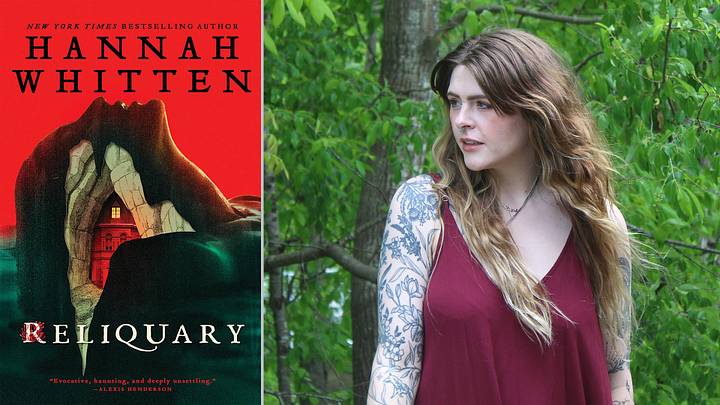
After wowing readers with her dark, atmospheric fantasy over the years, author Hannah Whitten is officially trying her hand at horror. Her newest book, Reliquary, is now on shelves. The oceanic horror tackles timeless topics like trauma and greed, all while taking readers to a gothic manor on a private island—one with sinister things stirring beneath the surface.
Reliquary takes us there following the sudden and mysterious death of its main character's fiancé. After losing Elias, Claire feels completely alone in the world. She jumps at the opportunity to meet his estranged family and grieve together, but the Ashburys have something else in mind. It doesn't bode well for Claire. That's not surprising, given that her bond with Elias wasn't necessarily in her best interests either. Unfortunately, her trauma and loneliness cause her to overlook obvious red flags.
It leads to a haunting journey throughout Reliquary, which forces Claire to grow if she wants to survive. It's a gripping ride, full of body horror, claustrophobia, and dread. Whitten delivers on the tensions throughout, giving horror lovers a perfect summer read.
Winter Is Coming got the opportunity to ask the author a few questions about her new 2026 book. She explained what inspired her to delve into horror, discussed some of the challenges and highlights of shifting gears, and teased what's coming down the pike. (And this f
AMANDA MULLEN FOR WINTER IS COMING: Your background is in fantasy, and Reliquary is your first horror novel. What made you want to break into the category now, and what inspired this particular story? Did you draw from any of your own favorites in the genre while writing it?
HANNAH WHITTEN: I've always known that I wanted to give horror writing a shot, since it’s my favorite genre to read! When I was waiting on notes for For The Throne, my sophomore novel, I was firmly in the sophomore slump and having a lot of anxiety about my range as a writer. I knew I wanted to play in a wide span of genres and voices but wasn’t confident enough to believe that I could.
I try to watch lots of movies when I’m on a writing break, and one of the ones I picked out for this particular break was Ready or Not. Watching that film really kicked my story brain in the pants, and the idea for Reliquary seemed to spring up fully formed, which wasn’t something I was used to. I started writing it mostly as a personal challenge, just to see if I could, and didn’t tell anyone I was working on it until the first draft was finished. Then I sent it to my agent like, “heyyyyy…”
As for “why now,” mostly it’s just because I had the entire thing written when it came time to pitch my next book and desperately needed a year to take a break from drafting. But really, it couldn’t have come at a better time. Horror is really having a moment, and I’m thrilled that the timing worked out so perfectly that I get to dip my toe in the genre at a point where readers seem to be hungry for it.
WIC: This is a horror story with deeper lore and a very atmospheric setting in Harrow Point. Did your fantasy roots help you piece together those aspects of it? What was your process like?
HW: Cutting my teeth on fantasy absolutely helped! I’m a very top-down kind of writer, so I know what I want to happen aesthetically and emotionally before I really know the scaffolding that will hold those elements up. So the lore came with edits and rewriting, making sure I had the rules solid enough to keep all the gore and the tension necessary and satisfying. While the end products are very different, my processes for writing fantasy and horror are pretty similar. The first draft is lots of set pieces and atmosphere building, and the bones that fix it all in place come with revision.
WIC: There is a strong “eat the rich” element to this book, and in some ways, greed is the villain. Can you talk a little about that theme and why you felt the sea was a good representation of it?
HW: The only thing greedier than the sea is a billionaire. I think we’re all at a flash point where we’re realizing that no one needs that much money, hoarding it is actively harming every aspect of our planet and society, and that the normal citizen cannot bootstrap hard enough to ever get a piece of that pie. And the sea is a great illustration of that, especially environmentally. We’ve known that sea levels were rising for decades. We’ve known that the coral reef is dying. The sea is the canary in the coal mine of climate change, and greed is the reason why nothing has been done.
I thought a lot about orcas attacking yachts as I was going through the piecemeal, years-long process of editing Reliquary. I thought about how the sea itself is a fickle ally and how trying to harness that power might turn back on you. Because at the end of the day, it’s hungry, and it might eat anything. Just like greed.
WIC: It’s so easy to get frustrated with horror leads for missing all the red flags, but this does a really great job of tying that to Claire’s trauma. What are you hoping people learn from her emotional journey in Reliquary?
HW: I knew that Claire was gonna be a tough nut to crack and that she would drive some readers bonkers. She is decidedly not final girl material. But I was uninterested in writing about someone cool and self-possessed who could immediately clock what was happening and fight her way out.
Claire carries a lot of trauma, but the one that I think has the biggest impact on her story in the book is the emotionally abusive relationship she has with Elias. The insidious thing about emotional abuse is that it’s hard to define, especially for someone in that dynamic, and it can be difficult to have sympathy when you’re watching from the outside. It’s so clear to the reader that Claire needs to get the hell out, but to Claire, it’s been normalized. All of her relationships up to this point have been a mix of distance and love-bombing, so her nervous system is used to that, and it’s a dynamic she continually seeks out because it feels like home. She’s come to the conclusion that in order to be loved, she has to get over her own discomfort and that her intuition is something to be ignored.
Overall, I hope that the main message to readers in Reliquary is that it’s never too late to start over and that the sunk-cost fallacy is a lie. But I also hope that it might give some insight into why people stay in terrible relationships. I think everyone has a friend or acquaintance that they’ve watched drown in a bad relationship because it’s lasted so long and been annoyed with them for not changing anything. And while the annoyance is valid, I hope maybe this story can illustrate why it’s important to be there for them and have sympathy when they finally come up for air.
WIC: None of the characters in Reliquary are exactly likeable, not even Claire. Yet they often have sympathetic moments or qualities. That’s immediately evident when Claire first reflects on her life with Elias, and it continues when she meets his other family members. How do you approach that balancing act? Did you have a favorite character to write?
HW: I try not to worry about characters being likeable when I’m writing, because trying to write someone universally beloved is a good way to write really boring characters, hah. My personal rule of thumb is that you don’t have to agree with the decisions a character makes, but you do need to understand why they made them.
So while I’m not necessarily trying to make anyone sympathetic, I’m trying to make them understandable. I want the reader to be able to track how they got from point A to point B, and to follow along with the thought process that got them there. It’s very rare to meet someone that is entirely good or entirely evil, because humans are complicated creatures. But people do make the decision whether they are going to listen to their good or bad impulses, and the process of that decision is an integral part of an interesting narrative.
WIC: There are quite a few different types of horror in this book – body horror, claustrophobic horror, and religious horror. What was your favorite to dig into and why?
HW: The body horror was the most fun! Probably because that’s what scares me the most. The idea of being transformed into something monstrous really gets to me. There have been moments of body horror in all my books, so it was fun to get to go full throttle on it this time around.
WIC: Were there any parts of this book that were challenging for you? Why, and how did you overcome that?
HW: I knew what I wanted to do with Claire’s character, but getting her to a place I was happy with took a lot of revision. She’s the truest representation of anxiety I’ve ever written, and I put a lot of my own coping mechanisms on her, which isn’t something I’ve attempted before. Some of it was difficult to put into words, but I’m glad I kept at it and stayed true to the vision for the character, even though it was hard to get there.
WIC: I know you have a standalone romantasy novel and a romantic fantasy duology on the horizon. Is there anything you’d like to tease about your future projects, and could we see more horror or horror-fantasy mash-ups in the future?
HW: I’ve got a ton on the docket! In 2027, I’ll have the first in the duology coming out, which is a dark contemporary fantasy about scary faeries with a smidgen of romance. This is the story I’ve been trying to write since I was a teenager, so I’m really excited that it’s going to be a real book! The second book comes in 2028, and then the standalone romantasy in 2029. It’s called Hawkheart and it’s the first book of mine that I think is a true romantasy. The characters are in their thirties, and the MMC is a single dad. There are so many things I’m thrilled to finally get to write about in that book, including Parent Feelings and infertility and still being cool and sexy when you’re no longer in your twenties, hah.
And I’ll also have another horror coming out in 2028! I won’t spill the title since it technically hasn’t been announced yet, but it’s my take on a haunted house. I’m drafting it right now and having an EXCELLENT time.
 Add us as a preferred source on Google