

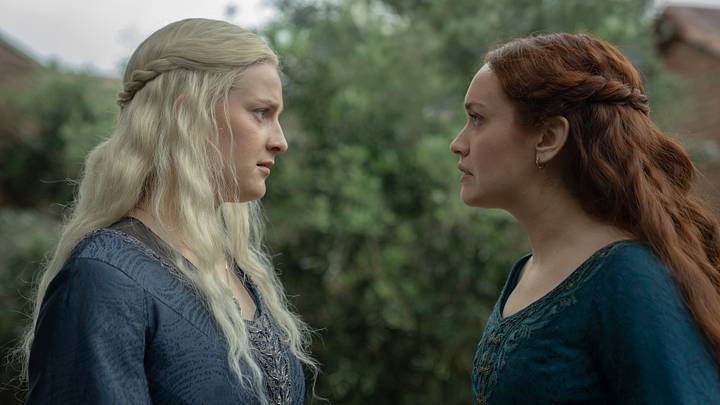
If there is one thing Game of Thrones book fans have come to expect, it’s that House of the Dragon is going to take creative liberties with the source material. While the show has done a solid job of adapting certain moments from Fire & Blood, there is an ever-growing list of changes the show has made to the source material that has turned heads and left them wondering what the writers were thinking.
Season 3 has been full of these moments, with the show’s third season taking some of the biggest creative liberties we’ve seen in the franchise. From cutting Nettles from the show and giving her story arc to Rhaena to creating a major dragon fight that never occurred in the books, season 3 has been keeping book readers on their toes by making several changes, and it sounds like another could be coming in the season finale.
Warning: Fire & Blood spoilers and potential House of the Dragon season 3 finale spoilers ahead!
Trigger warning: This article mentions suicide.

House of the Dragon is likely going to change the motive for Helaena’s death
As Fire & Blood readers know, in the book, Helaena throws herself from a window, resulting in her death after she learns that her youngest son, Maelor, has been killed. The book makes it clear that grief fuels her actions, with Helaena taking her life after learning of the events in which her son was literally torn apart by a mob of people. It’s a heartbreaking end to a beloved character, and grief plays a pivotal role in the moment, but it seems the show could be setting the stage for a very different motivation behind her final, tragic choice.
Unlike in the book, Maelor has not yet been born by the time Rhaenyra takes King’s Landing and takes Helaena captive. As such, he and his sister Jaehaera are never smuggled out of the city by Alicent, and Rhaenyra never offers a reward for Maelor’s return, which is what prompts his death and leads to Helaena’s death.
Maelor’s exclusion from the show and the creative changes taken with Helaena’s storyline have long been major pain points for George R.R. Martin. He was strongly against certain changes made to Helaena’s storyline and even alluded to the show making a major change to Helaena’s motivations in taking her life in a since-deleted blog post.
"In Ryan [Condal]’s outline for season 3, Helaena still kills herself… for no particular reason," Martin lamented at the time. "There is no fresh horror, no triggering event to overwhelm the fragile young queen."
As Martin’s comments were made ahead of production on season 3, it was unclear if the plans for Helaena would come to fruition or if the show would find a way to introduce Maelor. Now that season 3 is nearly complete, it seems that Martin’s warning has come to fruition and change is coming to Helaena’s storyline.
It’s clear that the show has been building to her death all season, and we fully expect it to come in the season 3 finale; however, the motives behind her suicide are likely to shift, and director Nina Lopez-Corrado may have just revealed the updated motives behind her death.
“Helaena has such a strong feeling about the dragons in which she’s torn because she thinks that they do change people and that they’ve changed their whole world, essentially,” Lopez-Corrado explained in an interview with Entertainment Weekly. “So when she sees herself on the dragon and sees Dreamfyre basically take out all of King’s Landing, internally for her it burns deep.... I think she knows that deep down inside, because she is a Targaryen, there almost is no positive outcome to anything that’s happening in regards to this war in this family. And the dragons, as long as they exist, are going to keep this inner turmoil inside of the Targaryens.”
These remarks seem to suggest that the show has a plan to reframe Helaena’s tragic fate by suggesting her actions may stem from something deeper than grief caused by the death of her son. Her vision of Dreamfyre killing innocent men and women at her order reinforces this belief that dragons change their riders for the worst and ensure the cycle of violence never ends. In this light, her death begins to read less as an act of sorrow and more as an attempt to escape or prevent a future she believes is both inevitable and catastrophic.
While there is a chance that Helaena’s death could still be motivated in part by grief, as there is a chance Maelor could be stillborn, it’s looking likely that Helaena’s motivations might shift to be grief-driven toward a more haunting sense of foresight, positioning her final act as one driven by fear of what’s to come rather than simply the pain of what she has lost.
If you or someone you know are experiencing suicidal thoughts, call the Suicide and Crisis Lifeline 24 hours a day, 7 days a week at 988.
 Add us as a preferred source on Google