

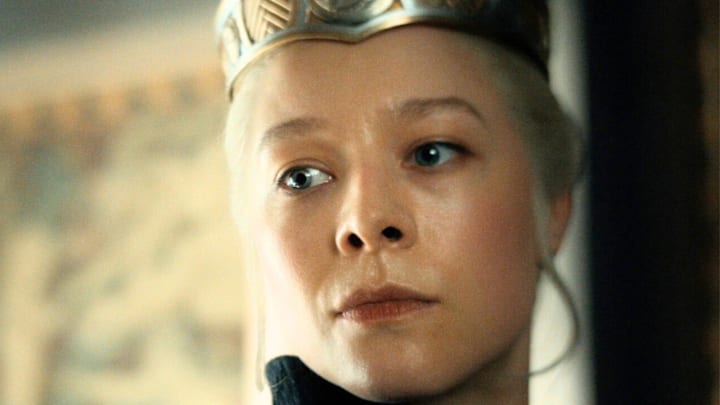
There are few moments in the history of Westeros more inevitable or more politically devastating than the Fall of King’s Landing during the Dance of the Dragons.
It is not simply a military victory for Rhaenyra Targaryen and the Blacks, nor is it merely a defeat for Aegon II Targaryen and the Greens. It is the moment where the illusion of Targaryen permanence begins to fracture beyond repair. Dragons still soar overhead, but after King’s Landing falls, the war ceases to resemble a struggle for succession and instead becomes something far uglier: the slow-motion collapse of a dynasty consuming itself.
What makes the Fall of King's Landing interesting is how House of the Dragon season 3 is positioned to adapt it. The series has already shown a preference for emotional intimacy over spectacle for spectacle’s sake. Battles matter, certainly, but the show’s real interest lies in the psychological erosion of its characters. And the Fall of King’s Landing offers the perfect convergence of those themes, where a capital city is caught between competing visions of legitimacy.
The Fall of King’s Landing, explained

In the source material, the fall itself is almost deceptively straightforward. With Criston Cole, Aemond (and, in the show, Aegon) departing from King’s Landing, this opens up a huge opportunity for the Blacks. Daemon and Rhaenyra fly over on their dragons with the intent of taking back the city, and, with the help of the Gold Cloaks (who are still loyal to the former Commander of the City Watch, Daemon), they are successful.
"Meanwhile, Prince Daemon Targaryen himself hastened south on the wings of his dragon, Caraxes. Flying above the western shore of the Gods Eye, well away from Ser Criston’s line of march, he evaded the enemy host, crossed the Blackwater, then turned east, following the river downstream to King’s Landing.Fire and Blood
And on Dragonstone, Rhaenyra Targaryen donned a suit of gleaming black scale, mounted Syrax, and took flight as a rainstorm lashed the waters of Blackwater Bay. High above the city the queen and her prince consort came together, circling over Aegon’s High Hill."
Following mounting instability within the city and the military weakening of the Greens, Rhaenyra finally claims the Iron Throne she believes was stolen from her. Yet even in victory, there is no catharsis.
The city she inherits is starving, terrified, and exhausted by factional conflict. The people do not greet her as a liberator so much as another ruler arriving beneath dragonfire. This matters because the tragedy of Rhaenyra’s reign is not that she fails to take power, but that power itself has already become poisoned by the time she grasps it.
The show has been carefully building toward this transformation since its beginning. Early portrayals of a younger Rhaenyra framed her as rebellious, emotionally intelligent, and trapped within patriarchal expectation. Even when she acted recklessly, there remained an underlying sympathy to her characterization.
It’s also worth nothing that at the end of House of the Dragon season 2, Alicent Hightower agrees to open the gates to King’s Landing to allow Rhaenyra take the Iron Throne back. This means the show will most likely depict the Fall of King’s Landing a bit differently, at least how the Blacks manage to invade.
The impact of this event

But war changes people in Westeros, and perhaps no character embodies that better than Rhaenyra herself. By the time King’s Landing falls, she is no longer merely fighting for recognition or inheritance. She is grieving children, navigating betrayals, and carrying the psychological burden of believing herself chosen by destiny while watching that destiny destroy everyone around her.
That complexity is likely where the adaptation will focus its attention. The image many viewers may expect is one of glorious conquest with dragons descending upon the capital and the long-awaited ascension of the “rightful queen.”
But House of the Dragon rarely frames victory cleanly. If anything, the series consistently undermines the romanticism associated with Targaryen exceptionalism. Every dragon-backed triumph leaves scorched civilians beneath it, and every assertion of destiny produces collateral damage measured in human suffering.
King’s Landing itself will almost certainly become a character during this arc. The city has always occupied a strange place within George R.R. Martin’s world, simultaneously the center of political power and a monument to decay. By the time Rhaenyra enters the capital, it is already unraveling under fear, propaganda, and scarcity. Food shortages, unrest, and mistrust create an atmosphere where victory feels hollow before the crown even changes hands.
If the adaptation leans into that societal collapse, the Fall of King’s Landing may resemble less a coronation and more a funeral procession for the stability Westeros once pretended to possess.
What House of the Dragon has the opportunity to do

There is also the unavoidable shadow of Game of Thrones looming over the entire sequence. Audiences already associate the destruction of King’s Landing with Daenerys Targaryen and the catastrophic final turn of her story. That parallel is not accidental.
House of the Dragon exists, in many ways, as a generational echo of that same warning: the Targaryens’ greatest strength has always contained the seeds of their ruin. Dragons grant power quickly, but they also accelerate moral decay. When rulers begin to see themselves as chosen beings above consequence, devastation inevitably follows.
However, the crucial difference is that the Fall of King’s Landing during the Dance is less about sudden madness and more about accumulated mistakes. Rhaenyra’s descent is gradual, shaped by loss, isolation, and political desperation.
That nuance is where the series has an opportunity to succeed where its predecessor stumbled. If handled carefully, her occupation of the capital could become one of the franchise’s most tragic arcs precisely because viewers understand her pain even as they viscerally recoil from what she becomes.
And then there is the deeper irony underpinning the entire event, that despite all the bloodshed, neither side truly wins. The Greens lose the city, but the Blacks inherit ashes. The throne remains physically intact, yet spiritually diminished.
Trust in House Targaryen erodes beyond repair, and the dragons themselves inch closer toward extinction. The Fall of King’s Landing is not merely a turning point in the war. It is the moment the dynasty’s decline becomes irreversible.
That is what makes the event so compelling, and why House of the Dragon is positioned to portray it with the tragedy it deserves. Beneath the spectacle of dragons and sieges lies a story about inherited power destroying the very people who believe they are destined to wield it.
King’s Landing will fall, the Iron Throne will change hands, and if done well, this event could truly leave a mark on us hardcore fans and more casual viewers alike.
House of the Dragon season 3 premieres on June 21 on HBO and HBO Max.
 Add us as a preferred source on Google