

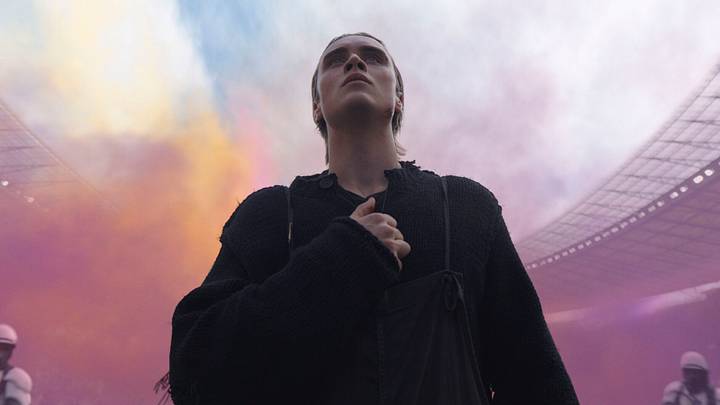
The latest installment of the Hunger Games franchise comes out on Friday, Nov. 20, and there are some things that I hope the movie will not gloss over. Sunrise on the Reaping is the adaptation of Suzanne Collins’ novel of the same title, telling the story of Haymitch Abernathy (Joseph Zada), the future mentor to Katniss Everdeen and Peeta Mellark, who won the 50th Hunger Games.
Although some of these moments may seem small or insignificant compared to the violence and action of the Hunger Games, they are essential to the emotional depth of the story. Including them would also help the film remain faithful to the emotional significance of Collins' novel, as well as enrich the story portrayed on screen. Let’s discuss them.
Spoilers from the Hunger Games: Sunrise on the Reaping book are ahead.
- Maysilee weaving tokens for other tributes
- The Heavensbee library
- Lou Lou clutching Haymitch’s hand while sleeping
- Silka eating the chocolate
- The Covey graveyard
- Katniss getting Haymitch goose eggs to hatch

Maysilee weaving tokens for other tributes
Maysilee Donner (McKenna Grace) is one of the most complex characters in the Hunger Games saga, and I sincerely don’t think this movie will betray her. But if there is one scene I hope they don’t cut or rework, it’s from chapter 8:
“… kids bring her their district trinkets and ask her to make them special, and she agrees. [...] Whatever they present her with, Maysilee gives dignity to their tokens, and even though she still offers a fair amount of unsolicited fashion advice, our allies adore her.”
While the Hunger Games are designed to encourage selfishness and violence, Maysilee fashioning tokens for the other tributes demonstrates her kindness and compassion. She challenges the expectations set by the Capitol, which force tributes to view one another as enemies. So, rather than treating everyone as competition, she recognizes their shared humanity and offers them something personal.
The tokens scene shows that, despite the circumstances, people can still choose kindness. And most importantly, it reinforces the idea that the Capitol can control the Games, but it cannot completely control the tributes’ final choices.
Including this scene in the movie would also help the audience develop a stronger emotional attachment to Maysilee. In the book, it’s in these pages that the reader begins accepting Maysilee’s cold demeanor as a defense mechanism rather than pure meanness.
The Heavensbee library
In chapter 9, Haymitch is brought to Plutarch Heavensbee’s (Jesse Plemons) house for a private audience with President Snow (Ralph Fiennes). Haymitch is taken to the library, and the scene is the subtle key to understanding how Snow’s propaganda actually works in the Capitol:
“This room is Lenore Dove’s dream come true. A world of words to wrap herself up in. Each book’s as precious as a person, she says, as it preserves someone’s thoughts and feelings long after they’re gone. The Covey have a collection of them, ancient things with cracked leather bindings and paper delicate as moth’s wings. The family treasure.”
Libraries represent knowledge and the freedom to think critically and independently. In Panem, information is controlled and manipulated by the Capitol through propaganda and the Hunger Games. The Capitol’s job would be much harder if everyone in the country had a library like Plutarch Heavensbee’s. Seeing a library like this in a Hunger Games movie would be very jarring and surprising, since we’ve never seen something like it in the previous installments.

From the same chapter, it’s especially telling what Plutarch says to Haymitch in the library: “Reading in general isn’t a popular pastime in the Capitol. It’s a shame. Everything you need to know about people is right here in this room.”
This is the very first time we might be able to see this concept in a Hunger Games movie — that books are powerful tools against oppression, and that complying with the dictators who profit from keeping people ignorant is beneficial to no one but them.
The scene could also create an interesting contrast between the wealth and privilege of the Capitol and the poverty experienced by the districts, as well as develop Plutarch Heavensbee’s character and give the audience a greater understanding of the world outside the districts. It shows that not everyone in the Capitol necessarily has the same beliefs or experiences, and that individuals can have complicated relationships with the system they benefit from (the Heavensbee are established as one of the richest families in the Capitol, after all).
From Plutarch’s words, we also gather a precious piece of information about the gamemaker who will be essential in the rebellion: everything he knows, he learned from his books; not just people’s nature, but also the very real possibility of freedom. I can safely assume that the Heavensbee library houses ancient copies of philosophical works, one or two dystopian novels, and hundreds of history books.
Lou Lou clutching Haymitch’s hand while sleeping
After Louella’s violent demise, she is substituted with a body double, whom the other District 12 tributes start calling Lou Lou. She is unhinged and brainwashed, but still a kid. We can see this clearly in chapter 10:
“Lou Lou stirs fitfully, and I hear her murmuring something but can’t make out the words. Don’t really want to know. It won’t be good. Dog-tired, I start to doze off but startle at the feel of frigid little fingers clutching mine. In her sleep, Lou Lou’s rolled over onto her side. She holds on to my hand for dear life, her pulse beating fast like a baby bird’s heart. I remember Louella’s hand taking mine on the train, and resist the impulse to pull away. ‘It’s okay, Lou Lou,’ I whisper, sort of patting her side. ‘No one here will hurt you.’”
This scene shows Haymitch’s softer and more vulnerable side (which is not news to readers). Lou Lou holding his hand reflects the trust and affection that Louella had for Haymitch, but also that the tributes are still children. This scene humanizes Lou Lou after she’s been dehumanized by the Capitol; her reaching for a connection to her fellow tribute is rebellion but also human instinct.
This also reminds the audience that the consequences of the Hunger Games extend far beyond the arena, and that the victors’ trauma begins at the Reaping, not in the arena.
Silka eating the chocolate
Near the end of his Games, Haymitch allies up with Wellie, a girl tribute from District 6. Along with another girl tribute from District 4, Silka, they are the last three people left. At this point, they all should be driven to end the Games in any way they can. But, in chapter 23, Haymitch shares an unexpected moment with Silka:
“The weeping comes from far below at the base of the tree. Silka? Who else could it be? She isn’t trying to hunt us, just huddled against the trunk. […] I become intensely aware of the three of us, huddled around this tree, the last trio of human heartbeats in the arena. Sad, desperate, but also a rare moment of district unity in the Games. You know what would make it even better? I drop a handful of chocolate balls into the night. A startled sound. The sobs soften to sniffles. A candy wrapper crackles. Quiet. Not a bad poster, all in all.”
Although this may seem like a very small moment, it profoundly changes how Haymitch eventually wins. From what we used to know before Sunrise on the Reaping, Silka relentlessly purses Haymitch until they fight to the death. The violence of that last few moments of the 50th Hunger Games can be read now as Silka’s desperate attempt at winning and going back home, which is exactly what passes through Haymitch’s mind, too.
The scene in chapter 23 highlights the humanity of the characters. The chocolate Haymitch offers his supposed “enemy” ends up bringing her comfort, and maybe a brief moment of happiness and normality. In a world where the tributes are treated as entertainment rather than human beings, moments like this remind the audience that they are still ordinary people — children, actually — and not animals to slaughter for their entertainment.

The Covey graveyard
In the last chapter of Sunrise on the Reaping, we read of Haymitch’s life after the Games: he tells us of the Victory Tour that follows, the distance he puts between him and everyone he cares for, and how his trauma from the Games eventually leads him to start drinking. He is desperate to find out where Lenore Dove (Whitney Peak) was buried. Burdock Everdeen (Scot Greenan) eventually takes pity and shows him:
“I follow him far, far into the woods. Beyond the lake, beyond my ken, to a hidden grove no normal human eye could detect. And here he leaves me. A small, secret graveyard with beautifully carved headstones. Covey. Each marked only with a snippet of their name poems.”
Following these words, Haymitch reads what’s written on some of the tombstones, including Lucy Gray Baird’s: “Yet some maintain that to this day / She is a living child; / That you may see sweet Lucy Gray / Upon the lonesome wild.” Multiple fan theories grew out of this passage, especially that Lucy Gray might have survived the end of The Ballad of Songbirds and Snakes.
But apart from this, the scene also reinforces one of the novel’s central themes: the importance of remembering those who have been lost. In a world where the Capitol attempts to control history and erase the identities of those who challenge it, having a place dedicated to remembering the dead Covey becomes an act of resistance. The rebellious spirit of the Covey is what fuels Haymitch in the arena, and what made Katniss Everdeen what she is in the trilogy.
Katniss getting Haymitch goose eggs to hatch
We do not know if the movie will adapt the epilogue as Collins wrote it. After all, it was slightly changed for the trilogy. But I’m sincerely hoping they won’t alter anything from the epilogue of Sunrise on the Reaping. In it, Haymitch tells the readers of how he eventually opened up about his past to Katniss and Peeta, some time after the last chapter of Mockingjay.
“A few days after that, Katniss showed up with an old basket filled with goose eggs. ‘Not to eat, to hatch. I raided a few different nests, so they can breed all right.’ Never mind that we had roast goose for dinner. She’s not an easy person; she’s like me, Peeta always says. But she was smarter than me, or luckier. She’s the one who finally kept that sun from rising.”
The connection between Katniss and Haymitch is at the core of Sunrise on the Reaping. This scene especially shows how their relationship began long before Katniss entered the arena, and it also highlights Katniss’s compassion and willingness to help others — qualities that Haymitch recognizes in himself.
And if we really want to get into the literal analysis of it all — the goose eggs represent new life, hope, and the possibility of a brighter future, which contrasts with the destruction and death that surround Haymitch's experiences, and teases what readers already know from the Mockingjay epilogue: that Katniss and Peeta, unlike Haymitch and Lenore Dove, will have children of their own, safe from the Reaping.
The Hunger Games: Sunrise on the Reaping hits theaters on Nov. 20. May the odds be EVER in your favor!
 Add us as a preferred source on Google