

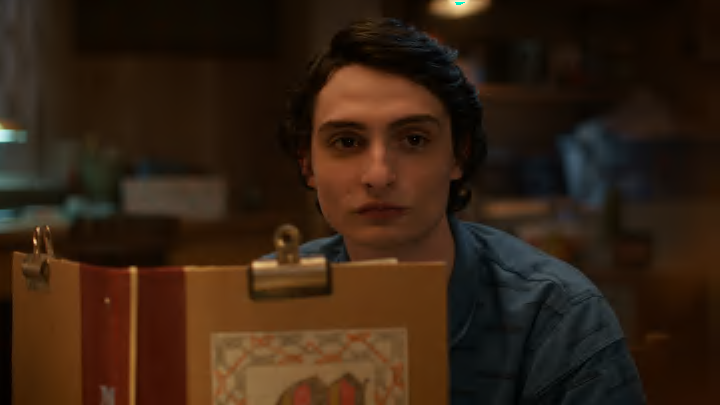
Everyone is going to have their own subjective opinion about how any given franchise that they like should conclude. Even worse though, in the age of the internet, each and every one of those people has a way to publicly express their opinions. This can take the form of things like healthy criticism or fascinating fan-fiction, but it can also result in highly detrimental relationships between a show’s creative team and the audience, whether that be adversarial or symbiotic. With its final episode, Stranger Things became the latest in a long line of franchises to attempt to toe-the-line and make every individual segment of fans happy, and as a result, made no one happy.
Infamously, far more egregious instances of this in recent years included the final season of Game of Thrones and the final film in the Star Wars Sequel Trilogy, Star Wars: The Rise of Skywalker, both of which worked so hard to either avoid or incorporate popular online fan theories that they derailed the entire story in the process. While Stranger Things doesn’t sink to levels quite this low, it is woefully apparent that nearly every major story beat in the finale is compromised in an effort to not take the kinds of bold stances that might offend certain sections of the fandom. Which is not how a great story is told.
For example, heading into the finale, between the stage-play production of Stranger Things: The First Shadow and substantial chunks of this season’s story, a lot of legwork had gone into humanizing the character of Vecna. While some fans felt sympathetic towards the character because of his tragic backstory and were eager to see him redeemed in some capacity, others felt that doing so could have drastically undermined the entire point of him being the big-bad of the series.
Thus, as a result, the show just doesn’t really pick a side here, instead doing a bit of both. Vecna is a tragic character who was manipulated by the Mind Flayer, but he also did choose to stay with the Mind Flayer and work with it when he could have left. All of this is sped through in about five minutes of screen time and feels more needlessly muddled than compelling, resulting in a very wishy-washy conclusion for the series’ primary story.
Similarly, the show itself was clearly grappling with how exactly to handle Eleven’s culminating moment. Even in the narrative of the show itself, characters such as Kali, El, and Hopper were constantly debating whether Eleven should die, which feels like a direct mirror of what must have been happening in the writers’ room. In the end, again, the show simply opts to not really make a decision, and attempt to have its cake and eat it too.
Eleven seems to die, but then the series ends with Mike proposing a theory that she survived and had to go into hiding, which the show supports with footage of such a thing happening. Thus, fans who hated the idea of Eleven being dead can believe the theory, and others can believe she’s dead.
In short, in attempting to appease a wider variety of fans, Stranger Things watered down its finale and made a lot of convoluted, waxing-waning choices that don’t leave much of an impact because they don’t feel definitive at all. Instead of telling a singular story that left the audience with bold statements about these characters, this story, and this world, the show opted to sand the edges off all of its biggest beats in a desperate attempt to keep everyone content. But the thing is, when everyone’s content, no one really is.
 Add us as a preferred source on Google