

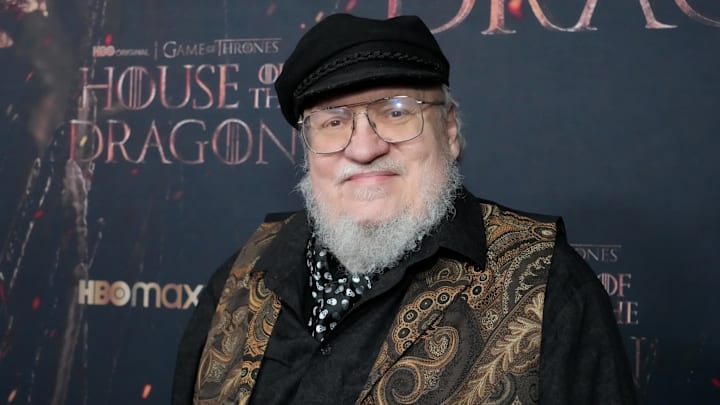
George R.R. Martin would change the landscape of fantasy literature and television when he set out to write A Song of Ice and Fire, while he was, in turn, influenced by the great works that came before. A Game of Thrones, the first novel in the series, was published in 1996, with The Lord of the Rings, The Wheel of Time, and more established as genre pillars.
Martin, however, knew he wanted to accomplish something different, exploring a harsher setting that challenges the romanticizations and plot holes of past fantasy. In a notable interview in 2014, three years after Game of Thrones premiered on HBO, he detailed the questions he had about J.R.R. Tolkien’s world that drove his storytelling.

GRRM had questions about how Aragorn would rule
“Ruling is hard. [A Song of Ice and Fire] was maybe my answer to Tolkien, whom, as much as I admire him, I do quibble with,” Martin said in the 2014 interview with Rolling Stone. Martin famously questioned “Aragorn’s tax policy” in this interview, but the essence of his comments lies in the unrealistic nature of many narratives where the “one true heir” reclaims their throne.
In both the Lord of the Rings books and movies, the story essentially ends with Aragorn (Viggo Mortensen) becoming king and marrying Arwen (Liv Tyler). While Tolkien provided readers with the outline of Aragorn’s reign for the next century, the details aren’t known. Martin, in contrast, wanted to explore the idea that being a supposedly predestined heir or a good person is not a guarantee of being a good ruler.
“Lord of the Rings had a very medieval philosophy: that if the king was a good man, the land would prosper,” the author said. “We look at real history and it’s not that simple. Tolkien can say that Aragorn became king and reigned for a hundred years, and he was wise and good.”
“But Tolkien doesn’t ask the question: What was Aragorn’s tax policy? Did he maintain a standing army? What did he do in times of flood and famine? And what about all these orcs? By the end of the war, Sauron is gone but all of the orcs aren’t gone — they’re in the mountains. Did Aragorn pursue a policy of systematic genocide and kill them? Even the little baby orcs, in their little orc cradles?”

All rulers fall in A Song of Ice and Fire
Rolling Stone started this discussion with Martin by saying, “A major concern in A Song of Ice and Fire [...] is power. Almost everybody – except maybe Daenerys [Emilia Clarke] [...] – wields power badly.” This quote has aged ironically, but the overall point is still sound. Nearly every character in A Song of Ice and Fire who finds themselves in a position of power is either seeking that power for the sake of it, is corrupted by it, or is too honorable to maintain it.
The TV adaptations have further explored this paradox through some storylines that differ from the source material. Martin’s displeasure with House of the Dragon is well-publicized, but season 3 depicts Rhaenyra (Emma D’Arcy), who seemingly wants to rule well, becoming more vicious and self-serving once she has the throne.
Martin went on to say, “In real life, real-life kings had real-life problems to deal with. Just being a good guy was not the answer. You had to make hard, hard decisions. Sometimes what seemed to be a good decision turned around and bit you in the ass; it was the law of unintended consequences. I’ve tried to get at some of these in my books. My people who are trying to rule don’t have an easy time of it. Just having good intentions doesn’t make you a wise king.”
This is clearly the case with Ned Stark (Sean Bean), who goes to King’s Landing to serve as the Hand of the King and is in over his head, appalled by the scheming, greedy nobles. He also cannot bring himself to put Cersei (Lena Headey) and her children in harm’s way, warning her first that he will tell Robert (Mary Addy) of her infidelity, which ultimately costs him his life.
Daenerys also runs into similar problems of maintaining her grip on Meereen and controlling her dragons. She also proves many times that she is comfortable doling out violent punishment, if she believes it is just or necessary. Though most agree the arc was rushed, Dany’s story ending with her becoming the “mad queen” is not out of line with her characterization or the overall franchise.
Ironically, Bran (Isaac Hempstead Wright) and Sansa Stark’s (Sophie Turner) respective ascensions in the Game of Thrones finale are more akin to the positive framing of Aragorn’s. But the tone of A Song of Ice and Fire as a whole suggests that the books were meant to end differently.
 Add us as a preferred source on Google