

With the release of its tenth and final episode, “Where We Belong,” the second season of Apple’s MonsterVerse TV series, Monarch: Legacy of Monsters has reached its conclusion. As with any season finale in the modern entertainment landscape, that means that the episode must be evaluated both on its own merits and with regards to how it ultimately recontextualizes the sum total of the season itself. In years past, individual episodes of a TV show were much more distinct, different, and separate from one another. However, with the rise of streaming platforms and prestige TV, this kind of episodic approach has largely given way to far more serialized tactics, wherein a single overarching storyline is sustained over the course of an entire season.
Monarch is very much the latter. It isn’t exactly difficult to imagine a ‘monster of the week’ type of episodic approach that this show could take, and perhaps it will in future seasons, but this second season of the series proper swings for a serialized approach, which means that the ways in which various elements from across the season culminate, payoff, or don’t, is inherently going to affect one’s judgement of the episode at hand. I say all of this to say that while there were many things that I quite enjoyed about “Where We Belong” as an episode in its own right, it’s difficult not to notice all of the ways in which the season as a whole ultimately fell short.

Monarch: Legacy of Monsters season 2 finale review
What works about this season finale? Well, a lot actually. I noted in my review of last week’s episode, “Ends of the Earth,” that the penultimate episode was far and away the strongest hour of television that Monarch had delivered this season. It was an episode that felt like the show had finally gotten to the story it had wanted to tell ever since the finale of the first season, and was able to really sink its teeth into it in some fascinating ways. On top of this, the episode was easily the best paced and most cinematic-looking entry of the season. Pretty much all of that carries over here, with “Where We Belong” playing out as the second half of the finale storyline that started last week, and keeping the vast majority of the creative team in place.
There’s a few kind of off-kilter hiccups along the way, such as the show’s inability to really commit to what Axis Mundi really is anymore or how it’s time dilation elements actually work within the narrative. When it was established earlier this season that characters could converse with younger versions of themselves or past versions of deceased characters, I thought it would be a one-off kind of thing, mostly fabricated to allow Kurt and Wyatt Russell (each of whom play different-aged versions of the same character, Lee Shaw) a chance to play off one another. However, in writers’ Joe Pokaski and Andrew Colville’s work here, Axis Mundi is positioned as a kind of narrative catch-all. Some characters believe they can essentially time travel and save any formerly dead character who can be retconned to having spent anytime inside Axis Mundi at some point, while other characters get to say melancholic goodbyes to past-selves with seemingly very little logic as to how or why any of this works the way it does within the story.
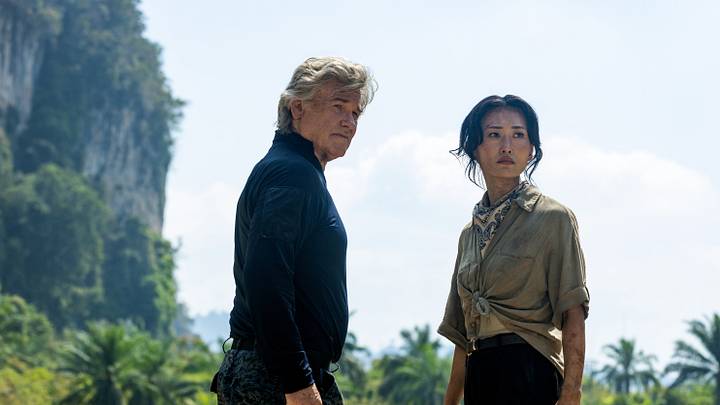
This uncertainty about exactly how they’re handling Axis Mundi also, unfortunately, bleeds over into the show’s most dynamic relationship: Lee Shaw and Keiko’s (as played by Mari Yamamoto). Both Kurt and Wyatt are fantastic in their respective performances of Shaw, and have been all season, and Yamamoto has been one of the series’ greatest pinch-hitters for the entirety of its run. Their scenes together in last week’s episode were some of the single strongest moments of the entire series thus far, so it’s more than a bit deflating to see their scenes together in the finale essentially being utilized as a vehicle through which the writers’ room can hash out their differing opinions on Axis Mundi and whether or not Shaw made the right choice by not saving Keiko decades earlier (thanks to time dilation hijinks).

However, that is not to say it is all bad, by any means. The final confrontation between Titan X and Kong takes on a much more subversive angle than I would have expected going in, and the choice to interweave the familial and interpersonal conflicts between Cate, Kentaro, and Keiko into the showdown in such direct fashion pays off in spades. The effects look great as always, and the integration of them into the real-world footage is really strong, with director Lawrence Trilling once again really strutting his stuff. I also find the focus of this really admirable; the season finally arrives at its big monster punch-up, but manages to invest the sequence in the emotional arcs and fallouts of its primary human characters in a really interesting way. It also must be mentioned that a huge part of why this works as well as it does is because of Anna Sawai’s tremendous performance as Cate. After being shorted for much of the season, she really gets to shine in this finale in some pretty astounding ways.
Which brings me to another highlight of the finale: Leopold Ross’ score. The composer’s main theme for the show is a certified banger, for sure, but throughout this season, the rest of his work has rarely been afforded the opportunity to really shine through. But here, Ross’ work is put front and center on several different occasions and really becomes the palpable heart and soul of the scenes. His work throughout said monster showdown is great, but I can genuinely not express just how powerful his score is in the sequence that follows, where Cate and the gang are guiding Titan X back home. It’s probably the single strongest setpiece of the entire series, with Ross’ operatically emotive score finding a real sense of synchrony with the deliberate and controlled visuals, all of which is elevated even further by Sawai’s performance at the center of it all. A genuinely great and striking moment of television.

Having said all of that, does the episode make the whole season feel worth it? I’m not sure it does. The end of the first season set up a pretty clear and compelling story for moving forward, and then this season as a whole decided to just kind of buffer about for eight-ish episodes before getting to the actual telling of that story in the last two episodes. This is far more an indictment of the serialized approach than it of this episode in isolation, but it bears criticism in its own right, especially with regard to how it makes the final minutes of this episode feel a bit jaded by comparison. When the first season’s finale ended by setting up a whole new set of stakes, new complications, a new timeline, and a new antagonist in the form of Kong, it felt invigorating. But knowing that all of that amounted to relatively little in the grand scheme of this season, it’s difficult to get that jazzed when the show essentially attempts to pull a similar trick at the end of this season.
Do the final minutes of this episode promise some interesting future developments? Yes. But am I really excited to sit through eight meandering episodes of a potential season 3 before the show finally decides to explore its characters and concepts in earnest for two final episodes before ending? I’m not sure that I am.
Verdict
Overall, Monarch: Legacy of Monsters’ second season was a decidedly mixed bag, with a cumulative total of way more downs than ups. But when it hit, it hit good, and this final episode (especially when paired with last week’s episode as well) is a potent encapsulation of the show at its very best. This is a great cast and a strong creative team; when they are afforded the right material, they really do fire on all cylinders. I just hope that moving forward, the series can find a better equilibrium in the pacing of these season-long stories and make it all feel as well-structured and motivated as these final episodes did.
Grade: B
 Add us as a preferred source on Google