

After spending the prior several weeks idly twiddling its thumbs narratively while also missing the mark from an emotion, thematic, and character standpoint, the fifth episode of this second season of Monarch: Legacy of Monsters, titled “Furusato,” finally manages to find a pulse in this flailing MonsterVerse series.
That’s not to say this new episode is devoid of the issues that have so hampered many parts of the season thus far, but rather that it is able to effectively shift focus and reprioritize the elements of the series that present the greatest levels of emotionality and intrigue. “Furusato” also benefits greatly from being the first episode since the first two that actually feels like it has forward momentum in terms of the overarching story, resulting in an episode that covers a lot of narrative ground while also carving out time for some meaningful character and performance work.
Starting off with the good, “Furusato” immediately kicks things off by exploring some of the most interesting stuff this series has to offer, in my opinion: the space between the spaces.
The series’ two primary timelines take place either in the ‘50s or the mid-2010s, leaving a whole lot of room in-between for characters to grow and change. Thus far, the series has been largely reluctant to cover any of that ground when it comes to the primary characters, giving weight to the idea that they were saving some of this for down-the-line stories. And that still may be true, but this episode does at least divulge some key bits of it in a way that feels extremely satisfying.
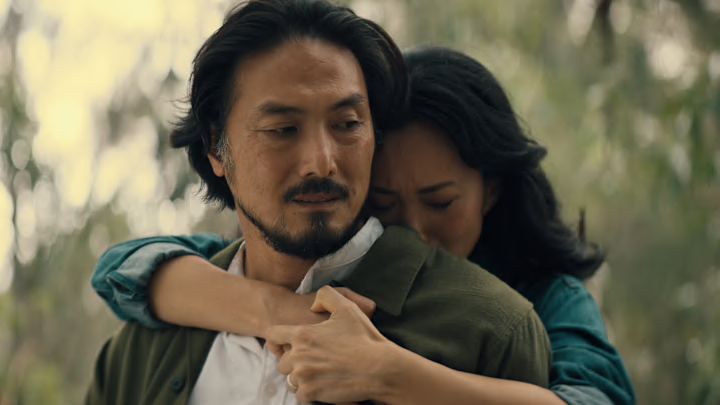
The episode opens on Hiroshi Randa (as played by Takehiro Hira) in 1990 and, in an especially potent moment, sees him quite literally torn between the two families he has forged in separate countries. It’s a great beat that gives Hira a kind of space and resonance to perform that so much of the rest of this season has not, and he manages to elevate the material even further through his work. This scene also establishes a pace and tone that really works for the episode as a whole, one that I sincerely hope the rest of the series keeps pace with.

On a narrative level, this episode is also one of the first of the season to really dig into the meatier science-fiction elements inherent to the story’s core hook, and I appreciate that immensely. It is insane to me that this is a series whose time-traveling antics have made it so that Keiko (as played by Mari Yamamoto) spent what felt to her like a period of months in Axis Mundi, but that decades passed by in the real world during that time, and little-to-no meaningful exploration of that has occurred at all up until now.
Sure, it was milked for some cheap gags about her being a woman-out-of-time in the first few episodes, but one would surely think the series would be interested in digging a bit deeper than that, right? Well, “Furusato” finally delivers at least some of the goods, allowing this core detail of her character to rise to the surface in regard to how it ultimately affected Hiroshi, her son. I honestly wish there was more of this here, especially given how this episode ultimately closes out, but I’ll take what I can get.
For as much as Monarch claims to be a series set within this world of Titans and Kaijus but grounded in a human perspective, much of this season has failed to sell the human side of that equation convincingly, feeling more like a rushed-through Saturday morning cartoon than any kind of empathetic prestige drama. “Furusato,” however, actually does walk-the-walk and not simply talk-the-talk, deliberately crafting an episode that carves out room for its characters to grow, change, come into conflict with one another, and ultimately evolve as human beings.
Many of this episode’s strongest moments are simple conversations between characters that actually feel authentic, earned, and emotional. Which makes sense, given that this cast is stacked with the likes of Anna Sawaii, Mari Yamamoto, and Kurt motherfucking Russell. Pairing any number of these combinations together and allowing them to talk about meaningful things in a way that doesn’t feel encumbered by needlessly convoluted plot mechanics works wonders for opening up the show, making it an altogether more affecting work, and I hope that continues.

Having said all of that, there are character beats here that play as woefully underdeveloped, which is insane since the series basically took two whole episodes prior to this to (at least, in theory) build to these moments. There is no better encapsulation of all of this than poor May (as played by Kiersey Clemons). Clemons is doing solid work as always, but the show apparently expects audiences to believe that between the last episode, where May was acting as a deliberately placed double agent within the villainous Apex organization and helping all the other characters sneak in to steal company secrets. Now, she has had a full-blown change of heart and is willing to cut ties with her friends and work dutifully for Apex. I can absolutely see how a turn like this could have worked, really playing into Cate’s own guilt relating to the release of Titan X, but it simply doesn’t. None of this was given the kind of care, attention, or time needed to make this fracturing of relationships feel earned, and thus it lacks any kind of believability or impact.
Similarly, despite the fact that most of the episode is focused on him, Hiroshi seems to have an entirely out-of-nowhere, about-face change of heart in the middle of this episode, and god bless you if you can figure out what prompts it. For half of the episode, he is extremely upset about the revelation regarding his time-traveling mother and Lee Shaw’s actual relationship. But then, around the midpoint of the episode, he just suddenly tells his mother he’s actually not upset anymore, and he went through some extreme degree of personal evaluation and enlightenment just off-screen, I guess. It’s an incredibly odd beat, and one that could have so easily been assuaged into something that really soared.
All in all, “Furusato” has its own share of highs and lows, but is at the very least one of the most coherent and effective episodes of the season thus far. The human stuff largely works, the big monster-sized action set piece is mostly goof stuff, and it does make some substantial changes to the status quo moving forward. My hope is that, moving forward, Monarch really embraces these changes and uses them to springboard into a more meaningful, concentrated style of storytelling. Only time will tell.
Episode Grade: C+
 Add us as a preferred source on Google