

There must be a Kaiju-sized story behind the scenes of what actually happened to this season of Monarch: Legacy of Monsters, because even when it finally manages to get its ducks in a row and start firing on most of its cylinders, there are still elements at play that feel disorientingly underbaked. I say all of this because the latest episode of Apple’s MonsterVerse series’ second season is far and away its strongest offering to-date; it foregrounds the interpersonal character drama and pathos-driven performances in a way that this season has regularly failed to. And yet, even amidst the triumph of this culminating episode, which does coalesce in a way that so much of the earlier episodes have struggled to, it’s still difficult to really embrace it as an out-and-out victory, given just how much of the episode feels hampered by some truly bizarre technical shortcomings and scattershot story decisions.
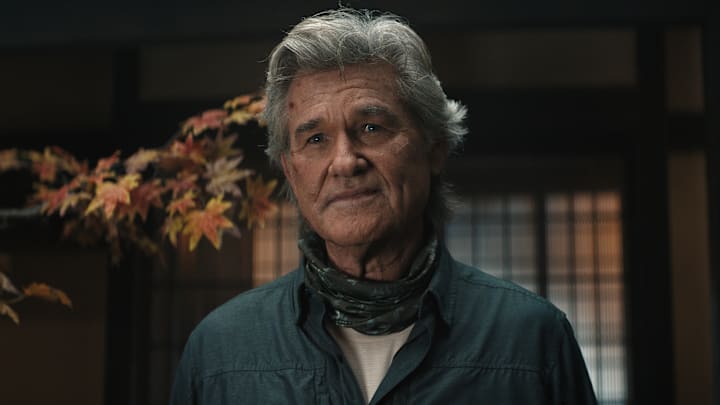
The greatest strength that “String Theory” has to offer is the greatest strength of the series as a whole; the dual performances of Kurt and Wyatt Russell as Lee Shaw. Thanks to some time-dilation shenanigans, the end of last week’s episode, “Requiem,” saw these two iterations of the same character coming into contact with one another for the very first time. Previously, Wyatt had exclusively played the character in his youth (during the 1950s-set flashback material) and Kurt had exclusively played him in the present day. However, thanks to the time-jumping capabilities of Axis Mundi, a kind of space between spaces in this universe, the two found themselves on opposite ends of a walkie-talkie conversation that was spanning several decades of time at the conclusion of last week’s episode. I was eager to see where the creative team might take this development, and am even more eager to report that they really do a stellar job of making the most of it.
The lion’s share of “String Theory,” as written by Joe Pokaski, is devoted to allowing these two versions of Lee Shaw the proper amount of room and resonance to get to interact with one another in meaningful way. Despite the fact that their conversation never actually goes beyond being on opposite ends of a radio-based communicator (no one walks through a portal to shake the other self’s hand or anything like that), there is a bona fide sense of presence and purpose to these interactions. In fact, I’d be willing to bet a significant amount of change that the two Russells went the extra mile and even showed up on-set for one another to stand out-of-frame and have these conversations in real-time while filming, rather than allowing it to be constructed exclusively in post-production, because there’s a heft and emotional viability to it all that feel unmistakably authentic.

Of course, this is all the more notable given how infrequently Monarch has actually allowed for these kinds of rich character interactions this season. Again, for a series whose modus operandum was supposed to be exploring the human perspective of living in a world filled with monsters, this season has routinely chafed at actually exploring its human characters in a purposeful way or giving their developments the kind of space necessary to grow and land in an organic fashion. Here, each Russell is given the space to really dig into their own respective takes on the character and express that in a way that feels palpable. Their performances are fantastic throughout this episode, bringing a kind of power and nuance to the forefront that has been entirely missing for the rest of this season.
Further accentuating these strengths are the direction and editing, both of which rise to new heights, striving to compliment these performances through articulate craft. This is Gandja Monteiro’s first at-bat this season for the series (she’ll be back directing next week’s episode as well, though) and it's absolutely fantastic. Whereas prior weeks have felt largely shot-for-coverage and utilitarian in their visual language, simply attempting to express something in blunt fashion and quickly move along, Monteiro brings real cohesion, concentration, and focus to the proceedings, in a way that deepens the experience and further enriches the performances she is getting from her actors. Most specifically, there are multiple shots in this episode where Monteiro and her editor stay on sustained shots of Wyatt Russell’s performance, allowing viewers to really marinate in an emotional reaction with him in a way that feels wholly earned and incredibly impactful. This slower, more deliberate pacing of the editing also allows Leopold Ross’ musical score the room it needs to really soar. The result is an episode whose best moments are synchronous in their craft and wholly affecting in their emotional and thematic content; really great stuff.

However, it is sadly not all great news. One of the other main plots that is going throughout “String Theory” features Keiko (as played by Mari Yamamoto) and Cate (as played by Anna Sawai) going on a bonding expedition of their own, attempting to learn more about Cate’s unexpected connection to Titan X. Ideally, this could have been another real bright spot for the series, spotlighting two great performers in a similar way to the Lee Shaw-centric stuff. Instead, this portion of the episode gets saddled with a ton of exposition, and an inability to handle of it even the least bit gracefully.
Throughout this season, ADR has been a recurring element that I’ve often found jarring and quite strange in its implementation, but the use of it throughout this portion of “String Theory” may be the most harmful use of it all season, as it well and truly tramples all over what should be intimate, emotionally-driven scenes. It’s as if Apple test screened these episodes for people and kept getting feedback that audiences weren’t able to understand what was happening for one reason or another, so Monarch had to go back and redub substantial amounts of dialogue to clarify plot points and reincorporate exposition in some really ghastly and abhorrent ways. Here, there are entire swaths of emotional exchanges between these two characters that play out off-screen, with the editing cutting entirely to the other person’s reaction and just dubbing the off-screen character’s dialogue in over the top in a way that is exceedingly crude, both technically and artistically.
It’s one thing when the series is using ADR to ham-fistedly attempt to explain some nonsensical plot-related stuff, but it’s something else entirely when the ADR begins to trample all over the emotional resonance of the series, as it does in Keiko and Cate’s scenes here.

I would also be remiss not to mention that despite the power of the performances, there are about a million questions that are opened up by the time-hopping antics at-play here, most of which the episode is thoroughly unequipped to engage with, much less answer. Given the sheer power of the performances and craft surrounding this section of the episode, I was more than content to look past all of the intricacies of this storytelling, but given that this is a sincere attempt at a grounded science-fiction work, it bears mentioning that it falls short in this regard. You just kind of have to roll with the punches here, or else you’re not going to get the great stuff that comes with it.
Overall, while “String Theory” does unfortunately have many of the same drawbacks that much of this season of Monarch: Legacy of Monsters has suffered from, it rises to far greater heights and should be lauded for it. This is among the few episodes of this season that I believe well-and-truly live up to the potential of this series, capitalizing on great performers with a genre-indebted hook and articulate cinematic craft.
Episode Grade: B
 Add us as a preferred source on Google