

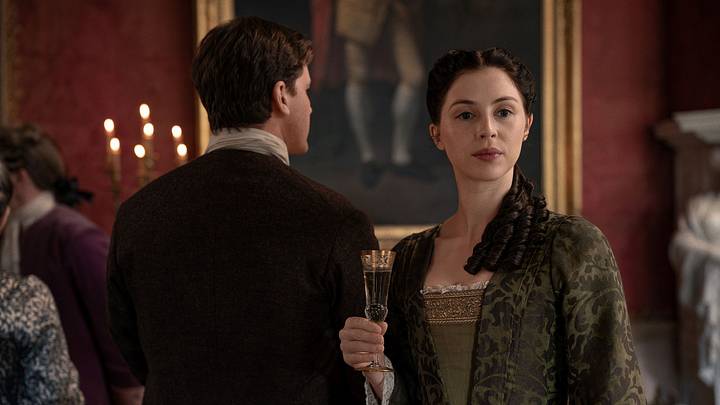
There is a lot of dancing around the truth in Outlander: Blood of My Blood season 2, episode 8, appropriately titled “The Dance.” Julia and Lovat attend an event honoring loyalist lairds who fought against the Jacobites at Sheriffmuir and Inverness, while Ellen’s longstanding plan to protect clan MacKenzie is finally put to the test.
In episode 8, the dance is not just the chance to lay new political schemes and start what soon will be the aftermath of the Jacobite Rising of 1715. Let’s see what new strategies have been implemented.

The dance of political ambition
The episode starts at a new location: Merlewood House, the Scottish estate of a young Duke of Sandringham, an old foe of Claire’s in Outlander. The casting deserves my praise: the actor, Jacob Dudman, bears a rather uncanny resemblance to his older counterpart, making the connection immediately recognizable for long-time fans of the franchise. In the opening scene, Sandringham presents King George I (Guido Renner) and announces that Gerard Grey (Digby Edgley) has been rewarded with the Duchy of Pardloe. Lady Grey is the one who receives the honor instead of her husband (here I have to correct myself: in my review of episode 5, I had stated that he wasn’t married yet): Gerard Grey is elsewhere, hunting down Jacobites and executing them on the spot.
The two scenes are made to be in contrast to each other: Grey passes judgement in the rain and the mud, spilling Jacobite blood onto Scottish ground, and appears jarring against Merlewood House’s warmth, regality, and luxurious brightness. The contrast is made even more dramatic thanks to the music choice: a Bach choir dramatically cries out to a full-on concert orchestra, overpowering at times the sounds of muskets firing.
Lovat (Tony Curran) is also rewarded: he has his titles restored and has been appointed governor of Inverness. Both Grey and Lovat are rewarded for killing people, which is a rather bleak illustration of how political violence works when you’re on the winning side.
The festivities at Merlewood also bring Malcolm Grant (Jhon Lumsden) and his sister Margaret (Erin Shanagher) into the orbit of Lord Lovat and Julia (Hermione Corfield). Margaret Grant was introduced in episode 7: redcoats pillage her coach on the way to Castle Grant and she demands her precious pearl necklace be brought back, and that’s the excuse Henry (Jeremy Irvine) uses to go out and look for gemstones.
Henry is present at the dance, too, and has to endure a demeaning conversation centered around Julia’s previous status of scullery maid at Castle Leathers, as Malcom Grant reminds everyone. But Lovat is quick to remind Grant that he could kill him for what his bladier, Henry, did, when he “kidnapped” Julia and baby William. There are several layers to this conversation, layers that Margaret is quick to find interesting, as well as useful.
Lovat is clearly attracted to Margaret, and wastes little time in seducing her — which is facilitated by Margaret playing her own game. Lovat sends Julia away, leaving himself free to dance with Margaret. Their scheming chemistry is immediate, and it’s not long before the two are making rather more intimate use of the evening.

A solution to Julia’s dilemma
Henry and Julia, meanwhile, are having a much more complicated conversation. She asks him to return to the 20th century with William, since she’s not a traveler herself. Henry doesn’t want to abandon her, but Julia quickly points out that they are already lost to each other in the 18th century, with no hope of being together without risking Lovat hunting them down, and especially William.
Then Julia reveals something important about her ability to travel through the stones: she was pregnant when she made the journey. Henry begins to wonder whether another pregnancy might allow them to travel again. His suggestion is initially met with resistance. Julia isn’t immediately convinced that bringing another child into their complicated circumstances is the right thing to do. But it’s their dance — which turns into a flashback to the time they decided to get pregnant again after Claire — that eventually warms her up to the idea.
Henry’s reasoning is tender although very impractical: “I want more of you. I want more of us,” he says in the flashback. The same sentiment belongs to him in the present, with them dancing the foxtrot while Julia’s other husband is dancing a waltz in the ballroom. He accepts to wait, since both of them are currently safe. For now, at least.

Lovat’s next target
Lovat and Margaret’s relationship is progressing rather more quickly. But Margaret makes it clear that she has conditions: she won't sleep with him without the promise of marriage. “I am not Lady Amelia,” she tells him, referring to the lady Lovat abused, a crime for which he had lost his title. This detail tells us that Margaret knows of his reputation, and that she’s playing to get Lovat’s new wealth and social status, not the man himself. Margaret knows precisely what she wants, and she has no intention of becoming another disposable woman in Lovat’s life.
Lovat then speaks with Malcolm while they watch the King laughing with his mistresses, rather crudely nicknamed Elephant and Maypole for their physical appearance. Malcolm lists all of Margaret’s good qualities and considerable dowry, essentially offering his sister to Lovat as a potential bride (no matter the wife he already has).
Lovat tries to breach the differences between his family and the Grants, offering an apology for how Young Malcolm died “of a broken heart,” directly caused by his betrothed, Ellen, and the fact that she was already handfast to Brian. Now that the cat’s out of the bag, this revelation will surely lead to other struggles between the Grants and the MacKenzies, as well as between Ellen and Colum: it’s only a matter of time before he discovers that Ellen was in fact not “pure” and that she has been lying to him for a while. Will this change their already precarious sibling dynamic once again? Probably not, as we later see in episode 8.
Julia notices just how attracted Lovat is to Margaret, and she has every reason to be concerned; if Lovat wants Margaret as his wife, then Julia is an obstacle. She fears he might divorce her, or worse, arrange for her death, so that he can marry Margaret and keep William.

Brian’s loyalty
While the aristocracy is busy negotiating marriages and exchanging political favors, Brian (Jamie Roy) and Murtagh (Rory Alexander) are having an honest conversation in the wilderness about their losses and hope for the future. Brian tells him that Ellen has lost the baby, and Murtagh responds with the familiar explanation that it just wasn’t God’s will. But Brian isn’t interested in hiding behind fate — he knows the truth of the circumstances.
Murtagh asks him what stopped him from killing his father, and Brian answers with honesty: “Ellen. What kind of life would she have if I swung for murder? What if I ran for the rest of my days?” Ironically, he doesn’t know this yet, but he’s actually describing the kind of life his son, Jamie, will have; after all, he was running from the law when he married Claire.
Murtagh asks how long Brian intends to wait. “However long it takes. If it takes forever… Forever.” If you know the history behind Outlander: Blood of My Blood, then you know a wedding is coming. Maybe in the season finale?

Ellen takes control
A recovering Ellen (Harriet Slater) is taking a stroll with Mrs Fitzgibbons (Sally Messham) in the grounds surrounding Castle Leoch. She stops to pick snowdrops, delicate little flowers that appear towards the end of winter and are among the first signs of spring. Their symbolism is particularly fitting here: snowdrops traditionally represent hope, renewal, rebirth, and new beginnings. This is painfully appropriate for Ellen, yet she continues to look towards the future. With this in mind, she is able to face the test that’s presented to her in this episode.
Beside the snowdrops, it’s Mrs Fitzgibbons who gives Ellen confidence. She tells her she doesn’t need fortune on her side because she can get what she wants: she has intelligence, determination, and a formidable ability to read people. Unfortunately, she'll need all three when redcoats arrive at Castle Leoch.
Gerard Grey has come looking for Dougal (Sam Retford), who has escaped from Fort William. Dougal comes out of hiding to intervene when Grey threatens to execute Colum (Séamus McLean Ross). He’s accused of allowing sedition to flourish under his roof: “You let sedition grow under your roof and called it prudence,” says Grey. It’s a feeling the audience will share about Colum this past season: he has done nothing to change the dire situation in his household in the name of peace. But doing nothing is also doing something.
Grey declares that Leoch and all its lands now belong to the Crown. Ned immediately challenges this assertion, revealing that Ellen owns it. When Grey threatens the Mackenzies, Ellen reminds him that her family has “a talent for survival.”
Grey decides that both men should be executed, but Ellen has other ideas: she asks Grey to allow the brothers to pray in the chapel before their execution. This gives her time to speak privately with Colum and Dougal and put her plan in motion.
What follows is perhaps the finest demonstration of Ellen’s political intelligence yet. She lays out her conditions: Colum will become the sole laird of clan MacKenzie, and Dougal will retain the title of war chieftain in name only. Ellen will sign the land back to Colum, but she will keep a parcel bordering Brian’s land, which will eventually become the other half of Lallybroch.
If her brothers refuse, she threatens them with another option: she can marry Leoch into the Fraser family through Brian. Leoch would then become “Brian Fraser of Leoch and I’s" (it does have a nice ring to it, though). Dougal is absolutely furious, calling her a “blackhearted bitch” and a “devil,” and Colum is mad that Ellen has “stolen” part of his lands. Honestly, these men have some nerve: Ellen is attempting to save both their lives, secure her own future, and prevent the family from losing everything; the least they could do is show a little gratitude. But then again, these are the Mackenzie brothers, so perhaps gratitude was never likely.

Ellen’s next conversation is with Gerard Grey, and it’s a masterclass in persuasion. He remarks that she has a sharp tongue for someone who claims to have no taste for politics. Ellen points out that his reputation would be ruined if the truth about Dougal’s escape and subsequent execution became public knowledge: the story would spread, songs would be written about Dougal, and the Jacobite cause could gain a new martyr; killing Dougal might actually make the rebellion stronger. Her solution is simple: keep him alive, but contained — “Not loose, caged.” It's a clever distinction, and one that gives Grey a way out without forcing him to admit defeat.
Ellen also offers him money, further sweetening the deal. But her most compelling argument is about the nature of loyalty. “What am I if I break faith the moment it profits me? We’re not so different. You fight for a king you've never met, I fight for the blood I was born to. Neither of us can choose our loyalties, only what we do with them.” She doesn't ask him to abandon his principles, just as she asks him to understand her point of view. Remarkably, it works.
Ellen signs the deed, but it doesn’t lessen Colum’s reaction. He is furious that Ellen has effectively coerced him into surrendering a parcel of land. He seems genuinely offended that his sister has taken control of her own future, despite the fact that she’s just saved his life and that that very future had been almost destroyed by Colum’s own actions. Dougal is no better: he congratulates his sister pointing out that she is now “free to marry your bastard” (the very bastard who saved his life only a couple of episodes ago, mind you). Again, ungrateful little brothers.
Ellen has one final condition: Colum will never set foot on her land for as long as she and Brian live. She is determined to establish a life that belongs to her and Brian only. Colum, for his part, tells her that she is always welcome at Leoch.
When Ellen leaves, Ned attempts to comfort Colum, suggesting that although he may have lost his sister, at least he has Dougal back and a safe clan. He even jokes that he half-expected Colum to bring the redcoats to Dougal. To this, Colum sheds a tear and whispers, “Never.”
Before Ellen leaves, Ned has one final conversation with her. He admits that he will miss her, and they exchange lines from their favorite they used to put up when Ellen was little, William Shakespeare’s A Midsummer Night’s Dream: “I am a spirit of no common race" feels almost like a declaration of independence.
Ellen may be leaving behind the home she has known, but she isn’t leaving as a defeated woman. She has negotiated her freedom and successfully secured her future with Brian.

A love story interrupted
In the meantime, another couple is discovering just how little control they have over their own future. Murtagh finally tells Grace (Ruby Fubara) that he loves her, but unfortunately, their happiness is short-lived.
John Cameron (Alastair Mackenzie) announces that he has purchased a sugarcane plantation in the West Indies. He intends to leave Scotland, with his cousin Hugh (yes, the same Hugh Cameron who will be married to Jocasta) remaining to manage the estate in his absence. Grace will accompany him; Jocasta, meanwhile, is to remain behind.
Grace is obviously devastated by the news. She begs Jocasta (Sadhbh Malin) to intervene and change her husband’s mind to no avail. When Grace tells Murtagh that she is leaving for the West Indies, he immediately tries to find a solution. He proposes that they run away together, or that he buys her bond, offering her the possibility of a life that belongs to them rather than one dictated by her owner. He even proposes marriage, but Grace refuses.
It is painful to see this after Murtagh has finally found the courage to admit how much she means to him. He has already spent so much of his life sacrificing his own happiness, like when he had to abandon the idea of a future with Ellen when she fell in love with Brian. I am sure this is not the end of Murtagh and Grace’s story, but it still remains to be seen.

Verdict
It is a dance between love, loyalty and survival. “The Dance” as an episode does a terrific job of balancing the political manoeuvring and the emotional dimension that are happening at the same time at Merlewood and Leoch. In this episode, every character is forced to experience the unbalanced dance that is the complicated relationship between love, ambition, and the unstoppable forces of history.
If the episode belongs to anyone, though, it’s Ellen. Her confrontation with Colum, Dougal, and Gerard Grey is the episode’s strongest sequence. She manages to save her brothers, secure her own land, and negotiate a future with Brian, all while dealing with men who seem determined to both underestimate her and be furious with her, even when she acts against her own interests (let’s remember that she could’ve stayed the sole owner of Leoch if she refused to sign the deed, and walked away with a lot more than mere “dirt,” as she calls it).
There is a recurring idea throughout the episode that people cannot always choose the circumstances of their lives, but they can choose how they respond to them. Ellen understands this better than anyone: she cannot prevent the political upheaval surrounding her family, but she can negotiate, strategize, and carve out a place for herself in a history of men. She was able to decide what her loyalties are worth, which is not something that every woman from this time can say is possible. And sometimes, as Ellen demonstrates in this episode, survival requires knowing when to dance with the devil.
Grade: A
 Add us as a preferred source on Google