

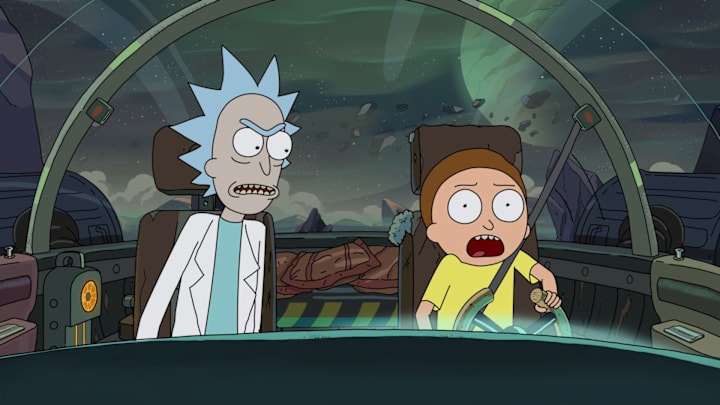
Pluribus' premise is incredibly unique, but at the same time, it also kind of borrows little things from a bunch of different sci-fi shows and combines them to make something unrecognizable. On the other hand, some of those fragments can stand out far more prominently than others. In season 1's penultimate episode, "Charm Offensive," Vince Gilligan's sci-fi show borrows a specific and steamy storyline from Rick and Morty.
For those of you who haven't been watching Pluribus, the basics of the show are that Earth has been swept into one big hive mind, but Rhea Seehorn's Carol Sturka has inadvertently remained an individual. So, when she talks to those in what's referred to as the Joining, she's essentially speaking to the planet's entire population, and they all answer back as one. But often through just one mouth. Rick and Morty fans probably know where I'm going with this, but it made me chuckle when I realized what was going to happen between Carol and a member of the Joining.
FULL SPOILERS below for Pluribus season 1, Episode 8, "Charm Offensive."
Carol and Zosia hooking up in Pluribus mirrors Rick's relationship with Unity in Rick and Morty
Introduced in Rick and Morty season 2's "Auto Erotic Assimilation," Rick Sanchez is reunited with a former lover, but they aren't a conventional ex. Rather than being an individual, Unity is an alien hive mind that takes control of vast numbers of people at once. Unity is even capable of connecting everyone on the same planet into a shared consciousness. (Sound familiar?)
General concept aside, Pluribus specifically borrows the unconventional romantic encounter that happens between Rick and Unity and adapts it to suit the Apple TV show's tone and premise. While it's not uncommon for sci-fi shows to bear certain similarities, this one seems almost amusingly specific. That said, there are some key differences.

How Rick & Unity's relationship differs from Carol & Zosia's
Other than the incredible irrelevance of the dynamic between Rick and Unity, the characters otherwise appear to have found each other relatively organically, at least by Rick and Morty's standards. They weren't forced together by circumstance in the same way Carol and Zosia were, and Rick also doesn't seem to have a preference for any of Unity's countless avatars. Instead, he essentially fell for Unity as a non-corporeal being and is just content being in their company in any way possible.
Inversely, the concept of the Joining is completely outlandish to Carol at the start of Pluribus, as the show is otherwise grounded compared to the likes of Rick and Morty. So, Seehorn's character initially resists any kind of involvement with any member of the Joining. First, it's out of fear, then it's out of other, more measured emotions, like anger.
Even then, when Carol and Zosia hook up in "Charm Offensive," Carol seems solely attracted to Zosia rather than the hive mind she's part of. She obviously knows that she's technically sleeping with the whole world at once, but it's a secondary thing. For Rick, this is an active turn-on. Furthermore, while Zosia and the Joining actively want Carol to volunteer to join the hive mind in Pluribus, Carol also wants to bring the entire psychic network to an end. Rick's individuality is instead valued by Unity, and Rick probably couldn't take down the hive mind anyway without ending Unity's existence.
Perhaps most saliently, Unity is a pretty minor character in Rick and Morty. She's buried under a pile of wild worldbuilding that seems to be brought into the canon via throwaway lines or random jokes. So, the whole hive mind concept is a drop in the adult animation's figurative ocean. Inversely, the Joining is right at the heart of Pluribus, and an episode never goes by that doesn't directly address it. As such, Pluribus is a far more layered approach to the storyline it borrows from Rick and Morty, and that includes the romantic elements.
Pluribus is streaming now on Apple TV.
 Add us as a preferred source on Google