

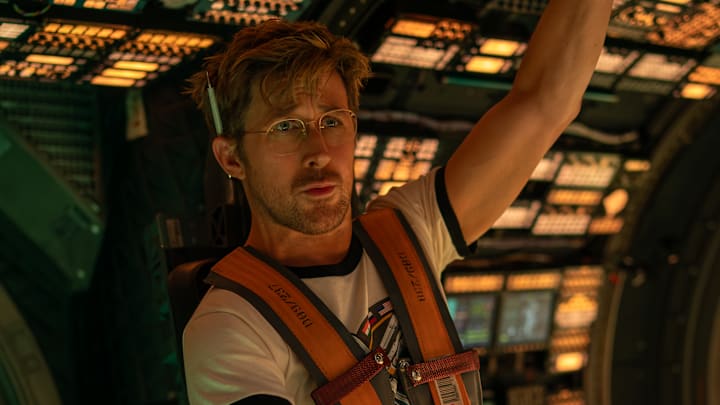
The blockbuster adaptation of Andy Weir's science fiction novel Project Hail Mary has taken the box office by storm. The film, starring Ryan Gosling and directed by Phil Lord and Christopher Miller, has become Amazon MGM Studios' biggest opening ever and only the second non-franchise film in the past decade to debut above $80 million domestically following Christopher Nolan's Oppenheimer.
With its stunning visual effects and breathtaking cinematography, the film has earned a 95% critics score and 96% audience rating on Rotten Tomatoes. But while Weir's imagination birthed the story of teacher-turned-astronaut Ryland Grace and his alien companion Rocky, the author himself played a surprisingly hands-off role when it came to the film's visual language.
Weir trusted the experts when it came to visual design of Project Hail Mary

In an interview with ScreenRant's Liam Crowley, Weir was refreshingly candid about his limited participation in the film's visual design process. He cited a lack of visual imagination as the reason he didn't contribute significantly to the creative design of the film and trusted the experts to do their best.
"I didn't really participate too much in the visual design," Weir explained. "Not that I wasn't invited, but I don't have a very visual imagination. So when I'm writing, I just see sort of blobs in my mind, like a blob for Ryland, a blob for Rocky. I'd worked out Rocky's morphology, like how his body works and stuff, but not the details of what he would look like if you were staring at him. I just don't have that visual of an imagination."
"I'm definitely not someone who can give any useful advice to visual artistry. I just let the people who are good at that do their job," he added.
This admission reveals an interesting truth about Weir's writing process. While he crafts the scientific and mechanical aspects of his stories working out exactly how Rocky's alien physiology functions or how the Hail Mary spacecraft operates, the specific visual details remain mostly secondary to the logic and function of his creations.
No cognitive dissonance on Andy Weir's end

Weir allowed the film's extraordinary creative team to translate his "blobs" into fully realized visual spectacles.
"They came up with it and said, 'Here's what we got,' and my brain was like, 'Okay, that's Rocky. That's Ryland. There we are,'" Weir said. "I didn't have that cognitive dissonance because it wasn't competing with an image I had in my head."
This collaborative approach proved remarkably successful. The team Weir trusted to bring his vision to life included some of the industry's most accomplished artists and technicians.
The visionary team behind the film

Directors Phil Lord and Christopher Miller, the duo behind The Lego Movie, 21 Jump Street and the Spider-Verse films, brought their signature blend of heart, humor and visual innovation to Project Hail Mary. Their background in animation proved invaluable in tackling the film's most challenging element in Rocky, an alien with no face who communicates through something similar to whale songs.
Screenwriter Drew Goddard, who earned an Academy Award nomination for adapting Weir's previous novel The Martian, returned to translate another of Weir's science-heavy stories to the screen. Lord and Miller specifically waited for Goddard to become available because of his unique ability to balance scientific accuracy with emotional storytelling and accessible humor.
The Oscar-winning cinematographer behind Dune, Dune: Part Two and The Batman, Greig Fraser, brought his mastery of scope and atmosphere to the film. Fraser's approach has always been practical solutions and simplicity using ARRI Alexa 65 cameras and innovative techniques like removing infrared filters to create unique visual effects. His work turns the vast emptiness of space into something both terrifyingly infinite and so incomprehensibly beautiful.
Production designer Charles Wood and his team built extensive practical sets for the Hail Mary spacecraft studying real-world vessels like the International Space Station to create an authentic sense of claustrophobia and functionality. The production famously avoided using any green or blue screens building nearly everything practically.
Legendary creature designer Neil Scanlan, who worked for Jim Henson's Creature Shop and created numerous iconic Star Wars creatures including the Porgs, built the physical Rocky puppets. Scanlan told lead puppeteer James Ortiz: "Think of it like this: You're Frank Oz, and I'm making Yoda for you."
A celebrated Broadway puppeteer and Drama Desk Award winner, James Ortiz led a team of puppeteers nicknamed "The Rockyteers" who brought Rocky to life on set. Originally expected to be replaced by a more famous actor in post-production, Ortiz's performance proved irreplaceable. His voice and performance create Rocky's personality; intelligent yet anxious, brilliant yet emotionally vulnerable like "a little brother who really wants to be invited to the party."
The team used multiple versions of Rocky including a primary animatronic puppet with functioning fingers, a "Bun-Rocky" based on Japanese Bunraku puppetry for action sequences and a remote-controlled "Waldo" for complex scenes. CGI animation from Framestore, led by Arslan Elver, completed Rocky's performance in shots where practical puppetry couldn't follow.
The production-level VFX supervisors, Paul Lambert and Mag Sarnowska, oversaw work distributed across multiple studios including Framestore (supervised by Stuart Penn and Robert Winter), Industrial Light & Magic (supervised by Tristan Myles), Sony Pictures Imageworks (supervised by Chris Waegner), BUF (supervised by Stephane Vogel) and Wylie Co. Despite the film's 2,018 VFX shots, the emphasis on practical effects kept the digital work feeling realistic.
Composer Daniel Pemberton, who previously collaborated with Lord and Miller on Spider-Man: Into the Spider-Verse and its sequel, scored the film. Beside the original soundtracks, the movie also features emotionally resonant needle drops including the Sign of the Times, Sunday Mornin' Comin' Down, Rainbows, Pata Pata, The Final Bell, E Cosi Per Non Morire, Let's Call the Whole Thing Off, Gracias a la Vida, Stargazer, Wind of Change, Po Atarau (Now Is the Hour), Glory, Glory, El Amanecer and Two of Us.
Working with NASA consultants, the costume team, led by David Crossman and Glyn Dillon, designed over 50 outfits for Gosling's character including a practical EVA spacesuit. Every component was based on existing technology, following NASA's practice of never putting untested equipment into space.
The trust Weir placed in this creative team has paid off spectacularly. Project Hail Mary exceeded all expectations with its $81 million opening weekend domestically, quickly becoming a word-of-mouth phenomenon.
More sci-fi movies:
 Add us as a preferred source on Google