

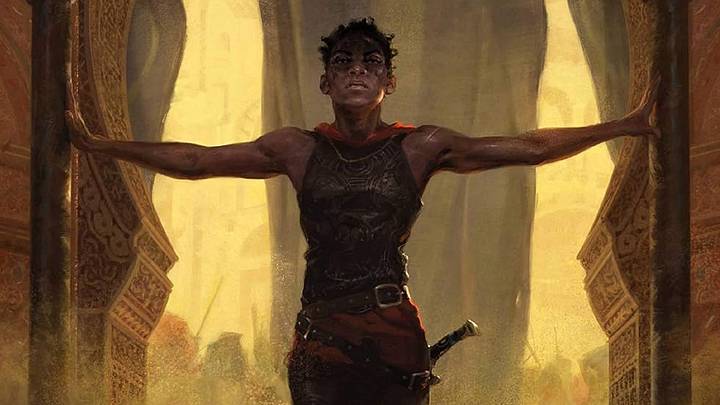
Author C. L. Clark's debut trilogy is as unique a take on heroic fantasy as you will find out there. The Magic of the Lost trilogy explores the issues of empirical colonization and the pitfalls that can cause it to fall apart.
The series is certainly a fantasy series, but the magic takes a backseat to the characters and the overall narrative. Magic is more of an obscure, barely tangible aspect of the series. Clark's occasional focus on the magical part of her world is often rather vague. The story is so good, however, that it does not need to lean on magic to carry the narrative.
All three books in the series are excellent, and all have a different feel to the stories within each book. The world created is realistic and explores a topic seldom regarded in the fantasy genre. It is a unique, fictional world but clearly influenced by history.

3. The Faithless, Book 2
The Faithless is clearly a bridge book, and it took a surprising turn, taking readers away from the established setting of book one. Clark moved away from the expected setting from The Unbroken, which took place in the colonial capital of Qazal, El-Wast. In The Faithless, the setting moves to the empirical capital of Balladaire.
Where the first book was gritty and dark, the second book is set in an otherworldly glamorous and wealthy modern city. Political intrigue becomes more important to the story, and the dual heroines, Touraine and Luca, must now connect in a much different world than where they first connected in Qazal.
While Touraine is relatively familiar with Balladaire, the world she grew up in is figuratively far away from life in the royal court. Touraine and Luca have to learn to navigate this world together as Luca works to gain her crown from her uncle, who is regent.
There is plenty of action, but it is paced slower than The Unbroken. Luca's search for the lost magic of her people leads down roads that hint that it was a good thing that this magic was lost.
Balladaire resembles late 18th-century Paris, complete with a building element of revolution bubbling under the surface. It adds yet another layer to the story and another hurdle Luca must overcome to realize her goal to become the queen of Balladaire and its sprawling empire.

2. The Unbroken, Book 1
Most first books in a fantasy series take a little while to immerse the readers into the author's created world, but not in this case. The Unbroken jumps right in with an assassination attempt on Luca, the royal princess of Balladaire. She's been sent to Qazal to end a native revolution in one of Balladaire's conquered colonies.
Touraine leads a squad of colonial troops who have been stolen or sold to the empire. Balladaire then educated and trained them as frontline fodder in the empire's army. Touraine was from El-Wast, though she remembers little of her childhood there.
The story is unique to the fantasy genre, inspired by the historical colonization of North African countries. The series deals with the problems of colonization, but that topic is the focus of The Unbroken. Outside the rollercoaster relationship between Luca and Touraine, the inherent issues with colonization in general are magnified. People's desire and right to be free are in direct conflict with an empire's right to rule after conquest.
The world is gritty and harsh in book one. The setting, story, and characters grab the readers, pull them in, and keep their attention. This book was difficult to put down.
This might not be the best-written or most smoothly flowing book of the three, but there is a lot going on. Touraine's balancing act of trying to exist between the world to which she was born, the world where she was raised, and the love developing between her and Luca generates inner conflict. This is fueled by Luca's desire to gain her crown by forcing the Qazali revolutionaries into submission.
The uniqueness of this first book and the powerful emotions behind the characters make it an incredible first book to this trilogy.

1. The Sovereign, Book 3
When the story moved from colonial Qazal in book one to empirical Balladaire in book two, the series lost a bit of its initial uniqueness. It is less gritty and more political for sure, but it is still an intriguing tale.
Magic takes on a bigger role as Luca continues to search for the answers as to why it disappeared in her country. She insists that the magic will save her empire, but she is almost blind to the growing unrest among the common citizens of her capital city and her kingdom.
She is too focused on gaining power and finding the key to magic and doesn't concentrate enough on the growing discontent on her kingdom's border. Forces have gathered to march on Balladaire that include her ancient enemies and troops from her colonies. These forces want to overthrow Luca and take over the kingdom.
The pace is quick in The Sovereign, with plenty of moving pieces. War, revolution, famine, plague, and political intrigue all fuel the narrative. Luca and Touraine must navigate the changing of the times and, at times, don't feel up to the task.
There aren't many happy endings in modern-day fantasy, and that is the case in the Magic of the Lost trilogy. The last book is unpredictable and has some mystery to it, and in the end, the characters aren't where the readers may have thought they would be. There is a satisfying end, however. For readers who understand the historical empire versus colony backdrop, the end shouldn't be startling.
Clark creates something unique in the genre and plays it out satisfyingly. She finds a way to stay connected to the colonial world, even after she moves the focus to an empirical one. She provides insight to both sides but also shows how the system could fail.
Lastly, she incorporates a love story between Luca and Touraine, two women from entirely different backgrounds. Both characters are horribly flawed, yet they find a way to finally be true to each other. Their love isn't a romantic thing but is a thing that must be survived. This part of the story is well-done in the fact that it isn't the focus of the overall narrative but simply a very important part of that story.
 Add us as a preferred source on Google