

It doesn’t feel like an overstatement to say that Steven Spielberg is one of the most influential filmmakers of all time. In fact, it feels like an understatement. The man has been making movies for the vast majority of his life, engaging in a back-and-forth with audiences over the course of more than five decades now. And one of the things I’ve always found the most fascinating about Spielberg outside of the normal stuff (he’s a maverick with camerawork, a master of externalizing emotionality, knows how to capture movement in exceedingly palpable fashion, etc.) is that for as much as he has become renowned as the blockbuster filmmaker, he’s very much an auteur who follows his own artistic instincts above all else.
For example, at a time when everyone and their mother seemed to be attempting to cash-in on ‘80s nostalgia, which was explicitly linked to Spielberg’s own past works, Spielberg was busy making completely outside-the-box stuff like Bride of Spies, The BFG, and The Post. The only film he made that could be considered catering to that cultural nostalgia in any way would be Ready Player One, a movie that sees Spielberg deliberately drowning audiences amidst a sludge of references to IPs, and then closes out with one of the most mournful and deeply melancholic final acts of his career.
Or even more recently, where Spielberg has foregone the need to appease audiences, and instead started making movies that feel wholly for himself. West Side Story and The Fabelmans are two of the greatest films Steven Spielberg has ever made, and each of them serves as an absolutely fascinating recontextualization of nearly his whole body of work up until this point. I say all of this to say; audiences have learned more about Spielberg as a man and an artist in the past few years than they did in the previous few decades. So it is into this unprecedented landscape that Spielberg releases his new film, Disclosure Day; a return to the science-fiction genre that defined his past that is done exclusively on the filmmaker’s own terms.
In the press, Spielberg has referred to Disclosure Day as his “science-fiction summation;” a spiritual culmination of prior works like Close Encounters of the Third Kind and E.T. And while this is certainly true, Disclosure Day is far more than just a summation of his interest in this genre. It is, in many ways, a culmination of Spielberg’s entire career.
Disclosure Day movie review
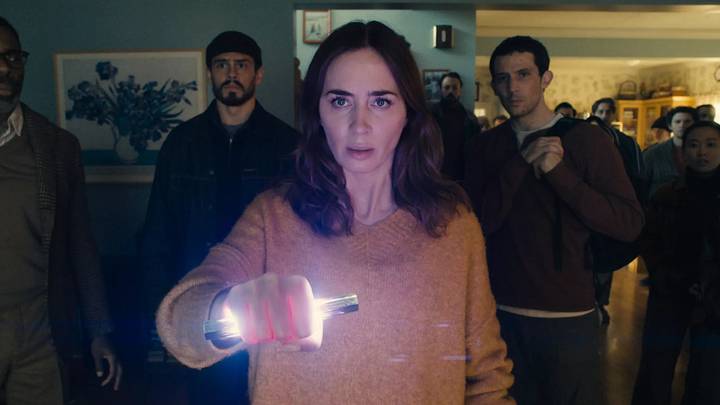
Written by longtime collaborator David Koepp and based upon a story by Spielberg himself, Disclosure Day is a tale of government obfuscation, conspiracy theories, and extraterrestrial visitation. The film takes Spielberg’s long-held fascination with ideas relating to UFOs and the like, and turns it into a two-and-a-half-hour cinematic pressure cooker. The film gets off to a raucous start and then never really lets up, playing out as an elongated chase, albeit, one that is filled with contemplative conversation and meditative themes. And yet, Spielberg and his team are able to essentially have their cake and eat it too, thanks to the propulsive craft on display.
Koepp’s screenplay is intricately structured and does a stellar job of really elevating the kind of fly-by exposition that Spielberg films are renowned for. There’s an entire world developed within the runtime of Disclosure Day, and Koepp’s writing gives audiences just enough to follow along without getting bogged down in the minute details of it all. I honestly am curious how much of this was fleshed out by Spielberg himself, because huge structural components of this are reminiscent, in very complimentary ways, of A.I. Artificial Intelligence, a film whose screenplay Spielberg has full credit on. Like that film, Disclosure Day so entrancingly pulls audiences in, delivering passing references to in-world events, places, or characters, and then subsequently fleshing them out in later scenes. It’s a very rewarding and satisfying kind of narrative structure that holds up even better on repeat viewings.
Disclosure Day is a cinematic feast of a movie, with Spielberg putting every cent of the film’s budget on screen in tactile ways. The production design by Adam Stockhausen (a frequent Wes Anderson collaborator) is staggering, the cinematography choices of Janusz Kamiński (Spielberg’s go-to director of photography for the past thirty-plus years) are as absolutely insane and inspired as always, and editor Sarah Broshar (apprentice and collaborator of Michael Kahn, Spielberg’s longtime editor) delivers a tonal tight-rope walk of a final cut. There are so many instances where the film is juggling so many different ideas, tones, and revelations simultaneously, that in lesser hands it could have so easily tipped too far in one direction or another. But here, Spielberg and co. are able to organically and thrillingly build to a finale that feels both highly impactful and unavoidable.
And of course, as practically goes without saying at this point, John Williams continues to deliver breathlessly synchronistic musical work that pairs so well with Spielberg’s visuals, it is as if they are synonymous with the two characters at the heart of Disclosure Day: destined for each other, gravitating towards one another even from miles away, in the service of communicating a singular idea to mass audiences.
The performances are similarly fantastic. Josh O’Connor brings the same kind of uninhibited and raw emotionality and intuition that made him such as standout in films like Challengers and Wake Up Dead Man, becoming a genuinely fantastic tool for Spielberg. Emily Blunt is flat-out incredible, having the heaviest lift of the entire film’s cast, and managing to make it soar with aplomb. Colman Domingo fits in so seamlessly into the larger vernacular of Spielberg’s craft and sells the ever-loving-sh*t out of some of the biggest stretches of exposition in the film, so much so that it’s easy to imagine him as a mainliner for anything else the director wants to do in the future. And Colin Firth gives what may be his best performance ever. His antagonistic performance is nuanced and intricate and adds so much to the film. Also, special mention for Wyatt Russell, who is great and continues his pinch-hitter streak across every project he’s been in lately.
Verdict
All in all, Disclosure Day is a blockbuster that is contemplative and compelling in equal measure. Steven Spielberg has made a career out of embracing emotion; a throughline throughout all of his films is his own beating heart. And in Disclosure Day, he has made a film that embraces that on an outright textual level: a film about empathy’s value to society, and about emotionality winning out over analytic objectivity. Funnily enough, if there is one film that Disclosure Day reminds me more of than anything else, it is Francis Ford Coppola’s Megalopolis. That similarly latter-era film from a long-venerated filmmaker was an open-hearted, unabashedly sincere film, and Disclosure Day feels like the Spielberg equivalent of it. It’s a big, bold, unapologetic swing of a hard science fiction movie that sees Spielberg capitalizing on the authenticity and transparency of his most recent previous films, and using that long-standing connection with audiences to deliver a deeply affecting message.
Movie grade: A
Disclosure Day is playing now in theaters.
 Add us as a preferred source on Google