

Takashi Yamazaki is a dude who loves Godzilla. When his first Godzilla film, Godzilla Minus One, released in 2023, much was said about what an accomplished film it was, about the now-Academy Award-winning revolutionary visual effects work, and the sheer scale of its use of Godzilla. However, something that got decidedly less attention in all of the discussion was the extent to which Yamazaki’s film was actively interrogating the origins of the franchise itself, and its place within culture. By returning to the time immediately following World War II and setting the story in Japan, Yamazaki made a film that was just as interested in exploring Ishirō Honda’s original 1954 Godzilla as it was in examining the long-lasting damage done to both the land and its people by nuclear warfare.
To this end, heading into Godzilla Minus Zero, I was excited but also a bit confounded. While the marketing had mostly played coy with regard to what the film’s actual primary story might be, it seemed simple enough to ascertain that this film would likely follow the trajectory of seemingly all iterations of Godzilla films, in which the sequel introduces another Kaiju for Godzilla to face-off against. And sure enough, that’s correct. But heading in, I couldn’t help but wonder how such a burly brawl could be accomplished without losing the emotional heft and fascinating metatextual elements that the first film had in spades.
However, as it turns out I needn’t have worried, because with Godzilla Minus Zero, Takashi Yamazaki has delivered a film that manages to double-down on the greatest strengths of the previous film while also expanding the palette of the craft in entrancing ways. The result is a bigger, louder, messier, and altogether even more engaging sequel.
Godzilla Minus Zero review
From the very opening moments of the film, it is clear that this production is going to be a much larger affair. While Minus One was made on the absolutely insane budget of only $15 million (emboldened tremendously by Yamazaki’s own first-hand experience as a lead VFX artist), Minus Zero is clearly working off a much larger financial backing, and eager to showcase that. The opening shot of the film is an extended oner that integrates huge practical sets, incredibly detailed digital effects work, and correlating practical effects, all filtered through the literal lens of the IMAX camera. It’s a big, bold, and riveting way to open the film, immediately dropping audiences into this fully-realized immersive experience.
This is a strength that only deepens over the course of the film, as Yamazaki and cinematographer Kōzō Shibasaki capture the large-scale disasters, conflicts, and emotions with an ever-widening eye for cinematic canvases. Having seen both Minus One and now Minus Zero in IMAX theaters on opening night, I can personally testify that the extensive and artistically invigorating use of the IMAX frame in this sequel pays off in dividends. Godzilla Minus Zero swallowed me whole in a way that I was genuinely not expecting; watching some of the Kaiju-filled chaos (especially in the final act) feels so experiential and immersive that I wasn’t just leaning all the way forward in my seat; my stomach was tightening, my brow was furrowing, as if I was right there alongside the human characters, because that’s what it f***ing felt like.
But what’s perhaps even more striking than the sheer scale of these endeavors is the precise articulation with which they are punctuated. There are tons of practical set builds throughout this film, many of which are made all the larger by seamless CG extensions, and each one of them feels so real and lived in. A tremendous amount of credit must go to production designers Anri Jōjō and Wataru Hirai, who ensure that even as the events of the film grow increasingly massive, the devil very much remains in the details. This also aids inexorably to grounding the human interactions in the film in a real sense of pathos and gravitas, and they are all the better for it.

While Godzilla Minus One had a large cast of characters, it was primarily focused on Ryunosuke Kamiki as Kōichi Shikishima. Shikishima is very much back for the sequel, but the scope of the story has been broadened out, allowing for Godzilla Minus Zero to play much more effectively as an ensemble piece. To this end, all of the returning performers get even more meaty work to do here, and there’s a host of new additions who become absolute scene-stealers in the best of ways. Hidetaka Yoshioka is better than ever as the returning Kenji Noda, who gets a lot more screentime here and makes the absolute most of it, infusing practically every line delivery with this tragic blend of hope and guilt that really makes the character sing. Elsewhere, Min Tanaka is added to the cast as Kanji Murakami, and his performance is nothing short of astounding. Minus One famously became the first Godzilla movie to win an Academy Award (for Best Visual Effects), but I would argue that Tanaka should net a Supporting Actor nomination for his work here; it’s incredible.
I also found the central relationship between Kōichi, Minami Hamabe as his wife Noriko Shikishima, and Sae Nagatani as their adopted daughter Akiko to be incredibly moving. In the first film, so much of the thematic body of work was tied directly into Kōichi’s arc of going from a literal kamikaze pilot to being someone who believes he has a right to be alive. Yamazaki’s script for that film so integrally worked to come around to that full-circle realization for the country as a whole: that survivors need not feel guilt for living, and that to live fully, even in the face of tragedy, is a beautiful thing.
Wonderfully, Minus Zero sees the natural progression of that larger theme, with the film this time instead being directly tapped into the idea of fostering a better world for this next generation; of caring for the children in a way that allows the Japan of the future to be better than the one of the past. Nowhere is all of this more palpably brought into the text of the work than it is in its central familial relationship, and each of the three performers does amazing work throughout. You genuinely believe them as this family, and the film is that much stronger because of it.

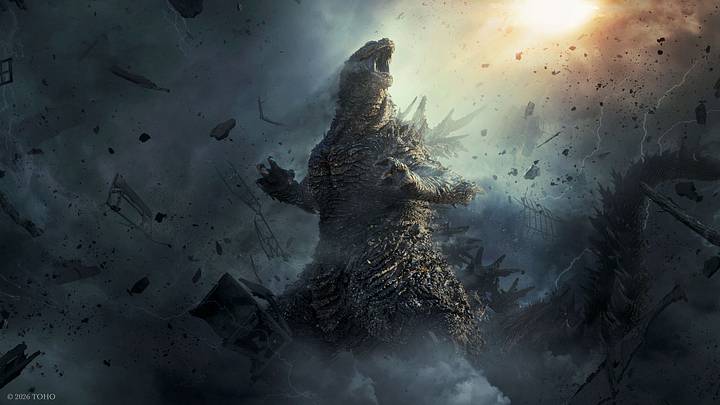
And then, of course, there’s Godzilla himself. I don’t think the Big G has ever been quite as terrifying, imposing, or monolithic as he is here. There’s another classic Kaiju featured heavily in the film (in the name of spoilers, I’ll spare the specifics here) and they are equally incredibly utilized, allowed to grow and develop over the course of the film in ways that both dramatically raise the stakes and allow the film to effectively on-ramp into its insanely gargantuan finale. Pound for pound, blow for blow, setpieces like the mid-film aerial dogfight or the final Kaiju brawl are some of the most enthralling sequences I have seen in any film this year. I would even go so far as to say that the final fight is so brutal, so no-holds-barred, and so remarkably capable of capitalizing on the massive scale and weight of these creatures in palpable ways, that it sets a new high-water mark for the franchise as a whole.
All of these elements come together to make Godzilla Minus Zero a bigger, louder, brasher, and altogether messier film than its predecessor. And I loved it all the more because of that. It feels so idiosyncratic and authentic to Yamazaki’s vision, delivering insane Kaiju action while also carving even deeper into the metatextual and thematic obsessions that made Minus One such a standout. Godzilla Minus Zero is unlike anything else you will see in the theater this year, which is why you should catch it on the biggest screen possible as soon as you can.
GRADE: B+
 Add us as a preferred source on Google