

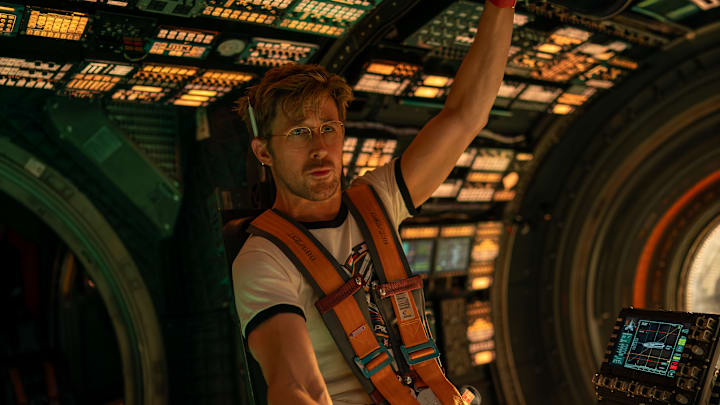
Based on the novel of the same name written by Andy Weir, Project Hail Mary is a fun, engaging sci-fi thriller that makes you feel smarter just watching it.
It's another movie I would put into the category of “nasapunk” sci-fi. The technology is near-future and highly practical, bringing us much closer to the engineering and biology the characters use to solve their astronomical problems. Nothing is outside the realm of possibility, which is a refreshing take on science fiction. It's similar to other nasapunk stories, like Interstellar (2014) and The Martian (based on the book, The Martian, also written by Andy Weir). Project Hail Mary is an optimistic yet dread-inducing story of sacrifice and bravery—for the good of humanity and the preservation of science.
The first half of this review is spoiler-free, but I would highly recommend going in on this one blind. Assuming, of course, that you haven't read the book. Whichever launches your ship! Read the bottom for a final verdict.

Project Hail Mary has a perfect balance of high-stakes and humor
Project Hail Mary follows a molecular biologist, Ryland Grace (Ryan Gosling), who wakes up on board a ship called the Hail Mary, hurtling through space toward the Tau Ceti system, with amnesia. He's the only surviving passenger. Back home, the Earth’s sun is dimming, and the answer to preventing this apocalypse is at his destination.
Directors Phil Lord and Chris Miller brought out their strengths for Project Hail Mary. Their style of humor was all over the characters and how they processed the stressful situations they found themselves in. However, no joke overstayed its welcome or felt misplaced. Most humans tend to make light of a situation to grasp its totality, and that's exactly what Ryan Gosling portrayed excellently in his character, Grace. If you can't laugh when the weight of the human race is on your shoulders, then you're gonna go insane real quick. It's not for everyone, but it's accurate to the book, and it's exactly what this movie intended to do.
Project Hail Mary isn't without its darker moments, though. There was one scene in particular that was genuinely unnerving. It changed the entire perspective of Grace's journey both literally and narratively. It's not something you typically see from a "heroic" protagonist, but it was undeniably raw and human.

As the scenes bounce from past and present, Grace gradually remembers how he ended up onboard the Hail Mary, and how much of a coward he was at the start. Although I'm not a master biologist on astrophages, Grace was still a relatable character throughout. Afraid to do what it takes to be brave, yet figuring out problems life throws at him one step at a time. Even in an adaptation, Andy Weir's style channels The Martian's "I've got to science the sh** out of this" energy perfectly. Trial and error drives character and plot like a light-speed rocket.
Rocky, played by James Ortiz, is the most likable character, despite having no “face.” It goes to show you don't need much to show emotion on screen. He's an alien astronaut whom Grace meets about halfway through the film. He's some sort of mineral or silicone-based lifeform that needs a hot atmosphere of ammonia to live, which creates friction with Grace, obviously. But they're both on the same mission from their worlds: find a cure for their star. Their friendly chemistry is done remarkably well, and I think it will be remembered as one of the best buddy comedies in space ever.

Spoilers for Project Hail Mary ahead!
Project Hail Mary contains one of the most fascinating alien concepts I've seen unfold on screen. The astrophage is an interstellar infection––a star disease. In humanity's cosmic background, stars have been dropping like flies. All except one, Tau Ceti. It either has an immunity, or something is protecting it.
Grace, with the help of Rocky, discovers that "life is reason" that the astrophages aren't consuming Tau Ceti. Lifeforms on its planet, Tau-Ceti-E, are attracting the star-traveling viruses and consuming them. There's a lot of science set up before this revelation, of course, like how astrophages breed and migrate. It's all revealed at a fast pace, yet consumable for the average viewer without dumbing down its hard-calculated concepts.
Grace's character arc is also like an inverted chosen one. He was sought out for his expertise on theorized alien molecular biology, only to find out his theory was wrong. Instead of letting go, he wants to join the project to discover more things and prove himself useful. He goes from being a school teacher to a world-class, top-secret clearance scientist. And by becoming invaluable, he inevitably became the only one who could study the astrophages in space onboard the Hail Mary. But there's only enough fuel for a one-way ticket. Getting on board means death, whether the mission is a success or not. Grace refuses the offer. That's when the government forces him onto the ship through sedation. It's a disturbing scene, even if you understand that it's the only way. Despite his agency being taken away at that moment, his choices led him there. He got himself into this whole thing.
In my opinion, he didn't redeem himself when he figured it all out and sent the data to Earth. He was always going to pull it off. Everyone had faith he would. Grace's redemption came when he chose to sacrifice making it back to Earth to save Rocky's ship, and save his world of Eridians. Ryland Grace chose for himself to be a hero, to be brave.
Verdict (No Spoilers)
Project Hail Mary is a fantastic space adventure with thrills and an engaging plot that doesn't compromise on fascinating ideas or memorable characters. It's highly recommended for fans of near-future science fiction with practical, NASA-inspired designs, like in Interstellar, The Martian, or even The Expanse. It's a balanced story with hope and despair, stakes that are earned, and it will have you walking out believing you can put your mind to accomplishing anything.
Final Verdict: 10/10
 Add us as a preferred source on Google