

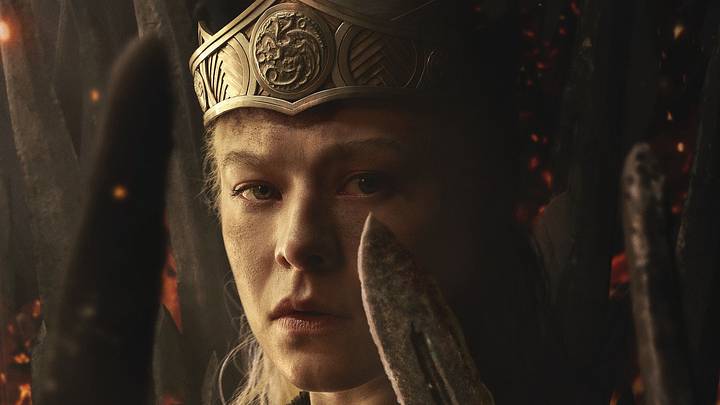
The premiere date for House of the Dragon season 3 is fast approaching, and the picture of what's in store is becoming clearer by the day. It's been a slow burn for HBO's Game of Thrones spinoff as the Dance of the Dragons civil war has heated up, but now at last, dragons and armies will collide, heads will roll, and the most deadly period of this struggle for the Iron Throne will begin. It should make for good television!
At the heart of it all is Rhaenyra Targaryen, played by Emma D'Arcy. Over the course of the first two seasons we watched Rhaenyra grow from a spoiled young princess, to a young woman causing scandals at court through an illicit affair, to a responsible heir worthy of the crown, to a queen stricken by indecision as her advisors pulled her to and fro while she tried to avert disaster. All that's set to change in season 3, as the show adapts a much darker arc for Rhaenyra from George R.R. Martin's novel Fire & Blood.
However, book fans are in for some surprises as well, if recent comments from D'Arcy and showrunner Ryan Condal are anything to go by. The pair appeared in a recent set of press conferences attended by Winter Is Coming, and they weighed in on a somewhat surprising development for Rhaenyra coming in season 3: her growing "religiosity," and how her belief in her own "divine mandate" to rule will shape her actions as queen.
"The delight for me is that she's sort of finally in a position of confidence and power, both personal and political, strategic," D'Arcy said of Rhaenyra's season 3 storyline. "And so a character who we've seen in a sort of reactionary position for the majority of two seasons is finally positioned to act. And some of the sorts of restraints have finally been lifted, I think."
"And I think there is a great clarity to her thinking," they added. "I think she has a sort of growing religiosity. I think she's leaning increasingly on her faith. I think she believes hers is a holy war. I think she believes she has a divine mandate to rule, and with that comes a reduction in doubt...so I think we are primed to see quite a different side to her character."

Rhaenyra believes she's the "chosen one" in House of the Dragon season 3
Condal dug even deeper into Rhaenyra's season 3 trajectory, saying that characters going on huge, transitional journeys that reframe how audiences view them is "the special sauce to the show."
"I think that's also the thing that Game of Thrones established so well...Jaime Lannister when he throws Bran out the window is different than the Jaime Lannister midway through the show when he's got one arm, or one hand, and he's running around with Brienne versus Cersei," he explained. "You know, with our big characters that we spend a lot of time with in the show, you're going through similar sort of experiences with them, just because who the character is in this single moment in time does not mean that that is that who that character is [for] all time. And that would be, you know, sort of boring to do."
Condal cited Rhaenyra as the "prime example" for House of the Dragon of this kind of huge, complex character arc. From her beginnings as a teenager who was unexpectedly named King Viserys' heir to her challenges commanding her subordinates in season 2 when she's "trying to rule by consensus" in the same way as her father, Rhaenyra has had a lengthy journey. But the most fascinating chapter is yet to come, and Rhaenyra will have to make "moral compromises for her family, for herself, for her claim."
"And then this idea of, you know, predestination and all these big ideas that we play with in epic fantasy," Condal added. "We were really fascinated that in the Song of Ice and Fire and Game of Thrones world, where this is where we subvert the tropes of high fantasy and that chosen one. Luke Skywalker, Harry Potter, you know Frodo or Aragorn from Lord of the Rings, these are well-established tropes. In this show that subverts everything...when you tell a main character that they're the one, the gods have chosen them to rule, the power of six dragons behind them, well you know at some point [they start] believing their own press, don't they? And they believe that they can do anything, right, if the gods intended it be so. And I love how that interplays with current politics and recent history in the way people rise in these kind of monarchic slash autocratic political scenarios. I think Rhaenyra's character is an incredibly complex characterization of that that hopefully is sympathetic and also, you know, kind of tragic all at the same time."

House of the Dragon will seemingly lean even more on prophecy in season 3
The arc D'Arcy and Condal describe for Rhaenyra lines up quite well with her book counterpart, since this is the phase of the Dance where the Black Queen starts becoming ever more paranoid and cruel, buckling under the pressure of rule, the specter of betrayals, and the weight of all those she's lost. The one big change is the inclusion of religion into the mix for Rhaenyra, specifically. In Fire & Blood, the smallfolk have their own beliefs that play a major role in the events that unfold in King's Landing during Rhaenyra's occupation, but Rhaenyra herself is depicted more as a grasping, power-hungry politician than a "chosen one."
Ever since House of the Dragon decided to include the idea that Aegon the Conqueror had a prophetic dream about the White Walker invasion which occurs centuries later in Game of Thrones, the series has found ways to cram it into plotlines for better and worse. It's been a central part of Rhaenyra's story, but I would be lying if I said this talk of her growing more religious didn't make me slightly nervous. I can only assume this path for Rhaenyra is where the lines "I am Rhaenyra the Chosen, I am the Prince That Was Promised," came from, which feature on an official shirt sold by HBO around a picture of Rhaenyra before the Iron Throne. (Curiously, this shirt has since been removed from the HBO store — perhaps because it was flagged as too spoilery?)
WB Shop has unveiled new ‘HOUSE OF THE DRAGON’ merch, featuring what could be potential Rhaenyra lines from Season 3. 🐉
— westerosies (@westerosies) May 6, 2026
“I am Rhaenyra the chosen. I am the prince that was promised. I did not wish to be ordinary.”
(🔗: https://t.co/1fqVTpAeUQ) pic.twitter.com/Y2wb4EXq34
Handled tastefully and with restraint, the Song of Ice and Fire prophecy has added an extra layer to House of the Dragon that ties it even more tightly to Game of Thrones. But when it has served as a convenient excuse to force people into actions, such as when Alicent Hightower pushed her son Aegon onto the throne because she misheard King Viserys mumbling about the prophecy on his deathbed, it doesn't work nearly as well. We'll have to see which of those camps Rhaenyra's newfound faith falls into when House of the Dragon premieres later this month.
House of the Dragon season 3 debuts its first episode June 21 on HBO and HBO Max.
 Add us as a preferred source on Google