

Five years on, and the board has moved
The Rings of Power season 3 opens five years after the fall of Eregion. The war against Sauron (Charlie Vickers) has ground to a stalemate, and the episode’s war council spells out his next move: with the Elves presenting obstacles, his eye turns to Men. He is recruiting the Lossoth from the north and the Haradrim from the south. The war is canon, as is Sauron’s approach to the Haradrim. The Witch-king of Angmar threatens the Lossoth in the LotR appendices.
Some of this catch-up is overdue. Míriel (Cynthia Addai-Robinson) no longer holds the sceptre of Númenor, so the show’s timeline is finally edging towards the Akallabêth, a key chapter of The Silmarillion. Galadriel (Morfydd Clark) finally brings up Elros. Durin (Owain Arthur) and Elrond (Robert Aramayo) are friends again, a relief after two seasons of strained loyalty, despite having no friendship in the books.

Celebrimbor is back, Sauron is plotting
Sauron puzzles out how to make the One Ring after his failed experiments in the opening scene, with Celebrimbor (Charles Edwards) hanging dead on a wall. His ghost, very much alive, paints the most detailed psychological portrait of Sauron offered yet. Invented, but believable. Tolkien was sparing with psychological detail on Sauron and many Silmarillion characters, but an adaptation updates its source material. And Sauron was starting to look a little childish in season 2, so this detail is right on time.
Tolkien loved to complicate narrators and perspective, with characters writing about characters talking about characters. Celebrimbor says he and Sauron were never partners, the machinery of Sauron’s soul is missing a piece, the part that allows a true bond with another being, so in place of connection he seeks control. And yet, Celebrimbor lives rent-free in Sauron’s head, the angel on his shoulder, communicating the more complex underlying logic that the show’s Sauron seeks, interrogating his drive for control.
Celebrimbor asks Sauron how it feels to know that the conquests he wants will forever elude him, and that he will never master “her”. But it’s Sauron really diagnosing himself in Celebrimbor’s voice. In the books, Sauron’s raison d’être did become control, but he was also capable of need for interpersonal stimulation or even love. He wasn’t obsessed with Galadriel, but did know she’d be one of his most powerful adversaries, disliking her scorn in Eregion and groping to see her mind for millennia, despite letting her into his.
Tolkien never said Sauron lacked empathy or was incapable of love, rather that nothing was evil in the beginning. He “adored” Morgoth at first. And in fact, Sauron had a whole normal social history before he was corrupted by Morgoth, working with Aulë and becoming widely respected, making works of great renown. And Tolkien never said Sauron was insecure and lonely as he clearly is here, but it does track for that to lie under his pride. It was shame and fear of humiliation that kept Sauron from submitting to the Valar after Morgoth’s fall — it completely guided his Second Age.

Galadriel needs company, Durin needs a holiday
Galadriel insists she has not seen Sauron in five years in the flesh or in her mind. Hilariously, cut to her dreaming of him lying in bed next to her, pulling her towards him and asking for her back. Later, she reveals her secret pain to Arondir — loneliness, harder to escape at night. Galadriel never pined for Sauron in the books. She did, however, interact with him mentally, searching his mind for details that could beat him, as she stated in the Third Age, while he certainly knocked on her mind’s door.
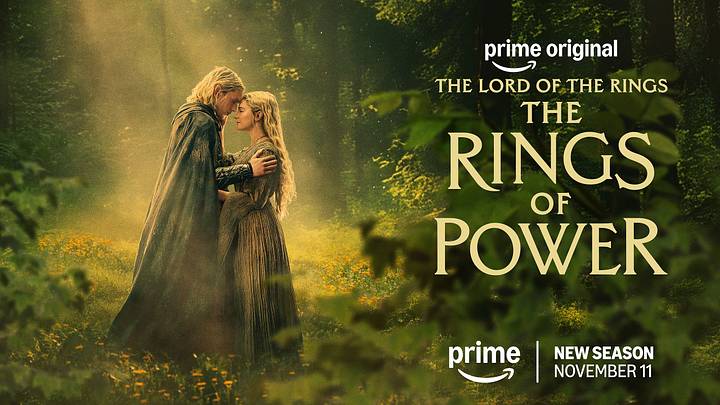
Vickers said to Nerdist: "I think in Sauron's mind, maybe Galadriel didn't reject him. I think he just tried to ignore that." So in this dream, Sauron is most likely invading Galadriel's mind. Tolkien’s Ósanwe-kenta posits that no mind can be forced open, only one left unguarded. Galadriel’s loneliness is the unguarded door. Enter Celeborn (Jamie Campbell Bower), if only in a flashback to his First Age meeting with Galadriel in a forest glade. And in most of Tolkien’s work, they did indeed meet in a forest kingdom — Doriath.
The dwarven storyline is the warmest part of the hour. Disa (an original character) has phenomenal hair. Her children with Durin (original characters) are driving them up the wall — also phenomenal. Thráin (Eddie Marsan), Durin’s brother, visits, showing off his “princely arse,” not a quote lifted directly from Tolkien, and probably all the funnier for it. Likewise, the expletive “Aulë’s arse.” The aptly named Thráin is an original character. Responding to criticism about the lack of distinct women’s Dwarf beards, this episode presents a truly impressive one that leaves Disa green with envy.

Ringwraiths rise, Rhûn’s purpose becomes clearer
Sauron says the ancestors of Khamûl (Zubin Varla) ruled Rhûn a thousand years before the Dark Wizard came, and when they refused him a place of honour, he cursed their flesh and their children’s children. Sauron calls Khamûl “fairest of the Nine.” This is all made up by the show, but it would make sense for the Ringwraiths to come from noble stock, given they managed to rise to become kings and rulers in their time, albeit with Sauron’s help. And of course, Khamûl the Easterling is one of the Ringwraiths in the legendarium.
Sauron is also tempting Númenor with rings, apparently without success. The Akallabêth says three of the Nine were great lords of the Númenórean race, so that refusal may not last. Shockingly but not surprisingly, Theo (Tyroe Muhafidin) turns up on Sauron’s doorstep at the end of the episode asking for a ring in return for rebelling against Númenor for him. Led by the vicious Kemen (Leon Wadham), the Númenóreans in Pelargir are no safer allies for Theo than the Orcs were in season 1. Tolkien never wrote a Ringwraith called Theo, but with most of their identities unknown, there’s room for invention.
Tolkien built Middle-earth from its languages outward, and the season 3 premiere’s vocabulary shows how the show handles that inheritance. Showrunner J.D. Payne has explained that the team took nazg, “ring”, from Tolkien’s Black Speech and inferred a word, nagôl, meaning “servant”. The result is Nazgnagôl, “ring-servant,” the Ringwraiths before they are full wraiths.
The Rings of Power season 3 is streaming now on Prime Video. For more on the season’s new arrivals, see our guide to the new characters coming in season 3.
 Add us as a preferred source on Google