

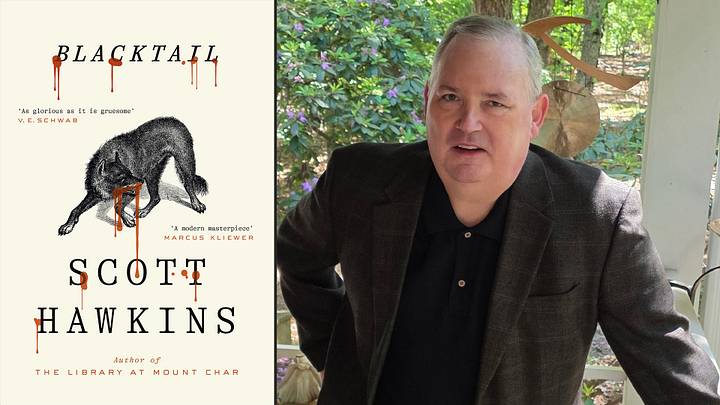
Scott Hawkins is one of the most celebrated cult figures in modern fantasy. His debut novel The Library at Mount Char published in 2015 and promptly found its way to the top of every essential dark fiction reading list on the internet, where it has remained ever since. 11 years on, the beloved author is back with his second novel, Blacktail.
Blacktail just hit shelves from Crown in the US on September 1 and from Tor Nightfire in the UK on September 3, and we were lucky enough to have Hawkins answer some questions over email ahead of its release. Where Mount Char was a story about gods and children and the terrible price of power, Blacktail goes somewhere rawer and more elemental, following a half-breed wolf named Blacktail who loses his mate and unborn pups to human cruelty. What begins as a grief-fueled rampage escalates—via an ancient feline witch with an offer he can't refuse—into a journey south to find and wake a sleeping Forest God and end the age of man altogether.
The book has been described as Watership Down meets the apocalypse, but I think that's underselling it. Hawkins brings this fable-like, oral-history rhythm to the animal world with the stakes cranked up to something apocalyptic and a deadpan streak of humor that keeps the brutality from becoming suffocating. It's eco-horror, folk fable and revenge odyssey all at once, and the book already has starred reviews from Kirkus and blurbs from V.E. Schwab, Mark Lawrence and Chuck Wendig.
We asked Hawkins about the 11-year gap, the experience of writing animal grief, where the Old Kitty Mother came from, and what he hopes readers take with them when they close the last page.

ASH ANJUM for Winter Is Coming: It has been 11 years since The Library at Mount Char. How did it feel to finally be bringing a second novel into the world, and was there ever a moment you doubted it would happen?
SCOTT HAWKINS: The true answer to this is also the obvious answer. It felt absolutely glorious.
It was also a huge relief. I sort of had it in my head that once you got published, you were more or less guaranteed a second at-bat. Part of that wrong assumption was economic, obviously, but another part was the idea that if you'd leveled up enough in skill to get one book published you could probably get another one out the door.
That turned out not to be true, at least in my case. Part of it was, I think, that I got sloppy. Mount Char was a weird book, but enough people found it comprehensible to get at least a cult following.
I wrote two complete manuscripts in addition to Blacktail between Mount Char and now. Everyone agrees that they were not very good. The word "incomprehensible" has been used more than once. There were other problems as well.
So yes, I did indeed have some very serious doubts about another book ever seeing the light of day. "One hit wonder" is a thing. Hopefully I get to be at least a two-hit wonder, but going forward I'm making a point to not take anything for granted.
WIC: Blacktail is a different book from your debut, but it feels unmistakably yours. How would you describe your own writing sensibility to someone who had never read you before?
SH: I would say that since childhood I've often been the weirdest guy in the room. My stories reflect that. I would emphasize that this isn't an affectation. If anything, I try to tone down the weird.
To me what I come up with feels perfectly normal. To other people…maybe not so much. I've had a lot of awkward first dates.
WIC: The decision to tell the entire story through animal perspectives is such a bold one and we love it. What drew you to that approach and what were the biggest challenges in doing it across a whole novel?
SH: The biggest challenge was relating concepts like time, distance and technology from the point of view of animals in a way that would also be comprehensible to readers. As a for-instance, getting across the notion of the automobile was a head-scratcher. I had to take several passes at that before I found one that I liked.
As far as what drew me to an animals-only POV, it was just a story I wanted to tell. The bigger question was whether it would be too risky to commit however-many months to writing a purely anthropomorphic story. I had to chew on that for a while before I took the plunge.
Ultimately, I decided to try it for a lot of little reasons. I was always a fan of Richard Adams, who also wrote some really cracking good animal stories such as Watership Down, The Plague Dogs and Shardik. So I knew such a thing could be done, at least in theory, even if it wasn't a common approach.
Another factor is that dogs are a big part of my life. At one point we had seven big dogs in the house full-time. During that same period, my wife and I worked with an animal rescue. So, in one way or another, I've been exposed to human callousness towards animals for a long time. I thought there might be a story in that.
Last but not least, the lion characters in Library at Mount Char were fan favourites. If it hadn't been for that, I probably wouldn't have chosen to commit to a story told entirely from an animal point of view.
You're right, it wasn't a small risk. But at that point, I already had something like six failure-to-launch novels boxed up in my basement, including three written prior to Library at Mount Char. What's one more?

WIC: Blacktail's grief over losing his mate and their unborn pups is the emotional engine of everything that follows. How did you find the right way to write that kind of loss so that readers would feel it as deeply as he does?
SH: I don't have a good answer to that. Honestly, it just flowed. Over the years I've buried eleven dogs and God knows how many people who I would give literally anything to bring back.
That kind of loss recedes, but I think it's always going to be there to some degree. Even to this day every so often I catch myself thinking that I need to tell my Dad something. He's been gone for twenty-plus years. Miss you pop.
WIC: The Old Kitty Mother is already being talked about as one of the most memorable characters in the book. Where did she come from, and how much fun was she to write?
SH: Blacktail the novel was written around a short story of the same name I did in response to a prompt in an online writing workshop. The prompt was something like "write a fantasy story from the POV of a non-traditional protagonist."
If you look very close you can see where I kind of filed the serial numbers off of the movie Conan the Barbarian for Blacktail. I'll stay away from specifics to avoid spoilers, but at one point in the movie Conan bumped into a witch who told him where he could find the man he was looking for. The Conan witch was the spark that became Old Kitty Mother.
And yes, she was an absolute blast to write. If memory serves she was originally intended to be a walk-on like the witch in Conan, but I was having so much fun that her part kind of ballooned.
WIC: The novel has been described as Watership Down meets the apocalypse and there is a real folk horror, fable-like quality to it. Were there any books, myths or storytelling traditions that were living in your head while you were writing it?
SH: I wasn't really consciously trying for an oral history-slash-fable-slash-folklore kind of vibe. It just kind of came out that way. Unusually for me, I knew pretty much where the story was going from page one and I just fell into that rhythm without thinking about it much.
The tone was also loosely inspired by the New Testament, where a figure is being remembered by different people who knew him in different ways.
WIC: Humanity does not come out of Blacktail particularly well. We are very much the monsters of this story. Was it uncomfortable to write from that perspective or did it feel oddly liberating?
SH: Yes, but I'd scratch the "oddly" and just call it "liberating," full stop. Here's a for-instance:
Several of my dogs were adopted from nearby kill shelters. One of the shelters reminded me of the building where they stashed the Ark of the Covenant at the end of the first Indiana Jones movie. It was just this vast, dark warehouse with fluorescent lights waaay up high. If memory serves, you couldn't see the far end.
The floor had rows of kennels, hundreds of them, with six or eight dogs each roughly segregated by size. You could tell they were all traumatized to a greater or lesser degree. The dog I ended up adopting was a Bernese mountain dog named Thane, who some of you may remember from the jogging chapter in Library at Mount Char.
While I was doing the paperwork, some guy came in to surrender a cat he didn't want anymore. I could have cheerfully shot him.
Humanity was not intended to come off particularly well in Blacktail.
Lest I come across as too holier-than-thou, I do not exempt myself from this. If I had the courage of my convictions, I'd be a vegetarian. I'm not.

WIC: There is a wonderful tension in the book between genuine darkness and moments of strange, deadpan humour. Squirrel death cults, cats named Snooky-Ookums, dogs revering their food-rocks. How do you find that balance between the brutal and the absurd?
SH: That's another very deliberate choice. It's actually part of my rewrite checklist.
I've noticed that readers will forgive a lot if you can get a chuckle out of them every so often. Left to my own devices, I tend to land a little bit too deep into the "gloomy" side of the bell curve. With that in mind, I do a rewrite specifically to punch up the one-liners and add scenes that are specifically for grins.
WIC: By the end, the stakes escalate to something cosmic. Did you know from the beginning how big the story would get?
SH: Yeah, I think I mentioned earlier that this particular novel was based on a story I wrote a loooong time ago. It was a more or less ground-up rewrite, but the beats are the same. I didn't have every single detail ironed out, but the bones were there.
WIC: Finally, what do you hope readers carry with them after they close the last page of Blacktail?
SH: At its core, Blacktail is an "Our Hero is Pushed Too Far" story along the lines of Outlaw Josie Wales, Conan, or pretty much any Bruce Lee movie. I'd be very happy to inspire the same sort of catharsis in the reader that those stories inspired in me.
And yes, maybe a little self-reflection about man's place in the natural order would be nice as well.
11 years is a long time to wait for a second book, but Blacktail makes a compelling case that some things are worth the patience. For Scott Hawkins fans like us, this book is everything we hoped for and nothing we expected — and our love and admiration for Scott Hawkins has only deepened for it.
Blacktail is available now, wherever books are sold.
 Add us as a preferred source on Google