

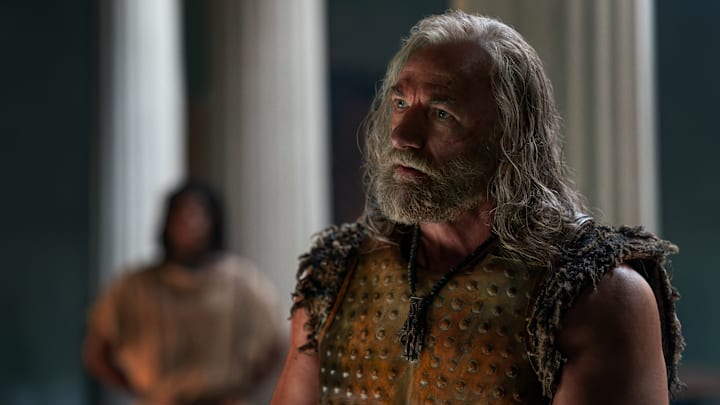
It's time to return to the ludus for another episode of Spartacus: House of Ashur. "Unworthy" picks up right where the show's two-episode premiere left off, with the gladiatrix Achillia (Tenika Davis) having gained the respect of Korris (Graham McTavish) after she managed to draw blood in a duel to the death. Ashur (Nick E. Tarabay) has strong opinions about Korris' approach to testing Achillia, and decides to send his Doctore on a mission outside the ludus walls.
This episode is where things really start picking up for Spartacus: House of Ashur, with some great politicking, drama at the ludus both in the fighting pit and among the house slaves Hilara (Jamaica Vaughan) and Messia (Ivana Baquero), and the most intense fight scene yet for the series. Let's get right into the FULL SPOILER recap.

Spartacus: House of Ashur Episode 3 is all about loyalty to the ludus
"Unworthy" begins with Ashur and Korris hashing out their differences over how things went down with Achillia and Creticus, the gladiator who she killed in the Episode 2 after he attempted to rape her. Ashur is frustrated that Korris tested Achillia with real swords where she could have died; Korris is upset that Ashur seems so indifferent to the death of Creticus, since the ludus isn't exactly overflowing with talented warriors. It's an excellently scripted and acted scene, where Korris and Ashur level with each other as near-equals in a way that adds a lot of depth to their partnership.
Of course, they aren't quite equals. After Ashur gets Korris to admit that he spared Achillia because she proved herself worthy — which supports Ashur's faith in her abilities — the Dominus decides to test Korris' own loyalty by sending him into Capua on a secret mission. We find out the true nature of that mission by the time the credits roll, and the gradual reveal is one of the episode's strengths.
With Korris heading out of the ludus for the day, he names Celadus (Daniel Hamill) as Doctore in his stead. Celadus is the oldest gladiator in the ludus and a former comrade of Korris. He's an interesting character and we need this time to get a better feel for who he is, as he tries to reign in his headstrong son Tarchon (Jordi Webber) and quash the growing resentment among the gladiators for the woman fighter training in their midst.

While Celadus trains the gladiators, Ashur observes from on high with Hilara and Messia. He can tell that something is holding Achillia back, but can't quite put his thumb on what it might be. This leads to a confession from Hilara that she visited Achillia in her cell, and has suspicions that whatever ghosts of the past haunt her, they're tied to the scarring on her hand. Ashur isn't a fan of Hilara going down into the ludus without his permission, which starts a smaller arc of the episode where he grows frustrated by Hilara overstepping her station.
For now though, Ashur decides to go out to the ludus and train with Achillia himself to see if he can figure out what's weighing her down in order to help her reach her full potential. And as part of that, he finally makes the call to let her train with two swords instead of a heavy shield, letting her capitalize on her speed. I've been waiting for this, and I'm glad that someone finally let Achillia switch up weapons to something that better suits her style.

Subterfuge in Capua
From there the scene shifts to Capua, where Cossutia (Claudia Black) is out on the town with her friends Horatia (Lisa Chappel) and Modesta (Jacque Drew). They run into another noble woman who they have a low opinion of, Lafrenia (Tandi Wright), and it gives us a deliciously awkward and catty scene as they all trade barbs about Lafrenia's un-notable husband and Cossutia's reclusive daughter, Viridia.
The costuming is also very much worthy of a shoutout here. It's so immersive on Spartacus: House of Ashur that it's almost easy to forget about because it just feels real, and the many colors of the marketplace are a great example of this stellar quality of the show.
Cossutia and her cohort spy Korris moving through the streets and try to gain information about Ashur while simultaneously hitting on the old gladiator. But Korris is a free man, and can go his own way as he chooses. Having a former gladiator like him in the mix adds a fascinating dimension to the show, as he comes into contact with the nobility and can speak freely to them, but is still in a completely separate social echelon. McTavish gets a lot of different scene partners in this episode, and he brings the most out of all of them.
This scene with Cossutia and Korris reveals an important detail which was only hinted at in the first two episodes: Korris is gay. That becomes relevant later in the episode, so file it away.
To the fighting pit
After his encounter with the nobles, Korris heads to a street fighting pit to try and scare up some grain for Ashur's ludus. The fighting pit is brutal and also a little hilarious. A lady in the crowd smashes a wine jug over a fighter's head, then gets promptly punched in the face as things devolve into chaos. People have sex in the hallways. It's Spartacus, through and through.
Korris has two important run-ins at the fighting pit. The first is with Fides (Mel Odedra), a former comrade-in-arms who has fallen on hard times. Fides asks Korris for money, then begs, then threatens, until finally Korris is forced to headbutt him and tell him off. We see Fides watching Korris afterward, so it's no surprise when this move comes back to bit Korris by the end of the episode.
The other big encounter is with Opiter (Arlo Gibson), where the Roman reveals there's no grain to be had from the master of the fighting pit, but that he has a stockpile he'd be happy to share if Korris would humor him with a visit that evening. The two depart, setting the stage for some of the episode's most interesting scenes to come.

The schemes of Cossutia and Gabinius
Before we catch back up with Korris and Opiter, let's go through the other plotlines of "Unworthy." The scene eventually follows Cossutia home from the marketplace, where she finds her daughter Viridia (India Shaw-Smith) and her husband Gabinius (Andrew McFarlane) playing a game similar to checkers called Ludus latrunculorum. Cossutia pressures Viridia to go out on the town, which obviously sours the mood of the game.
We don't see whether that parental pressuing bears fruit, but instead get a great scene between Cossutia and Gabinius that gives us more insight into their marriage and their joint scheming. There's a feeling that these two genuinely care about each other, but are such political creatures that they always have their hands in some manipulation or other. Gabinius may seem kind and gentle, but here he reveals he gave Ashur crucial information in the previous episode as a test, to see whether he passes it on to his patron Crassus or not. It's all in the name of discovering whether the Syrian can be a useful tool for Gabinius' own ends.
The pair also discuss Ashur's obvious interest in their daughter, something which Gabinius finds to be fine and makes Cossutia sick. They end their conversation with a spat about it. The only other scene we get with Cossutia in the villa is her receiving a letter addressed to Gabinius, which she decides to handle herself. We'll talk more about that momentarily.
There's one other intriguing detail that's worth noting here: both Cossutia and Gabinius believe that it's actually Korris' reputation as a former champion of the arena that's propping up the House of Ashur at this point. This episode really fills out a lot more of the picture about who Korris is and why he's such an important figure in this show.

Achillia lays her past to rest
There's also an interesting parallel going on between Cossutia and Ashur, who are both trying to manipulate things to their advantage and ending up frustrated. Ashur erupts at Hilara when she oversteps her position and offers unasked for advice, shouting that she is not his wife. But you can tell he regrets this outburst.
Celadus is also having his own problems as Doctore, mostly caused by his son and the headstrong gladiator Erato. Their refusal to listen forces Celadus to step in and lay out Erato, which is both a cool little fight scene as well as another good moment to get to know Celadus, for the audience as well as characters like Ashur and Achillia, both of whom clearly like what they see.
As Ashur continues dueling with Achillia to try and draw out the truth of what's holding her back, a different sort of confession happens between the house slaves Hilara and Messia. Messia reveals that she has feelings for Hilara — which are not reciprocal. Messia handles the rejection well enough in the moment, but later in the episode when Ashur makes love to Hilara as a way of smoothing things between them, Messia tries to join. Hilara kisses her once, before ordering her away to fetch wine and give them privacy. Things are getting messy in the House of Ashur.
Eventually, Ashur does get Achillia to reveal what's been holding her back: she failed an important duty in her previous home, and can't let go of the guilt. Ashur actually shows compassion during this scene, encouraging her to embrace her present rather than clinging to her past. It's a surprisingly emotional moment for the two of them. And just as they finish talking, it rains; a nice callback to Spartacus, who gained the nickname "Bringer of Rain" after a downpour during a crucially important scene.

Opiter and Korris
Now it's time to circle back to Opiter and Korris. Their meeting at the villa reveals a surprise attraction, as Opiter shamelessly (but skillfully) flirts with Korris, who gradually warms up to him. McTavish and Gibson play these scenes so well; Opiter is flawlessly charming and genuine, while Korris almost seems surprised at himself for enjoying the other man's company.
Opiter wants Korris to become the Doctore of his own ludus, rather than Ashur's. And it actually does feel like Korris considers it. When the entertainment turns from two naked slaves wrestling to having sex, it leads to Opiter spilling secrets about the appetites of Horatia and Cossutia. It's such a testament to how well-written this show is that while all of this is going on, the script remains so sharp that the titillation never undercuts the drama. Whether you love the extreme style of Spartacus or not, it's impossible to deny how utterly well-crafted this show is.
Opiter and Korris leave on an interesting note, with obvious romantic tension. Opiter wants to see Korris again, and Korris uses this fact to ask a favor: for Opiter to try and convince Cossutia, whose husband is hosting the Ludi Apollinares, to allow Ashur's fighters into the games. This is a intriguingly layered political play, because it disadvantages Opiter in the present — but since it's also a reflection on Korris' training if the gladiators do well, it would benefit Opiter down the line if Korris ever defects. The interplay between these two is a definite high point of the episode.

Korris shows he's the most deadly warrior on Spartacus: House of Ashur
However, the politicking is only a warm up to the real highlight to come. When Korris tries to head home in the rain, he's set upon by a group of assassins. What follows is easily the most brutal and well-choreographed fight scene of the series so far, as Korris cuts his way through the entire group of brigands. I genuinely worried Korris was about to die Barristan Selmy-style when he got stabbed in the stomach, but he fights through, showing that he is still by far one of the most dangerous warriors in the show. Eventually, Fides reveals himself as the person leading the group. I like that he takes a second to gloat and it blows up in his face. But he gets away before Korris can kill him, leaving our Doctore with the knowledge that someone else hired Fides and his assassins, but stopping short of revealing the name.
After the battle we head back to Ashur's ludus, where Achillia is once more in her cell. She gets flashes of memories, and, determined to finally leave her past behind, scribbles out the carving of the God of War on her cell wall. She's interrupted by Ashur calling her out to the ludus, where he brands her with the mark of the gladiator brotherhood, despite objections from Tarchon.
Right as Achillia swears her oath, Korris arrives back to the ludus. The medic does such a mediocre job stitching him up that Ashur yells at the man, which is a great example of House of Ashur's random humor popping up in unexpected places. It's revealed that Ashur's task for Korris wasn't to get grain, but to meet with Opiter and try to manipulate him into getting their warriors into the games. It's enough to actually make me feel bad for Opiter — and Korris, who seems conflicted about using the other man. They believe Fides was working for Proculus, and Ashur is fully prepared to get revenge at the opportune time. I like that these two are thick as thieves, and this episode firmly cements their partnership.
But then we get one final scene, which shows their theory about Fides' employer isn't accurate. It wasn't Proculus, but Cossutia who sent the assassins after Korris. Remember the letter addressed to Gabinius that she burned earlier? That was presumably from Fides, offering up information about Korris in exchange for erasing a debt. Cossutia promises his debt is paid, as she slices his throat and leaves him dying in the street, where he becomes a meal for stray dogs.
We've known Cossutia was a devious villain prone to political scheming and pettiness, but showing her casually commit a murder reveals just how ruthless she can get. I'm all for it, and can't wait to see how Ashur and Korris' mistaken assumption about Fide's employer will backfire in future episodes.

Verdict
If the first two episodes of Spartacus: House of Ashur were mostly set up to establish our cast and main story, "Unworthy" is where things really get moving. This episode had it all: interpersonal and political drama, great action, evolving character dynamics, razor sharp writing, stellar acting, and some unexpected twists and turns. If House of Ashur can keep up this sort of quality for the rest of its run, I have a feeling we're in for an exceptional ride.
Episode grade: A
 Add us as a preferred source on Google