

With its newly released fifth and sixth episodes, “Inquisition” and “Night of the Hunted,” Star Wars: Maul - Shadow Lord continues to be an unexpectedly nuanced, articulate, and altogether incredibly affecting series. Generally speaking, anytime Disney+ commits to a weekly release schedule that sees more than one episode dropping simultaneously, I’m not a huge fan of it. More often than not, it feels like a decision tacked on post-hoc, with the streamer and corporation simply looking to get the thing over with as quickly and unceremoniously as possible. However, I will go to bat for Maul’s use of the dual-episode release schedule thus far. Each two episodes have paired together incredibly well, building off of one another in organic ways, and the one-two punch of “Inquisition” and “Night of the Hunted” is perhaps the strongest example of this so far.
The first of these two episodes, “Inquisition,” was written by Jennifer Corbett and directed by the team of Saul Ruiz and Tatyana Drewry Carvin. Corbett spent years as the primary showrunner of Lucasfilm Animation’s previous animated series, The Bad Batch, to remarkable results, especially in its final two seasons. Here, Corbett is able to tap into the same kind of emotional gravitas and thematic cohesion that made that series so special, all while blending it with the world that Maul has crafted thus far in some surprising and striking ways.

Maul - Shadow Lord Episode 5 review: "Inquisition"
The big narrative development at the end of last week’s episodes was that despite the efforts of nearly every primary character, protagonist or antagonist, the Empire had indeed come to Janix. “Inquisition” capitalizes on this move in huge ways that are as satisfying as they are, frankly, unexpected. Maul - Shadow Lord’s treatment of the Empire has far more in common with Tony Gilroy’s Andor than it does with many of Dave Filoni’s prior animated series’, such as Rebels. For as strong as Rebels could be, I don’t think anyone is making the argument that the stormtroopers in that ever felt particularly threatening, or like anything more cannon-fodder. The Bad Batch, however, marked a distinct tonal shift, with an arc like the Empire’s bombardment of Pabu serving as a potent encapsulation of how Corbett and co. juxtaposed the clones at the center of the story with their Imperial replacements.
“Inquisition” takes this to the next logical level, showcasing the Empire’s invasive tactics in a cold, analytical light. Seeing the ways in which the Empire infiltrates every facet of life on Janix through the different perspectives of characters is so well done here, with Ruiz and Carvin doing a stellar job of keeping the whole episode’s visual vernacular so meticulous and concentrated. There’s such a weight, both narratively and visually, to the Empire and all that it is doing here, and that is an incredible accomplishment on the team’s part. They feel like a bona fide threat, making good on the raising-of-the-stakes final note from last week, which could have so easily played as limp in hindsight if these episodes didn’t hold up their end of the bargain. Instead, “Inquisition” delivers on the promise and then some.

Maul - Shadow Lord Episode 6 review: "Night of the Hunted"
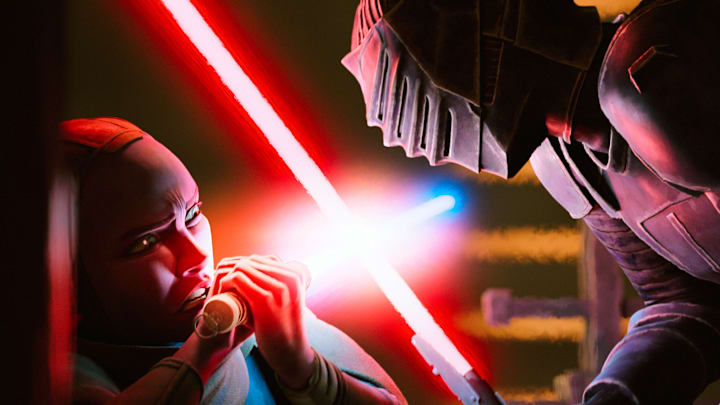
The second episode this week, “Night of the Hunted,” is written by Christopher Yost and directed by Lucasfilm Animation veteran Steward Lee. If “Inquisition” was the show allowing all of the various ingredients it had thrown in the pot over the previous weeks’ episodes to properly simmer, then “Night of the Hunted” is it all boiling over in thrilling fashion. From the very start of the episode, “Night of the Hunted” capitalizes in spectacular ways on the groundwork laid in its preceding episode, and is able to put the pedal to metal with zeal to spare. This thing is chock-full of some of the most stunning action setpieces not just of Maul thus far, but of Lucasfilm Animation’s history, period. A matter of minutes in, there’s a lightsaber duel that takes place in what amounts to the Star Wars equivalent of a shitty little apartment, and it’s one of the most thrilling sequences I’ve seen the franchise as a whole deliver in the past decade.
Similarly, the episode features a far more elaborate and intense climactic duel set on a high-speed train, and it is incredible. In my review last week, I compared Maul’s animation and action to Puss in Boots: The Last Wish, and that remains apt here, but I’ll go one further and pay the series an even higher compliment: this train sequence brought comparisons to George Miller’s masterpiece, Mad Max: Fury Road to mind, for how succinctly and impactfully it is able to push the perceived bounds of its editing. By keeping the primary action in the center of the frame, Lee and the team of animators are able to string multiple shots together in rapid-fire succession, giving the action this uncontainable kinetic energy without losing any of the clarity of legibility. It absolutely rules.

Maul - Shadow Lord knows how to use its cast for maximum effect
Another real strength of this pair of episodes comes in the form of the characters they focus on, which is to say: not Maul. Maul is used sparingly throughout these episodes, and yet the series has done such a strong job of developing its new characters that it never feels like a cheat of any kind. In fact, by using Maul as a character like a precision-based weapon, they’re able to make him feel that much more ferocious and dangerous in execution, rather than overexposed. This highlights the brilliance of Sam Witwer’s performance as the titular character, but also showcases just how great the characters of Devon (performed by Gideon Adlon), Daki (performed by Dennis Haysbert), and Lawson (as played by Wagner Moura) truly are. By investing such efforts into developing these characters into fully three-dimensional creations, Maul has freed itself up as a series to explore the different elements of this story in earnest, and deeply affecting fashion.
Elsewhere, the visual palette and cinematography of these episodes are similarly excellent, and a huge part of what sells the Empire as such a massive and imposing threat throughout. A specific case-study of how this kind of stuff works so well here, and why Joel Aron’s work as cinematographer is so phenomenal, comes in the form of the character Marrok. Marrok is an Inquisitor; part of the Empire’s elite team of Force-wielding Jedi hunters. Marrok is not a stranger to Star Wars fans, as the character previously played an integral part in Filoni’s live-action Ahsoka series for several episodes.
However, where the character was little more than a mostly forgettable third-tier antagonist in that series despite his relative prominence, Maul turns him into an infinitely more threatening antagonist in a matter of minutes. His visual introduction in “Inquisition” is so incredibly simple yet so effective, emerging from the shadows of a dark and ominous interrogation room, just after Lawson has seen the claw-marks left in the table by the previous interrogee. The choice to light the room so sparsely and allow Marrok’s all black and caped costume to become one with those shadows, only separated by a minimalist rim lighting after emerging, is fantastic stuff. Again, it remains kind of unbelievable just how much more visually articulate and capable the work is in these more recent Lucasfilm Animation shows when compared to their earlier work or even the live-action streaming shows.
And of course, it must be mentioned that the Kiners’ musical work continues to astound. From their interpolation of earlier Star Wars themes, from their own work in Bad Batch to John Williams’ in films like The Phantom Menace and Revenge of the Sith, to their new-for-this-series themes, its just immaculate stuff all around and remains so essential to the heart and soul of the show.

Verdict
In short, Maul - Shadow Lord continues to astound. The Star Wars series reaches new heights with its latest episodes, “Inquisition” and “Night of the Hunted,” all while continuing to pave the way for even most exciting developments ahead in exciting and compelling ways.
 Add us as a preferred source on Google