

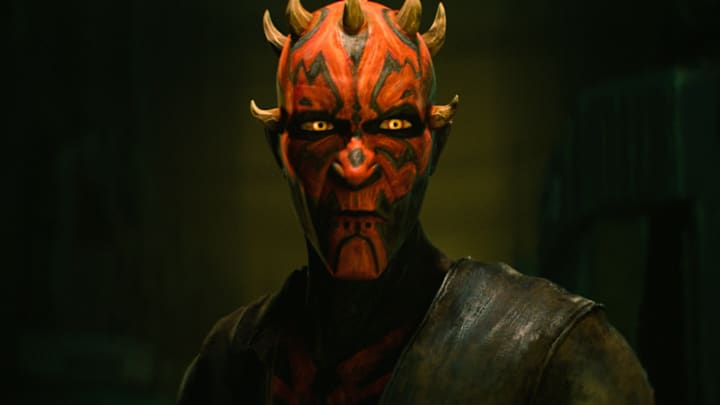
Prior to this week, Star Wars: Maul - Shadow Lord had been focused surprisingly little on the titular villain himself. That is not a criticism at all; in fact, it’s indicative of several impressive feats that Lucasfilm Animation’s latest Disney+ series has achieved thus far. Not only had the series been able to build out an entirely new ensemble cast of characters, many of whom were immediately compelling in their own ways, but it had also manages to carve out such a specific and concentrated role within the larger story for Maul himself. Akin to the titular shark in Jaws, Maul had relatively little screentime throughout the first six episodes, and yet his presence was abundantly clear. He had proven to be a looming, lingering threat that hung over the events of the series, and when he did make onscreen appearances, they were obscenely impactful. This was a result of the series’ synchronous successes: superbly crafted writing, exquisitely bold animation, and Sam Witwer’s full-throttle performance as the character.
However, this week’s episodes of Maul - Shadow Lord, “Call to Oblivion” and “The Creeping Fear,” tackle Maul as a character in a very different way. While a distinct change of pace for the series, it is a welcome one that spotlights Maul and digs deep into the decades’ long history of this seminal Star Wars antagonist.

Star Wars: Maul - Shadow Lord Episode 7 and 8 review
While previous weeks of the series have focused far more on new characters such as Devon, Daki, and Lawson, positioning Maul as the foil to their goals and ambitions, this week’s episodes flip the script in a dynamic way. The climax of last week’s episodes saw Maul leaping into action to save Devon and Rylee from Marrok, and this week sees that unexpected turn of events become a baton-passing moment for the show’s perspective. Now, with the Empire swarming and Inquisitors running amok, Maul - Shadow Lord seizes the opportunity to delve into how this entire situation is affecting Maul on both a professional and personal level.
For my money’s worth, writers Julia Cooperman and Jennifer Corbett handle this with aplomb in their respective episodes. While the former sees Maul smacking headfirst into his biggest obstacles of the season thus far, with Devon balking at his continued attempts to turn her into his once and future apprentice, his makeshift crew all beginning to turn on one another, and two Inquisitors literally breathing down his neck in the form of Marrok and the Eleventh Brother. Maul is cornered and forced to come face-to-face with these characters, who are each ostensibly (both in the narrative and from a metatextual perspective) replacements meant to serve the purpose he could not. The fact that “Call to Oblivion” ends on an extremely dour note, with Maul at his lowest point of the entire series, feels extremely deliberate; the episodes serves to crack Maul’s external façade, so that “The Creeping Fear” can then dive into the open wounds that drive him.
Corbett’s writing on “The Creeping Fear” is such a great encapsulation of her talents as a creative within the larger Star Wars sandbox, as she takes the narrative events that have unfolded across Maul’s tenure in other projects like The Phantom Menace, The Clone Wars, and even shades of the set-after-this Rebels, and recontextualizes them as key character beats within the larger trajectory of Maul’s life as a character. In the aftermath of a effectively losing to the Inquistors, being bested by these newer models of himself, he is forced to face the years of trauma inflicted upon him in a way that is both crafted and realized in genuinely stunning fashion.
In many ways, Maul's whole arc across these two epsiodes plays like a distorted parallel of Luke’s journey into the cave on Dagobah in Empire Strikes Back; a character being forced to face the root of their trials and tribulations, and it being realized in a visual manner that is both surrealist and highly subjective in nature.

Much praise is owed to directors Nathaniel Villanueva and Saul Ruiz as well as the entire animation team, who bring these moments to life with such intricacy, articulation, and clarity. When Maul is pulling himself out of the abyss that he falls into at the beginning of “The Creeping Fear,” and fighting against the literal tide that is attempting to keep him at bay, he faces visions of his past that wind up distilling into motivation for his future. It’s a really incredibly handled moment, that manages to bring a grounded sense of gravitas to him as a character in a way that has never been done before. In many ways, it reminded me of Ryan Coogler’s work in Creed; taking the somewhat insane narrative events from across a series and repositioning them as tragic events from a character’s own subjective viewpoint. By doing so, Coogler was able to ground the Rocky franchise back in a real sense of emotional pathos, and Maul - Shadow Lord pulls off a very similar trick here.
The visual language of the whole thing continues to be inspired and frequently jaw-droppingly gorgeous. There’s a single matte painting shot in “Call to Oblivion” that flies by in a second, but with its periwinkle blue skyline and accentuated design elements, could have been plucked straight out of a Powell and Pressburger film. The action is stupendous, incorporating big character beats into highly choreographed duels and shootouts, making for really emotive and affecting work that feels monumental in scale and scope. The music continues to be great, with the Kiners ratcheting up the tension and bringing a dark and foreboding sense of emotionality to Maul’s biggest beats, in a way that really works.
Overall, Maul - Shadow Lord continues to be an inspired work. This week’s episodes deprioritize the new characters, and instead sink their teeth into Maul as a character in ways that are surprisingly effective. I don’t know that I was necessarily anticipating that the series would leave me empathizing with Maul to such a degree, even after last week’s episodes. And yet, a week later, here we are; with the show and its creators having taken yet another bold and idiosyncratic swing that has paid off in big ways.
Grade: B+
 Add us as a preferred source on Google